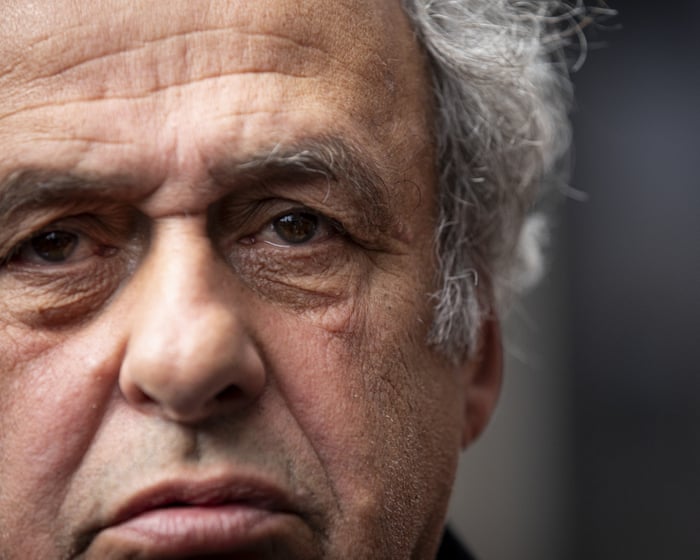
“There are millions of romantics in football,” says Michel Platini. He was asked if, after a decade away from the game, its shine has faded for him. “Millions who share my ideas. But in the end, it’s big business.”
It is an industry that Platini once reached the heights of, before one of football’s most dramatic falls from grace saw him cast out. He insists he would have become FIFA president if he hadn’t been banned over an alleged improper payment from Sepp Blatter in 2011, while he led UEFA. The scandal led to a criminal case, but both men were acquitted for a second and final time by a Swiss appeals court last year. Nothing hangs over Platini now, except his firm belief that he was wronged.
“It’s a strange feeling,” he says. “The last 10 years have been very complicated because of what my family went through: they see what’s in the papers, what people say about you, the global conversation. But I was never worried about the final outcome because I knew I was innocent, knew that in the end there would be nothing. I always felt fine within myself.”
Now that the matter is settled, the question is whether Platini, at 70, has more to offer at football’s top level. The sport has moved on, and his nine years as UEFA president feel like a lifetime ago. He was the three-time Ballon d’Or winner who jumped into the snake pit of football governance and emerged with his reputation tarnished.
Platini once compared himself to Icarus, and regardless of how one views the events that brought him down, there’s little doubt he flew close to the sun. His downfall came when, nine years later, he requested a £1.35 million payment for work done as Blatter’s technical adviser between 1999 and 2002. Both men said the agreement was verbal and that there was an innocent reason for the delay. When it came to light in September 2015, Blatter had agreed to step down from a scandal-hit FIFA, and Platini was expected to succeed him.
“I was destined to become president of FIFA,” he says. “Everything happened because they didn’t want that. The ban was a great injustice, and overall it was political. A group of people decided to kill me.”
But who? That has never been made clear, though he believes Blatter, clinging to power, “wanted to die in that job.” Platini thinks this, combined with his own profile as a former player ready to clean house, set things in motion. “It created an atmosphere against me,” he says from his home in the south of France. “This administration, people I didn’t know, didn’t want a different president. The soup was very good—they could earn a lot of money—and they didn’t want me in case I changed things. They were afraid of me.”
He does not include Gianni Infantino, then a capable and fiercely ambitious UEFA general secretary, among those who betrayed him, even though Platini filed a complaint against his former colleague in 2021, accusing him of influence-peddling in the corruption case. That case was closed last October after special prosecutors cleared Infantino. It was Infantino, not Platini, who succeeded Blatter in February 2016. “No, he profited from the situation but was not one of the instigators,” he says. “Infantino wanted to be president of UEFA, which meant he was pushing me toward FIFA.”
Mention of Infantino leads to a discussion on modern football governance. Some ongoing controversies, like FIFA’s peace prize award to Donald Trump and the political maneuvering involved, almost seem quaint in comparison.Michel Platini reflects on the differences between the Blatter era and today. “He was a good number two, but is not a good number one,” Platini says of Gianni Infantino. “He worked very well at UEFA, but he has one problem: he likes the rich and powerful people, the ones with money. It’s his character. He was like that as a number two, but back then he was not the boss.”
Despite the numerous scandals that eventually engulfed FIFA under his friend-turned-adversary Sepp Blatter, Platini believes the organization has strayed even further from its values. “Unfortunately, Infantino has become more of an autocrat since the pandemic,” he says. “I think he lost the game. There is less democracy than in Blatter’s time. You can say what you want about Blatter, but his main problem is that he wanted to stay at FIFA for life. He was a good person for football.”
“The administrators in football now, they are just doing their job. You find many who wouldn’t care whether it’s football or basketball. It’s not always a case of loving football if you work at UEFA or FIFA.”
What, then, of Aleksander Čeferin? The Slovenian succeeded the then-banned Platini at the helm of UEFA in September 2016, and there is no denying the pair are starkly different. A statesman of the game, a winner of almost everything, had been replaced by a lawyer with relatively brief high-level experience in football.
Platini is careful not to criticize Čeferin, save for observing that the constant back-and-forth between UEFA and FIFA needs tighter management. A group of UEFA delegates walked out of the FIFA Congress in Asunción last May in protest at the “private political interests” that led Infantino to arrive late, but publicly, at least, the flashpoint was quickly smoothed over.
“Čeferin has to be more present in FIFA,” he says. “UEFA was always something important: it was a counterbalance to the silly things done by FIFA. You have to be more energetic in defending the values of football. I have no contact with him and don’t want to interfere, but I think it is the only way to stop Infantino from doing some stupid things.”
He believes the role of UEFA president will become “more complicated,” largely due to the increased power wielded by leading clubs. In his time, Platini was forced to make regular compromises to keep members of the European Club Association (ECA), in whose establishment he was influential, from following through on threats to break away. In practice, this largely meant allowing bigger clubs a greater share of the Champions League revenue, and he was sometimes accused of being too hands-off. Relaunched in October as European Football Clubs and hugely expanded, the ECA’s influence in shaping the sport has never been greater.
“They always wanted to organize their own competition from the beginning, but I didn’t let them; I fought against that for many years,” he says of the body, then headed by Karl-Heinz Rummenigge. Čeferin was leading UEFA when a fully-fledged European Super League attempt fell apart in 2021, but Platini senses the threat has not remotely abated.
“It’s been a problem for a long, long time, and it will become more and more important,” he says. “It would be like a league of 18 clubs, the rich and the big. What happened with the Club World Cup last summer may be the tip of the iceberg. I have no idea what it will do for the future of the game, but I think there could be a big change in professional football in Europe.”
A central theme for Platini is the notion that football has been taken away from those who understand the sport. He contrasts Rummenigge, his old sparring partner, with the current EFC chair, Nasser al-Khelaifi, extolling the benefits of talking issues through with “someone who knew what football is.” Infantino has twice been re-elected at FIFA.If he runs unopposed, there is no clear candidate to challenge Ceferin next year, assuming he ends the long speculation by deciding to seek another term.
“My greatest hope is that more former players will enter football governance, so they can organize these institutions and protect the game internationally,” he says. “That’s who I am, and that’s what I did.
“It’s not an easy job, so not many want to do it. You have to campaign tirelessly, and it costs a lot of money. But for democracy, it would be better to have strong competition and new ideas. It’s not always about football—it’s about the people involved.”
Does he feel his own race is run? When his football ban ended in 2021, he was strongly linked with a role at FIFPro, the global players’ union. Over the past year, there have been whispers in European circles that Platini, if not planning his own UEFA comeback, would be willing to support new leadership.
He becomes evasive. “I don’t feel too bad; I have ten years to do something. I have ideas, big projects that will be complicated, so if I create something important, I’ll need time. If a good opportunity comes to advise someone or something, why not? But not in football administration anymore. I’ve been in the public eye for 50 years—now it’s time to stay in the background.”
Despite the deep frustration of a derailed career and the efforts he has made to clear his name, he doesn’t see the past decade as lost. “No, no—I’ve enjoyed my life and this time. Mentally, I was calm. I traveled a lot, discovered new things and people, spent more time with friends and family. I didn’t lose anything.”
That includes, he believes, the support of most people in football. “I was treated very well by the fans, by football people—but not by those who feared I would come back and take their seats,” he says. “Everyone else understood from the start that it was a plot to stop me from becoming FIFA president.
“With the media, it was different because they need FIFA, they don’t need me, and there was a big lobbying system of lawyers and others. That world was against me, and they didn’t want me to come back.”
In November, Platini filed a lawsuit in Paris against three unnamed FIFA officials and an unnamed member of a Swiss judicial body, accusing them of defamation over statements made during his legal battle. From the outside, he seems torn between moving on and settling old scores.
“I won’t give in to those who spread lies and false accusations against me,” he says. “This isn’t about revenge—it’s a fight for truth against those who did these things. There’s always energy to battle injustice. I don’t want anyone else to face the same problems I did one day.”
How would a FIFA led by Platini have looked? “It would have been an organization that cares about football, not politics,” he says. Surely he knows better than most that immersion in one often means deep involvement in the other. “I think romanticism can help pragmatism, but pragmatism doesn’t help the romantics.”
It’s a riddle no one, least of all Platini, has yet been able to solve.
Frequently Asked Questions
FAQs Michel Platinis Battle with FIFA UEFA
BeginnerLevel Questions
1 Who is Michel Platini and what is this about
Michel Platini is a French football legend a former star player and was the President of UEFA from 2007 to 2015 This is about his suspension from football in 2015 over a payment from FIFA and his subsequent fight to clear his name which he describes as a coordinated effort to remove him
2 What was Platini actually accused of
He was accused of a disloyal payment of 2 million Swiss Francs that he received from FIFA in 2011 This payment was for advisory work he did for FIFAs thenpresident Sepp Blatter between 1999 and 2002 Investigators said there was no written contract for it at the time which they deemed improper
3 What does he mean by a group of people decided to kill me
Platini uses this dramatic phrase to claim that his suspension was not a fair judgment on a payment but a deliberate political assassination by powerful figures within FIFA and its circles He believes they wanted to eliminate him as a candidate for the FIFA presidency and end his influence in football governance
4 What was the final outcome Was he found guilty
In 2021 a Swiss criminal court found both Platini and Blatter not guilty of fraud and other charges However by this time Platini had already served a fouryear ban from football from FIFAs ethics committee So while cleared in criminal court the football ban had already severely damaged his reputation and career
Advanced Detailed Questions
5 Why does Platini claim this was a conspiracy Whats his evidence
Platini points to timing and politics The payment was investigated years after it was made just as he was the frontrunner to succeed Sepp Blatter as FIFA President in 2016 He alleges that individuals who feared his reformist agenda and his independent power base at UEFA orchestrated the ethics case to disqualify him
6 What role did Sepp Blatter play in this
Blatter authorized the payment to Platini Both men maintained it was a valid oral agreement for work done Their stories were