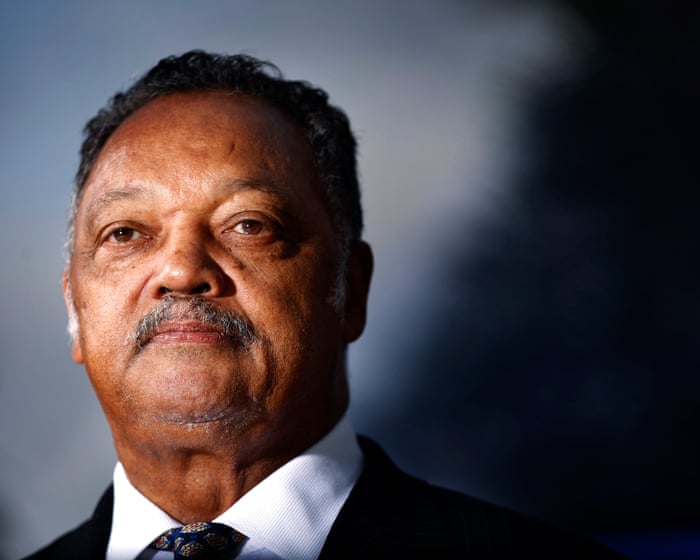
The Reverend Jesse Jackson, a civil rights leader who was a prominent figure for over 50 years and made a strong run for the Democratic presidential nomination in 1988, has died at the age of 84.
In a statement, his family said: “Our father was a servant leader—not only to our family, but to the oppressed, the voiceless, and the overlooked around the world. We shared him with the world, and in return, the world became part of our extended family. His unwavering belief in justice, equality, and love uplifted millions, and we ask you to honor his memory by continuing the fight for the values he lived by.”
No cause of death was provided. Jackson had been living with progressive supranuclear palsy (PSP) for more than a decade, after initially being diagnosed with Parkinson’s disease. In recent years, he was also hospitalized twice with Covid-19.
A constant presence in the civil rights movement and Democratic politics since the 1960s, Jackson was once close to Dr. Martin Luther King Jr. Reflecting on his historic presidential campaigns in a 2020 interview with the Guardian, Jackson said, “I was a trailblazer, I was a pathfinder. I had to deal with doubt and cynicism and fears about a Black person running. There were Black scholars writing papers about why I was wasting my time. Even Blacks said a Black couldn’t win.”
Two decades after his second presidential run, Barack Obama, the first Black president, credited Jackson for paving the way for his own victory. Jackson later recalled that moment, saying, “It was a big moment in history.” In an interview with NPR, he added, “I cried because I thought about those who made it possible who were not there … People who paid a real price: Ralph Abernathy, Dr. King, Medgar Evers, Fannie Lou Hamer, those who fought like hell [at the Democratic national convention] in Atlantic City in ’64, those in the movement in the south.”
During the Covid-19 pandemic, Jackson highlighted disparities in healthcare and outcomes, asking, “After 400 years of slavery, segregation and discrimination, why would anybody be shocked that African Americans are dying disproportionately from the coronavirus?” He also noted that all past presidents had failed to “end the virus of white superiority and fix the multifaceted issues confronting African Americans.”
Born on October 8, 1941, in Greenville, South Carolina, Jackson became politically active early on while growing up in the segregated South. He was elected class president at the all-Black Sterling High School, where he also excelled in sports. In 1959, he received a football scholarship to the University of Illinois. Although the Chicago White Sox offered him a spot on their baseball team, he chose to focus on his education.
During his freshman year winter break, Jackson returned to Greenville and attempted to borrow a book he needed from the whites-only Greenville public library but was turned away. The experience left a lasting impression. Months later, on July 16, 1960, Jackson and seven Black high school students entered the library in a peaceful protest. After browsing and reading books, the group—later known as the Greenville Eight—were arrested for disorderly conduct and released on a $30 bond. A judge eventually ruled they had the right to use the publicly funded institution, and the Greenville library system was integrated in September 1960.
Jackson did not return to the University of Illinois after his first year. Instead, he transferred to the historically Black North Carolina Agricultural and Technical College in Greensboro. There, he played quarterback on the football team, served as a national officer for the Black fraternity Omega Psi Phi, and was elected student body president. While earning a sociology degree, he continued his activism by participating in civil rights protests.Jesse Jackson first gained attention for his role in sit-ins at restaurants in Greensboro. Reflecting on his early influences, he told the Washington Post in 1984, “My leadership skills came from the athletic arena. In many ways, they were developed from playing quarterback—assessing defenses, motivating your team. When the game starts, you use what you’ve got and don’t cry about what you don’t have. You run to your strength. You also practice to win.”
While in college, Jackson met Jacqueline, whom he married in 1962. They had five children together: Santita, Jesse Jr., Jonathan Luther, Yusef DuBois, and Jacqueline Jr. He later had a sixth child, Ashley, from an extramarital affair with Karin Stanford in the early 2000s.
Jackson first met Martin Luther King Jr., who would become his mentor, at an Atlanta airport in the early 1960s. King had been following Jackson’s student activism from afar for several years. In 1964, Jackson enrolled at the Chicago Theological Seminary while remaining active in the civil rights movement. After watching news coverage of Bloody Sunday—when King led nonviolent marchers across the Edmund Pettus Bridge in Selma, Alabama, where they were beaten by law enforcement—Jackson traveled with classmates to Selma to join the movement. Impressed by Jackson’s leadership there, King offered him a position with the Southern Christian Leadership Conference (SCLC), which he co-founded.
After a few years, Jackson paused his seminary studies to focus on SCLC’s Operation Breadbasket, an economic justice program that mobilized Black churches to pressure companies through negotiations and boycotts to hire more Black people. In 1967, Jackson became the program’s national director and was ordained as a minister the following year. King praised his work, saying at a 1968 meeting, “We knew he was going to do a good job, but he’s done better than a good job.”
Tragedy struck soon after Jackson’s rise within SCLC. On April 4, 1968, he witnessed King’s assassination from below the balcony of the Lorraine Motel in Memphis, Tennessee. The memory haunted him for the rest of his life. “Every time I think about it, it’s like pulling a scab off a sore,” he told the Guardian in 2018. “It’s a hurtful, painful thought: that a man of love is killed by hate; that a man of peace should be killed by violence; a man who cared is killed by the careless.”
After King’s death, Jackson continued with SCLC until 1971, when he founded his own organization, People United to Save Humanity (Push), to improve economic conditions for Black Americans. Push created reading programs for Black youth, helped them find jobs, and urged corporations to hire more Black managers and executives.
In 1984, Jackson ran as a Democratic candidate for president, becoming the second Black person to mount a nationwide campaign, following Shirley Chisholm over a decade earlier. Addressing the Democratic National Convention in San Francisco that year, he said, “Tonight we come together bound by our faith in a mighty God, with genuine respect and love for our country, and inheriting the legacy of a great party, the Democratic party, which is the best hope for redirecting our nation on a more humane, just, and peaceful course. This is not a perfect party. We’re not a perfect people. Yet, we are called to a perfect mission: to feed the hungry, to clothe the naked, to house the homeless, to teach the illiterate, to provide jobs for the jobless, and to choose love over hate.””Choose the human race over the nuclear race.” However, he lost the Democratic nomination to former Vice President Walter Mondale, and the incumbent Republican President Ronald Reagan ultimately won the election.
After his first presidential campaign, Jackson founded the National Rainbow Coalition to advocate for voting rights and social programs. In the mid-1990s, he merged his organizations to form the multiracial Rainbow Push Coalition, which focuses on educational and economic equality. According to its website, the coalition has since provided over $6 million in college scholarships and financial assistance to more than 4,000 families facing foreclosure, helping them keep their homes.
Jackson ran for the Democratic presidential nomination again in 1988, performing well but ultimately losing to Massachusetts Governor Michael Dukakis, who was later defeated by George H.W. Bush in the general election.
In 2000, President Bill Clinton awarded Jackson the Presidential Medal of Freedom, the nation’s highest civilian honor, in recognition of his decades of work to expand opportunities for people of color.
Jackson carried forward Martin Luther King Jr.’s legacy, remaining a prominent figure in the global civil rights movement through a turbulent half-century of American history—from King’s era to the election of Donald Trump and the rise of Black Lives Matter.
“Dr. King believed in multiracial, multicultural coalitions of conscience, not ethnic nationalism,” Jackson said in 2018. “He felt nationalism—whether Black, white, or brown—was too narrow, given our global challenges. So, creating a multiracial movement reflected his vision for America and the world, and what America should stand for.
“The arc of the moral universe is long, but it bends toward justice. Still, you have to pull it to make it bend; it doesn’t happen automatically. Dr. King reminded us that every time the movement advances with a tailwind, there are also headwinds.
“Those who oppose change were, in a sense, re-energized by Trump’s demagoguery. Dr. King would have been disappointed by his victory, but he would have been psychologically prepared. He would have said, ‘We must not surrender our spirits. We must use this not to give up, but to strengthen our faith and fight back.'”
Frequently Asked Questions
Of course Here is a list of FAQs about the passing of Reverend Jesse Jackson designed to be clear and helpful for a wide audience
Basic Information
Q Is it true that Jesse Jackson has died
A Yes Reverend Jesse Louis Jackson the prominent civil rights leader and twotime presidential candidate died on at the age of 84
Q Who was Jesse Jackson
A He was a major American civil rights activist Baptist minister and politician He worked alongside Dr Martin Luther King Jr founded the Rainbow PUSH Coalition and was a powerful voice for social and economic justice for decades
Q How did he die
A He had been managing health challenges including Parkinsons disease which was diagnosed in 2017
His Life and Work
Q What was Jesse Jacksons role in the Civil Rights Movement
A He was a key organizer and close aide to Dr King He was present at Dr Kings assassination in 1968 Jackson helped lead Operation Breadbasket which fought for economic opportunities for Black Americans through boycotts and negotiations
Q What is the Rainbow PUSH Coalition
A Its an organization Jackson founded by merging Operation PUSH and the National Rainbow Coalition Its mission is to fight for social justice civil rights and political empowerment
Q Did Jesse Jackson run for president
A Yes he ran for the Democratic presidential nomination twicein 1984 and 1988 His 1988 campaign was particularly historic winning several primaries and caucuses and demonstrating significant multiracial coalitionbuilding
Q What are some of his most famous achievements
A He was a master of citizen diplomacy successfully negotiating the release of American hostages and prisoners abroad He also registered millions of new voters and advocated tirelessly for policies like affirmative action and corporate diversity
Impact and Legacy
Q Why was Jesse Jackson such an important figure
A He bridged the classic Civil Rights Movement of the 1960s with modern political activism He expanded the movements focus