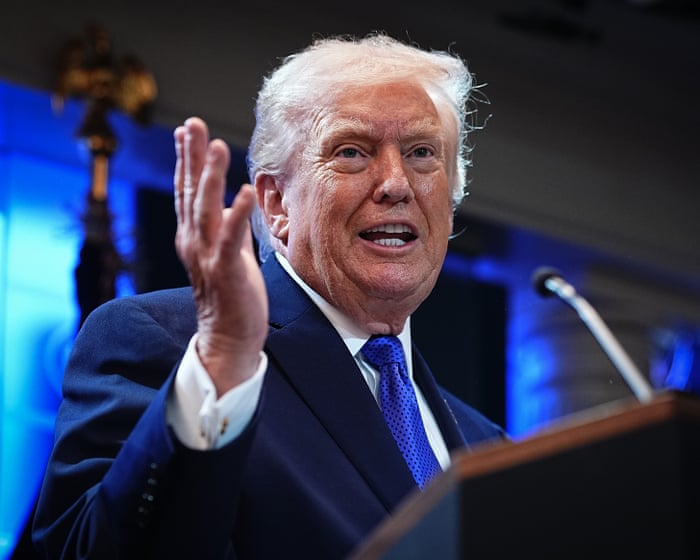
On Friday, Donald Trump sharply criticized the Supreme Court justices who blocked his use of tariffs, labeling them a “disgrace to the nation.” He later signed documents imposing a 10% tariff on all countries.
Trump stated he would immediately sign an order raising global tariffs by 10% under Section 122 of the Trade Act of 1974 and would launch investigations into unfair trade practices that could lead to further tariffs. He insisted he had the authority to impose these additional tariffs under existing laws without needing congressional approval.
By Friday evening, Trump posted on Truth Social: “It is my Great Honor to have just signed, from the Oval Office, a Global 10% Tariff on all Countries, which will be effective almost immediately.”
The temporary import duty is set to take effect on February 24 at 12:01 a.m. ET.
Shortly after, the White House released a fact sheet explaining that Trump had signed a proclamation “invoking his authority under section 122 of the Trade Act of 1974” to impose “a temporary import duty.”
The Congressional Research Service, which provides analysis to lawmakers, noted: “Section 122 of the Trade Act of 1974 directs the President to take measures, which may include a temporary import surcharge (tariff), when necessary to address ‘large and serious United States balance-of-payments deficits’ or certain other fundamental international payments problems. Section 122 has never been used, so courts have not interpreted its language. Some reports indicate this provision appears to allow the President to impose broad tariffs under certain circumstances.”
The law does limit such tariffs, allowing the president to impose them for “a period not exceeding 150 days” and at a rate “not to exceed 15 percent.”
The White House said Canada and Mexico will be exempt from the new duty under the North American trade pact. Certain food products, like beef and tomatoes, and critical minerals are also exempt.
“I wanted to be a good boy,” Trump said, referring to his earlier restraint in using tariffs under the International Emergency Economic Powers Act. He added that tariffs under Section 232 of the Trade Expansion Act of 1962 and Section 301 of the Trade Act of 1974 will remain “in place and in full force and effect.”
Speaking at the White House, Trump claimed: “It’s my opinion that the court has been swayed by foreign interests and a political movement that is far smaller than people would ever think.” He framed this influence as social and cultural, adding: “I’m ashamed of certain members of the court. Absolutely ashamed for not having the courage to do what’s right for our country.”
He praised the three dissenting justices: Brett Kavanaugh, who wrote the main dissent, Clarence Thomas, and Samuel Alito. The others—including two of his own appointees, Amy Coney Barrett and Neil Gorsuch—faced his criticism.
“They’re just being fools and lapdogs for the RINOs [‘Republicans in name only’] and the radical-left Democrats, and not that they should have anything at all to do with it,” Trump said. “They’re very unpatriotic and disloyal to our constitution.”
Referring to Barrett and Gorsuch, he called them “an embarrassment to their families” and said they were “barely” invited to next week’s State of the Union address.
When asked for evidence of foreign influence over the Supreme Court, Trump replied: “You’re going to find out.”
This story was amended on February 20, 2026, to clarify that Donald Trump called the justices who voted against his tariffs—not the ruling itself—a “disgrace to our nation.”
Robert Mackey contributed reporting.
Frequently Asked Questions
Of course Here is a list of FAQs about the hypothetical scenario Furious Trump imposes global 10 tariff after Supreme Court ruling on trade powers
Beginner Definition Questions
1 What exactly happened
A hypothetical Supreme Court ruling is imagined to have given the President sweeping unchecked power over tariffs In response a furious former President Trump uses this new authority to place a 10 tax on almost all goods imported into the United States from every country
2 What is a tariff
A tariff is a tax imposed by a government on goods and services imported from other countries It makes foreign products more expensive for consumers and businesses inside the country that imposes it
3 What does global 10 tariff mean
It means a 10 tax would be added to the cost of virtually all products coming into the United States from any other country in the world with few or no exceptions
4 Why would a President do this
The stated goal is typically to protect US industries and factories by making foreign competitors goods more expensive hoping to encourage production and job creation at home Its also sometimes used as a political or negotiating tool
Impact Why Should I Care Questions
5 How would this affect prices at the store
Prices would likely increase for a huge range of productsfrom electronics and clothing to cars and foodbecause either the imported item itself is taxed or the partsmaterials used to make things in the US become more expensive
6 Will this help American workers and companies
Its debated Some domestic manufacturers facing import competition might benefit However many US companies that rely on imported parts or sell to global markets could be hurt by higher costs and foreign retaliation potentially leading to job losses in those sectors
7 What is retaliation and will it happen
Retaliation is when other countries fight back by imposing their own tariffs on US exports In this global scenario retaliation from major trading partners like the EU China and Canada would be almost certain hurting American farmers and exporters
8 Is this legal What was the Supreme Court ruling
In this