Four days ago, Youssef El Abbas saw a chance to get back the life he had lost seven years earlier. Word was going around that around 400 people had swum from Morocco to the nearby Spanish enclave of Ceuta on the north African coast, about 12 miles (19km) across the Strait of Gibraltar from mainland Spain.
This was an opportunity for the 44-year-old Moroccan father of four to return to Spain, where he had been deported when his residency ran out after losing his job in Bilbao in 2019.
El Abbas took a taxi and headed to the city of Tétouan, south of the enclave. On the way, he saw Facebook posts and news reports saying the Moroccan authorities were letting people through their side of the border. That meant, unlike those who had crossed the night before, he could simply travel overland and then swim for just five minutes across the border from Moroccan to Spanish territory, avoiding Spanish border controls.
View image in fullscreen
People returning to Morocco on Sunday after crossing into Ceuta. Photograph: Reduan Dris/EPA
He reached Tétouan and found the city completely overwhelmed. “Young men were running through the streets, flooding every corner,” he said. By the time a second taxi took El Abbas to Fnideq, the town bordering Ceuta, he realized that the usual blockades and checkpoints stopping people without European documents from even getting near the frontier had been removed.
View image in fullscreen
Youssef El Abbas in Ceuta. Photograph: Okba Mohammad
“The Moroccan police were shouting at us: ‘Go, go, go! Run now, run into Spain,'” he said. “The night before, they were beating people. But that morning they were letting us through. Nothing made sense.”
Despite the crowds, El Abbas noticed the police were only letting Moroccans cross. “All the sub-Saharan migrants were being pushed back by force.”
He reached the border at 2.45pm on Wednesday. By 3pm, after a short swim, he was standing on Spanish soil. Not everyone was so lucky.
“In just 10 minutes in the water, I saw four people floating dead in Moroccan waters,” he said. “People were pulling their bodies out.” They were among at least 72 people who drowned or were crushed trying to reach the Spanish territory.
El Abbas is just one of the roughly 50,000 people who have crossed into Ceuta this week, in what Spain’s prime minister, Pedro Sánchez, called “a violation of Spain’s territorial integrity.”
Map showing location of Ceuta between Morocco and Spain, and another map showing line of Morocco-Ceuta border and Tarajal breakwater
Madrid has blamed the latest influx on “human-trafficking mafias” that have taken advantage of a decision by Spain’s supreme court, which recently ruled that those intercepted at sea while trying to enter Ceuta or Melilla – the other Spanish enclave on the north African coast – could not be summarily returned under special rules.
“The same hand that helped me out of the water was the one that later hit me” – Youssef El Abbas
But there has also been speculation that the Moroccan authorities may have opened the border to show their displeasure at Sánchez’s recent visit to Algeria, which supports efforts to free the disputed territory of Western Sahara from Moroccan occupation.
Morocco’s ambassador to Spain, Karima Benyaich Millán, said Rabat was not happy about the mass crossing, adding that it hoped those in Ceuta would return.
Moroccan government sources told the Europa Press news agency that the surge of people entering Ceuta was down to “criminal organisations” and insisted that Rabat’s cooperation with Spain remained “exemplary.”
In May 2021, Rabat loosened border controls – allowing 10,000 people to cross into Ceuta over two days – during a diplomatic standoff triggered after Madrid allowed a Western Sahara independence leader to be treated for Covid-19 in Spain.
View image in fullscreen
A manHe bends down to pick up a pair of shoes from the debris washed up on Ceuta’s shore. Photograph: Pedro Nunes/Reuters
El Abbas said he had never stopped dreaming of going back to Spain, where he had worked mainly in restaurants and hotels for 14 years. Since being sent back to Morocco in 2019, he has lived apart from his wife and four daughters, who remain in the northern Spanish city of Bilbao. He gets by with occasional work fixing mobile phones alongside his father.
“I never stopped thinking about coming back,” he said. “In Morocco, I was alive, but I wasn’t really living.”
skip past newsletter promotion
Free newsletter | Every day
Sign up to Headlines Europe
A digest of the morning’s main headlines from the Europe edition emailed direct to you every week day
Preview latest
Enter your email
Sign up
after newsletter promotion
Why is Ceuta a migration flashpoint and how were so many people able to cross from Morocco?
Read more
The return has been bittersweet. When he swam ashore in Ceuta, a Spanish Guardia Civil officer reached out a hand to pull him from the sea. But that gesture of help eventually turned into one of violence. Three days after arriving, the group he was with were surrounded by a military patrol and beaten.
“The same hand that helped me out of the water was the one that later hit me,” he said.
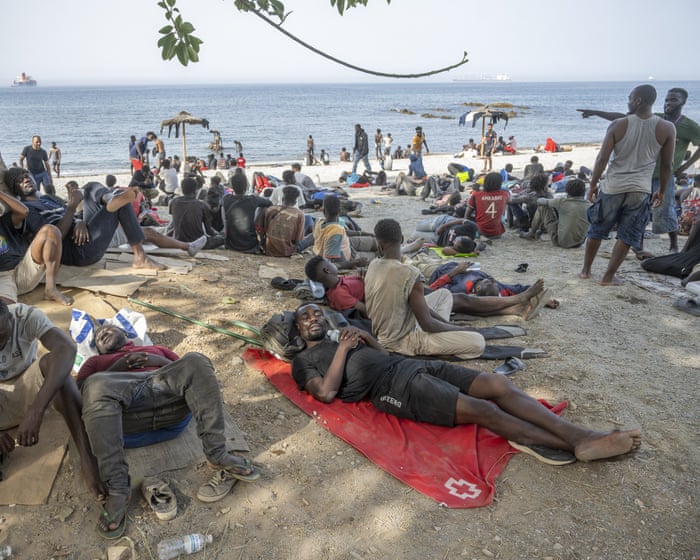
El Abbas’s story is hardly unique. Although more than 48,000 people had crossed back into Morocco by Friday night, hundreds are still sleeping in parks, public squares, and on pavements, waiting for a chance to move on or simply to find somewhere to rest. It seems almost impossible for migrants to leave Ceuta for mainland Spain.
Said, 17, from Casablanca, was sitting on a kerb a few hundred metres away. He, too, had joined the crowds heading for Ceuta when he heard the border was open. But the excitement had given way to reality, and all he had was a bottle of water and the carton of yoghurt a local resident had given him.
3:37
Tens of thousands of migrants cross into Spanish enclave Ceuta from Morocco – video
The teenager said he was taken to a centre for unaccompanied minors after he crossed, but there were no places available, so he ended up back on the streets. According to a soldier who asked to remain anonymous, the current approach for the authorities – including the military, the police, and the Guardia Civil – is to treat unaccompanied minors as regular migrants and return them to Morocco.
Said and the other teenagers with him said no one would sell them food or let them into shops and restaurants because they did not speak Spanish.
Three days after the mass influx, Ceuta is slowly trying to get back to a sense of normality. By early evening on Saturday, cafe terraces were beginning to fill up again, and some businesses had reopened their doors. Many of the remaining arrivals are being looked after by Ceuta locals, who walk the streets handing out bottles of water, sandwiches, blankets, and clothes. Others stop to ask if they need help or offer to call a relative.
Such shows of solidarity have been threatened by the arrival of far-right politicians and a neo-Nazi group, all keen to use the humanitarian crisis for their own purposes.
“They’re going to exploit our feelings to take the credit and say they defended Ceuta,” said a local woman called Malika. “We don’t want them here. If they want to defend something, they should go somewhere else.”
View image in fullscreen
People who crossed into Ceuta this week are escorted back to Morocco by the Spanish army on Saturday. Photograph: Antonio Sempere/AP
Malika, who was born in Ceuta to a soldier who served in the Spanish army, rejected the idea that the city should be defined only by the political confrontation that followed this week’s mass arrival. But she also acknowledged the pressure on a city of just over 80,000 people. “It would have been an impossible situation for any city,” she said.
Fatima Hamed Hossain, a member of Ceuta’s assembly, fears that the strain created bThe crisis has only deepened the divisions within the city. “Everything we’ve been through has created tensions between neighbors,” she said. “That’s exactly what fuels the far right.”
As a caravan of people made their way back across the border, Said’s thoughts were focused on what lay ahead. His goal is straightforward: secure a spot in a protection center, spend the next year learning Spanish, and once he turns 18, find work as a barber. His biggest fear is ending up without legal papers and watching that plan fall apart before it even gets started.
Still, leaving isn’t something he’s considering. “All I need,” he said, “is a chance.”
Frequently Asked Questions
Here is a list of FAQs based on the situation you described written in a natural and accessible tone
Frequently Asked Questions Moroccans Stuck in Ceuta
1 What exactly is happening in Ceuta right now
The mass border crossing has stopped but the crisis isnt over Hundreds of Moroccans who entered Ceuta during the chaos are now stuck They are living on the streets in parks or in temporary shelters waiting to find out if they will be allowed to stay or if they will be sent back to Morocco
2 Why dont they just go back to Morocco
Many of them are afraid to go back Some fear arrest or punishment for crossing illegally Others have burned their identity documents or left behind difficult situations in Morocco hoping to start a new life in Spain or Europe For them returning means facing the very problems they tried to escape
3 Are these people considered refugees
Not automatically Most of them are economic migrants To be considered a refugee they must prove they are fleeing war persecution or a serious threat to their life Thats a legal process that takes time and while they wait for their claims to be assessed they are in a legal gray area
4 What are the authorities doing to help them
The Spanish government has set up temporary reception centers and is providing food water and basic medical care They are also registering people and trying to process their cases as quickly as possible However the sheer number of people has overwhelmed the system and conditions are still very tough
5 Can they just walk into mainland Spain or other European countries
No They are currently confined to the city of Ceuta Spanish police have sealed off the port and the border crossing to the mainland They cannot travel further into Spain or Europe until their legal status is resolved which could take weeks or months
6 What is the biggest problem for these people right now
The biggest problem is uncertainty They dont know if they will be granted asylum allowed to stay temporarily or deported This lack of clarity makes it impossible for them to find work rent a place or make any plans for the future They are living daytoday
7 How long can this situation last
Its hard to say Some people may be processed and returned to Morocco within weeks Others who