If the US president were a developer, you might expect some sprucing up of the capital—a few buildings renovated, maybe some parks replanted. But when the person in charge is a megalomaniac builder, things can spiral out of control. A decade ago, when Donald Trump was first elected, I wondered what it would mean for the US to be led by a real estate tycoon whose career had left behind broken promises, angry buyers, and endless lawsuits—someone who flouted rules, trampled heritage, and dotted the world with aspirational towers covered in a thin veneer of luxury. The reality is worse than I could have imagined.
Like a nightmarish Hollywood sequel, Trump’s second term has unleashed his true architectural ambitions: The Blingpire Strikes Back. As America’s self-styled decorator-in-chief, Trump has not only overseen the gilded disfigurement of the White House but has also begun the Mar-a-Lago-fication of Washington DC itself—applying his gold paintbrush to statues, coating ponds with flaking pool liner, and plotting a colossal triumphal arch, all secured through a flurry of no-bid contracts. And, in true shady-salesman fashion, this program of building baubles is turning out to be a high-profile distraction from deeper damage being done elsewhere.
If the government wants to bulldoze the Statue of Liberty, nothing can be done.
The bloated White House ballroom is the most emblematic project of Trump’s reign so far—a chandelier-bedecked warehouse on a scale that would make Ceaușescu blush. Standing like an over-iced wedding cake atop a multilevel concrete bunker, it is a swaggering confection that masks deep-rooted paranoia: a decadently wrapped panic room where a besieged dictator might hole up.
View image in fullscreen. What lies beneath … the ballroom hides a full-scale military complex, including a hospital. Illustration: McCrery Architects/White House.
“It won’t interfere with the current building,” Trump promised last July when he announced the plans. “Not touching it.” It would seat 650 guests and cost $200 million, funded by private donations. Less than three months later, without waiting for congressional approval, he tore down the historic East Wing and dumped the rubble on a nearby public golf course (which he also plans to redevelop). The ballroom ballooned, as if injected with a rapid weight-gain formula, to seat 1,000 in a building three times the volume of the White House. The price has also tripled to $600 million, at least half of which will now be picked up by the taxpayer.
Trump boasted that his ballroom would be “more beautiful” than Versailles, but it looks like something thrown together from the classical off-cuts bin, without any regard for how the pieces fit. “It has all the kneejerk gestures of classicism,” a former Commission of Fine Arts (CFA) official told me, “but they are not integrated in a way that makes any sense.”
A sweeping ceremonial staircase leads to nowhere. A grand pedimented entrance is shunted to one end of the east facade. The portico columns run four rows deep (“The Supreme Court is three deep,” Trump noted. “No other building has it, and I did it because it’s incredible.”) The ballroom’s proportions are so out of whack that it will make the White House look like a lopsided fiddler crab, the swollen appendage vastly dwarfing the original building.
View image in fullscreen. Not exactly flag blue … the Lincoln Memorial reflecting pool. Photograph: Aaron Schwartz/Reuters.
The inflated scale was too much for its architect, the bowtie-wearing James McCrery II, who protested the increasingly Frankenstein nature of the classical details being applied. Enter Shalom Baranes, whose DC firm has handled multibillion-dollar federal contracts, including the renovation of the Pentagon after the 9/11 attacks.
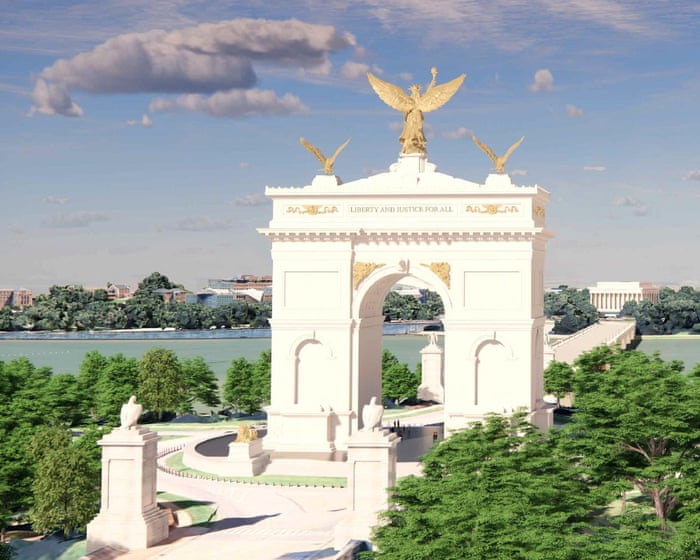
Baranes’s experience with fortified facilities has come in handy, given that the project has evolved into what Trump now calls “thThe “Magnificent Ballroom and Military Complex.” The party hall, the president confirmed in March, “essentially becomes a shed for what’s being built under” it – namely a six-storey military-grade bunker, complete with a command and emergency operations centre, a full-scale military hospital, secure telecommunications hubs and situation rooms, all served by specialised air-handling and filtration systems to protect against biological, chemical and radiological threats. “It’s meant for if there’s a nuclear attack,” Trump has boasted. “The concrete is so hard, I’m not sure you could take it down.” Behind the overblown cornice, the ballroom’s roof will house a military drone port and air-defence missile system. Images show it looking like an aircraft carrier parked next to the White House. In typically Trumpian newspeak, the project has gone from being a space to entertain dignitaries to a “desperately needed National Security structure” that must be completed at all costs. After court rulings halted construction, the supreme court recently stepped in to allow it to resume – although, tellingly, the ruling made no comment on the project’s legality. But questions in the courts have revealed just how far Trump’s aides see his absolutist rule extending. “If the government decides, very quickly, to bulldoze the Statue of Liberty,” one judge asked, “nothing can be done?” A lawyer for the administration responded: “I think that’s right, yes.” View image in fullscreenDrinks all round … construction continues on a helipad-cum-cocktail patio on the south lawn of the White House. Photograph: Julia Demaree Nikhinson/AP Similarly bullish efforts are being made to force through the president’s second flagship vanity project, the elephantine triumphal arch. It was casually announced last October, with 3D-printed models displayed like tacky souvenirs in the Oval Office. It is planned to tower 250ft above Memorial Circle, a vast roundabout on Columbia Island in DC’s Potomac River – 1ft for every year of US independence. But there has been no ambiguity about what the looming edifice is really there to honour. When asked, Trump simply replied: “Me.” It “will be the GREATEST and MOST BEAUTIFUL Triumphal Arch,” he boasted on social media, “anywhere in the World”. He has cited Roman precedents and “the one in Paris”, adding that his version “will surpass it in every way”. Oddly, given his fondness for the North Korean regime, he has neglected to mention Pyongyang’s Arch of Triumph, built in 1982 to mark Kim Il Sung’s 70th birthday. Clad with 25,500 blocks of sparkling white granite, one for each day of Kim’s life, its crowning stone slab rises 10m taller than Trump’s (although his is topped with a statue for an extra 25m of vanity height). Hitler’s Triumphbogen, also unmentioned, would have been twice the size. To aid his Napoleonic cosplay, the president has hired Harrison Design, purveyors of gaudy McMansions from Atlanta to LA, with the arch project led by Nicolas Charbonneau, principal of the firm’s Sacred Architecture Studio. Charbonneau first sketched the idea to illustrate an April 2025 essay by conservative critic Catesby Leigh, titled Washington Needs an Arch. It proposed a modest structure of 60ft. Trump got hold of the idea and, with his irrepressible lust for supersizing, pumped it up fourfold. View image in fullscreenDwarfing the White House … the ballroom will have a drone port on its roof. Photograph: Kevin Lamarque/Reuters As with the ballroom-bunker, the arch has become larger and more encrusted with gilded ornament – in a word, more Trumpian – as it has progressed. The final design, unveiled this April, features a 60ft golden-winged Lady Liberty sprouting from its summit like an oversized cake-topper, flanked by two plump eagles. Even Trump’s allies have suggested the design could be toned dAt a CFA review, McCrery, the first ballroom architect, recommended removing four golden lions from the base of the arch. “They’re noble, they’re courageous, and they’re strong,” he observed. But “they’re not from this continent.” The arch should celebrate only American triumphs—and that includes the animals.
Trump’s reflecting pool saga: a timeline of failure and finger-pointing
The National Park Service has determined that the project will “adversely affect” dozens of historic sites around DC, and a group of Vietnam veterans has filed a lawsuit arguing that the arch will be an unwelcome “expression of domination,” with its observation deck looming over Arlington National Cemetery. Neither of these has proven to be an obstacle, and excavation is set to begin soon.
Preliminary work does not bode well. A mockup of the arch was built for the Great American State Fair in July, made of plywood wrapped in white vinyl. It buckled in the heat, its surfaces warping and peeling, while globs of expanding foam oozed from its crooked cornice. It was immediately nicknamed the Temu arch—a fitting label, given that Trump’s Oval Office swags appear to have come from the Chinese online marketplace Alibaba.
The ballroom and the arch received tens of thousands of public objections, but both projects were fast-tracked through the system. As a former CFA official told me, it was “highly unusual” for the initial concept designs to receive final approval without the details being resolved. The ballroom took only 12 minutes of deliberation. And it has set the tone for what’s to come. There is nothing a developer hates more than red tape, and Trump has vowed to streamline regulations across the board. Beyond speeding up his DC follies, the proposed changes will ease the way for drilling, pipe-laying, and data center construction, all in the name of “reclaiming America’s proud heritage as a nation of builders.”
View image in fullscreen
Gold, gold, everywhere … Trump in the Oval Office. Photograph: Saul Loeb/AFP/Getty Images
Obscured by all the controversy surrounding these trophy projects is the fact that the administration has moved to drastically weaken protections for historic buildings and landscapes, unleashing a steamroller of development across the country. The changes to Section 106 of the National Historic Preservation Act would narrow the definition of historic places, exclude consideration of the “visual, atmospheric, or audible” effects of projects on historic sites, and reduce requirements for consulting Indigenous tribes and the public. As Brent Leggs, president of the National Trust for Historic Preservation, remarked, it would “eviscerate the preservation of our shared civic and cultural heritage in the United States.”
The irony couldn’t be clearer. Trump bloviates about continuing America’s tradition of monument building while weakening the very mechanisms that exist to protect the country’s heritage. Still, by slashing these protections, at least he is paving the way for his own additions to be toppled just as hastily as they were erected.
‘Dictator-for-life vibes’: our architecture critic on Trump’s bulletproof ballroom bling
Given the construction quality so far, future topplers might not need much help. The Lincoln Memorial reflecting pool has now been drained for a second time, after the coating used in the first $15 million renovation began peeling off within days of completion. Despite a new filtration system intended to keep the water a pristine shade of “American Flag Blue,” massive algae blooms quickly turned it a swampy green. While Trump blamed vandals, Justice Department legal filings eventually conceded that the failure was due to the “hasty and botched” renovation. “I have a guy who’s unbelievable at doing swimming pools,” Trump boasted, before awarding the no-bid contract to a company that had worked on his VirginiaElsewhere in the capital, the “Safe and Beautiful” initiative has spent $76 million on fountains, $5 million on gilding two equestrian statues—The Arts of War and The Arts of Peace—and $500,000 on a single pedestal for a statue of a prominent slave owner that had been removed from Delaware during Black Lives Matter protests. These are just a few of the many cosmetic changes made in the name of cleaning up DC’s “cesspool.”
One of the crowning projects will be the National Garden of American Heroes, for which $40 million has been set aside. According to Executive Order 13978, this park of 250 statues will “reflect the awesome splendour of our country’s timeless exceptionalism” in response to the “reckless attempt to erase our heroes, values and entire way of life.” The figures to be commemorated include slave owners and others whose statues were toppled after George Floyd’s murder. Sculpture experts called the proposed timeline “completely unworkable” and said it would likely produce “slapdash and uninspired” work, suggesting that the only place with foundries capable of completing a project of this scale and speed would be China. Alibaba, get ready!
Trump’s construction mania is all-consuming. He uses press conferences to show off his latest renovations and has said that building is the “fun” thing he does to relax—between kidnapping South American presidents, bombing the Middle East, and bullying Greenland. But White House insiders say his therapeutic hobby has become the policy priority, draining the administration’s energy and resources.
The Resolute Desk has never seen so many samples and swatches—whether marble for the Lincoln bathroom, golden drapes for the East Room, or the “million-year lifespan” pavers for the driveway—a White House shopping list that now exceeds $900 million. The Oval Office looks like a developer’s showroom, most recently displaying a two-metre model of Trump’s $22 billion makeover of Dulles airport, complete with gold-mirrored ceilings and “the largest garage in the world.”
The closer autocrats come to their end, the more frantically they build. Nero embarked on a golden palace before he was driven to suicide. Marie Antoinette built a model hamlet before she was beheaded. Hitler pored over architectural plans in his bunker during his final days. Trump is buried in catalogues of fixtures and fittings, busy inspecting the workmanship of his helipad-cum-cocktail patio, as the country crumbles around him.
Frequently Asked Questions
Here is a list of frequently asked questions regarding the architectural changes and proposed legacy projects in Washington DC specifically focusing on the Trumps legacybuilding display of excess narrative
1 What is meant by the defacement of Washington DC in this context
It refers to the criticism that recent and proposed architectural projects in the capitalspecifically those associated with Donald Trumpprioritize grandiose personal legacybuilding over the citys historic aesthetic and practical needs
2 What is the giant arch project being discussed
It is a proposed triumphal arch often compared to the Arc de Triomphe in Paris Critics argue it is a vanity project designed to cement a specific political legacy rather than serve a functional civic purpose
3 What is the nuclearproof bunker mentioned in the title
This refers to proposals or renovations for deep underground secure facilities often discussed in the context of continuity of government Critics view the extreme fortification of the capital as a symbol of excess and a disconnect from the general public
4 Why are these projects considered an architectural disaster
Critics use this term because they believe the designs clash with the neoclassical harmony of the National Mall and surrounding monuments often ignoring the input of established architectural review boards
5 Who decides what gets built in Washington DC
Major construction in the capital is typically overseen by federal agencies like the National Capital Planning Commission and the Commission of Fine Arts which review designs to ensure they fit the citys historic character
6 What is legacybuilding in architecture
Legacybuilding is when a leader commissions massive structures to ensure they are remembered favorably by history often prioritizing their own fame over the citys practical needs or budget
7 Can a president actually build a giant arch in DC without approval
No Federal law requires extensive review and public consultation However a president can significantly influence these processes or propose projects that bypass traditional norms
8 What is the main argument against these projects
The main argument is that they are egotistical wasteful and aesthetically damaging to the carefully planned layout of Washington DC which is meant to be a symbol of democratic ideals not individual rulers