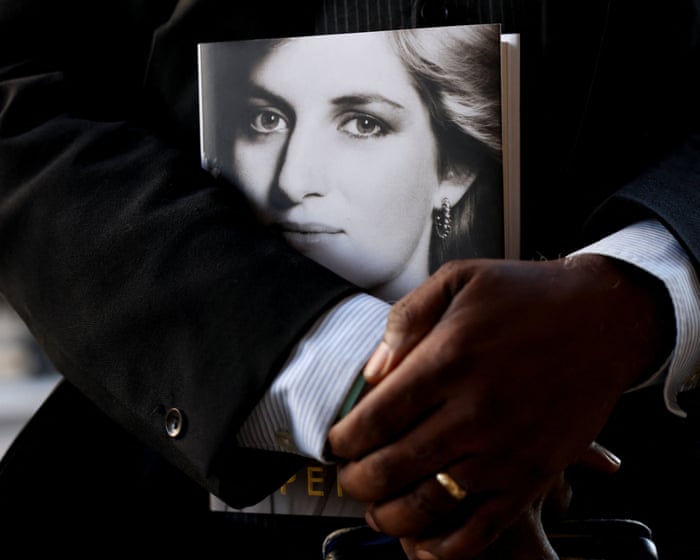
Charles Spencer’s Swan Song, a memoir about his relationship with his sister, the late Diana, Princess of Wales, is a fascinating document that reveals a little about Diana and a great deal about Charles Spencer—perhaps more than we needed to know. If that sounds snarky, after 400 pages of settling scores, boasting, wild indiscretion, and some genuinely touching passages about his late sister, the reader is left with a dizzying story of the world that created Diana and a certain distaste for how it is told.
Let’s start with the headlines in last week’s Daily Mail, the newspaper to which Spencer sold serialisation rights for a book that includes a line describing tabloid journalists as “those who inhabit the murky swamps of malevolence, and who need to suck their victims dry of their souls.” Perhaps he meant a different group of hacks. Anyway, the top line in the Mail was that, shortly after Diana’s death, King Charles insulted her in a phone call to Spencer: “‘Rest assured,’ he hissed, ‘we’ll forget her soon enough.'” Your reaction to this quote will likely determine how you receive the book, and here’s mine: I’m willing to believe the king behaved badly, but “hissed” is a red flag, one of those embellishments, like “snarled” or “flounced,” that writers tend to use to make those they’re writing about appear worse. Spencer, always the injured party, has so many axes to grind in this book that at times it’s impossible to hear what he’s saying.
Before we get to that, the question on everyone’s lips is: why write this book now? Spencer maintains it’s because, as the 30th anniversary of Diana’s death drew near, he kept being asked to contribute to other people’s projects. Rather than allow the narrative to be guided by “some TV producer” from a network “I will never watch,” he promptly got on with his own. Likely that’s not the sole reason; elsewhere in the book he writes about how, back in the day, his father was always at risk of running out of cash to run Althorp, the family’s Northamptonshire estate, and one wonders if the present earl is having similar difficulties.
Never mind. For fans of petty grievances, among whom I count myself, the book is an absolute corker of resentment, and in Spencer we have a hero who, decades after the fact, is still harping on about a great many things involving a large cast of characters whom he has absolutely not forgiven for any of it. While telling the story of his and Diana’s relationship, there are drive-by attacks on Peter Carter-Ruck, Princess Michael of Kent, Princess Margaret, his three ex-wives, whom he describes in an amazing parenthetical takedown as “all double divorcees,” and members of a police protection squad who, in 1986, let sniffer dogs jump all over his furniture.
Spencer writes that Charles’s poor behaviour towards his sister began from the very start of their courtship.
If too many words are spent on, for example, the treachery of Martin Bashir, I could read an entire book on the subject of Spencer’s horror at what his stepmother, Raine, did to the interiors at Althorp, including installing “exceptionally ugly double glazing,” “shiny velveteen” upholstery, and “unsightly wall-to-wall carpeting.” (This is before we get to the scene in which Raine, standing at the top of the staircase in search of breakfast, bellows to staff below, “where’s my fucking egg?”)
Interspersed with these delights is a portrait of Diana that is affectionate, sad, and lovely in places. Spencer suffers the pain of the less famous sibling who doesn’t want to give up his own version of their childhood, and there’s a stiffness to some passages as Spencer insists it was all less unhappy than the record implies. His portrait of their mother, Frances, feels like a useful corrective to a figure who has been publicly maligned, and whoIn the book, he comes across as the parent most responsible for Diana’s gifts: spirited, slightly eccentric, and a more interesting figure than the dull men in the Spencer family. (Charles graciously admits this, noting that the men in his family have always been outshone by the women.) And of course, there is the devastating account of the coldness and aggression of the then Prince of Wales. Spencer tells us that Charles’s poor treatment of his sister began right from the start of their courtship, during which he commented on her weight, ignored her at parties, and told her he didn’t love her—so much so that, Spencer writes, Diana tried to call off the engagement. Their father told her it was too late. This matches other accounts of the doomed marriage, though with more gruesome detail, and explains the fury behind Spencer’s finest moment: the speech he gave at Diana’s funeral, in which he attacked not only the press but also the royals, reclaiming the young princes William and Harry for their mother’s “blood family.”
At his best, in these passages, Spencer speaks for the rest of us by capturing the sheer madness of the days after Diana’s death—by which I mean not the public outpouring of grief, but the behavior of the royal family, who remained deaf to the nation’s needs until they were forced to change course. “What was Prince Charles actually doing there?” Spencer writes incredulously, referring to his former brother-in-law’s prominent role at the funeral, and points out to comic effect that no one wants their “ex” at their funeral. Diana’s former husband was there because the young princes were there, walking two miles behind their mother’s coffin while mourners wailed and shouted at them—something Spencer had vigorously argued against. Now, he writes flatly, “It all seemed mad to me—the more so as I began to appreciate the extent of the ordeal we had embarked on.”
To be honest, at times in this book, they all seem quite mad. “That’s it … it’s curtains … Duch is dead,” Spencer reports his sister Jane saying to him on the phone when news of Diana’s death was confirmed. Before the funeral, according to Spencer, Prince Charles wanted to walk behind the coffin in the middle, center stage, until his father, Prince Philip, stopped him, saying something to the effect of don’t be so bloody silly, and put Charles Spencer in the center, with the boys on either side and Diana’s ex-husband and ex-father-in-law on the outside. There was a split second, Spencer writes, when it seemed the pallbearers might buckle under the weight of Diana’s reinforced, lead-lined coffin. All of this is fascinating, and Spencer tells it well.
Still, the book suffers from self-pity and self-regard. (I won’t get into the passages about Spencer’s ADHD or the weaselly justifications he gives for telling Diana, in her hour of need, that she couldn’t move into a property on the Althorp estate; the main house has 90 rooms.) Every few chapters we return to the play-by-play of how he wrote his speech—his decision to substitute the word “power” for “strength”; how his oratory gathered force, his greatness took shape. And look, it was a fantastic speech, but at some point you start to think, alright, Alexander Hamilton, give it a rest. Before the funeral, Spencer visits Diana lying in her casket and reads his speech aloud to her, sensing that his dead sister is “applauding my words, with soft insistence.” Even here, Spencer manages to take center stage.
After the book’s litany of bitter grievances, I came away wondering whether Spencer has been in the ear of his nephew Prince Harry these last few years. Mostly, however, I felt sadness for the insurmountable difficulties his sister faced in marrying into that family. The king is peevish throughout, and Spencer isHe was peevish right back at him. You come away feeling the two thoroughly deserved each other. And in the middle is Diana, 30 years dead, frozen in time and – as she always was – at the mercy of other people’s interpretations. Swan Song: Diana, My Sister by Charles Spencer is published by Michael Joseph (£28). To support the Guardian, order your copy at guardianbookshop.com. Delivery charges may apply.
Frequently Asked Questions
Here is a list of FAQs based on the review of Swan Song by Charles Spencer
What is Swan Song about
It is a memoir by Charles Spencer Princess Dianas brother It focuses on his childhood his abusive boarding school experiences and his complicated relationship with his family and the press
Who is Charles Spencer
He is the 9th Earl Spencer Princess Dianas younger brother He is also an author and historian
Why is the book called a furious rant
The reviewer uses that phrase because Spencer writes with intense anger He settles old scores against people he feels wronged him especially at his strict boarding school and within his own family
What does settles scores mean in this context
It means Spencer uses the book to criticize or get even with people he believes hurt him He names names and describes painful events in detail
What is the main criticism of the book
The main criticism is that Spencer comes across as bitter and selfpitying The reviewer says the anger overwhelms the story and makes it hard to sympathize with him
Is the book only about Princess Diana
No Diana appears but the book is mostly about Charles Spencers own life He talks about his parents divorce his time at Eton and his struggles as an adult
What does Swan Song mean here
A swan song is a final performance or act The title suggests this might be Spencers last major public statement about his family and his past
Does the book have any positive parts
Yes The reviewer notes that Spencer writes well about nature and his ancestral home Althorp Some passages about his childhood grief are moving
What is a boarding school in this context
It is a school where students live during the term Spencer attended Eton a famous and strict British boarding school which he describes as brutal
Why does Spencer blame the press
He believes the media hounded his family especially Diana and contributed to her death He also feels the press misrepresented him
Is this book a good source for learning about Princess Diana
Not really It offers a few new details but it is more about Charles Spencers grievances than about Dianas life
What is the tone of the review
The review is