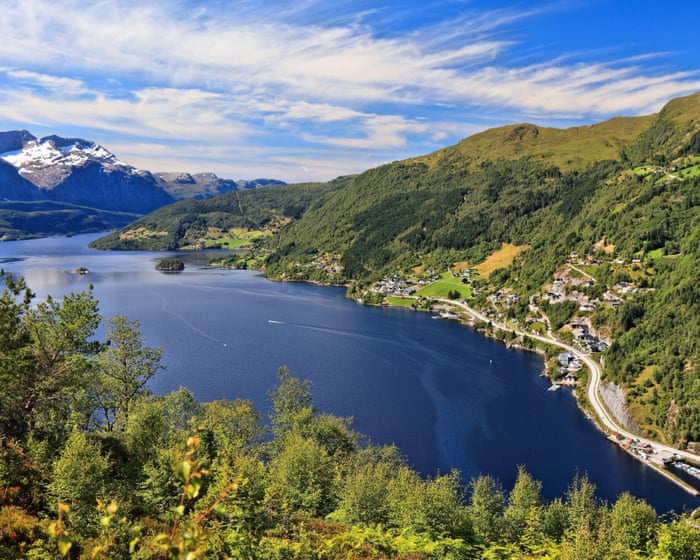
Shortly after the Norwegian stock market closed on 17 June 2026, a few dozen local people from the small west coast town of Vevring gathered around a laptop in a school. Surrounded by children’s drawings and windows overlooking Førde fjord, they listened as news came in from Oslo. Norway’s supreme court had ruled against the government: a permit to release mining waste directly into the fjord two miles upstream was illegal, the court said.
That moment marked the end of a 17-year fight, one of Norway’s longest-running environmental battles in recent memory. In Oslo, Ingvild Fonn Asmervik, project leader for Naturvernforbundet (Friends of the Earth Norway), compared her joy to giving birth. For Anne-Line Thingnes Førsund, a third-generation fisher who lives on the banks of the fjord in Vevring and volunteers for the charity’s local branch, it was more a feeling of relief. Like a mountain lifting off her shoulders, she said.
These feelings of joy were short-lived. While Førsund and others celebrated, a government lawyer appeared on a TV debate show to outline plans for a new temporary permit, allowing the mine to keep releasing waste directly into the fjord in the meantime. Four days later, the mine applied for fresh permission, and in late September, the climate and environment ministry granted it.
“When we heard the pollution would continue, it was like they pulled the rug out from under us,” says Førsund. “We have answered every letter, commented on every consultation, complained whenever we could. We have been knocked down so many times, and this could have been the chance for change.”
While the government insists it is acting lawfully, critics say the dumping threatens to foul one of Norway’s most pristine fjords. Others worry the decision signals a new wave of permits to pollute Norway’s fjords in the race to secure critical minerals.
View image in fullscreen
Anne-Line Thingnes Førsund, a third-generation fisher, has campaigned against Engebø mine for two decades. Photograph: Daniel Shailer
“This is not only about the fjord and us and our lives,” says Førsund. “This is about principles. When you have a government that doesn’t respect the supreme court, you’re changing the system itself.”
The move comes as polluted waters in Norway are drawing wider attention. A recent report showed that Norwegian fish farms are filling fjords and other coastal waters with nutrient pollution equivalent to the raw sewage of tens of millions of people each year.
Meanwhile, populations of Atlantic salmon are at a historic low in the country – 155 of Norway’s roughly 450 salmon rivers were closed to fishing at the start of this year’s season.
Submarine tailings deposition (STD) – known informally by Norwegian critics as “fjord dumping” – is the process of pumping crushed rocks and chemical waste into the sea through pipelines hundreds of metres underwater. Proposed as an alternative to disposing of waste on land, the Norwegian government’s own Institute of Marine Research (IMR) warns that STD releases fine particles of toxic waste that can accumulate in smaller sea life and disrupt ecosystems at large.
STD is banned in all of North America, Australia, Russia, Brazil, China and most of Europe. The few countries that still allow it include Papua New Guinea, Indonesia and Turkey.
The Engebø titanium mine, on Førde fjord near Vevring, was first proposed by Nordic Mining in 2006, and the government awarded a permit to release waste into the fjord less than 10 years later. In response, Friends of the Earth Norway launched legal challenges that worked their way up the country’s legal system, arriving at a week-long supreme court hearing in spring 2026. Meanwhile, the mine came online and began releasing waste late in 2024.
Nordic Mining is financed by investors including Japan’s Iwatani Corporation aand the British offices of international banks Morgan Stanley, UBS, and Goldman Sachs. Other banks, including Standard Chartered and Citigroup, explicitly prohibit financing projects that use STD.
Nordic Mining did not respond to repeated requests for comment from the Guardian. However, shortly after the supreme court ruling, the company said in a social media post that it would continue its waste disposal practices, with encouragement from Norwegian officials.
“It has been said that our operation is illegal, that we have to close, that our work must stop. That is not the situation,” Nordic Mining said, adding that it was continuing “with the ambition to act responsibly, with respect for the fjords and mountains, and for the local community around us.”
The legal dispute over the permit centered on the EU’s Water Framework Directive (WFD), which applies to Norway as a member of the European Economic Area. The WFD allows industrial activities to pollute water bodies only when there is an “overriding public interest.”
The supreme court ruled that the reasons given when the permit was first awarded were not strong enough. However, the government argues they have grown stronger since the EU added titanium to its list of “critical minerals” in 2020.
Nordic Mining’s Engebø titanium mine, near Vevring. Its new permit allows it to deposit waste into the fjord for three years. Photograph: Daniel Shailer
“The Norwegian government considers the Engebø project to be of significant importance for Norway and Europe,” a ministry spokesperson said, because “the Engebø mountain contains one of the world’s largest known deposits of rutile, a titanium-bearing mineral. Within Europe, Norway and Ukraine are the only countries with significant resources of this kind.”
Legal scholars have questioned this logic. “That’s wrong. A permit exists or it doesn’t, and the supreme court decision is quite clear: the permit is illegal,” says Tarjei Ellingsen Røsvoll, associate professor of administrative and constitutional law at the University of Inland Norway.
“The government is then openly allowing a company to dump a bunch of stuff in a fjord illegally. That is unprecedented; it damages trust and undermines a fundamental structure of constitutional and administrative law. They should take responsibility for having made an invalid and illegal decision, morally and legally.”
While Nordic Mining awaited its new three-year permit, it continued to dispose of waste into Førde fjord. Økokrim, Norway’s central office for white collar and environmental crime, is now considering whether to investigate the dumping for illegality.
While there have been few comprehensive studies of the impact of STD on marine ecosystems, scientists have linked heavy metal pollution now present in some fjords to STD decades earlier.
The impact is particularly damaging when the waste is milled into small pieces, according to Terje van der Meeren, a research professor at the IMR, who co-authored the institute’s response to the Engebø mine application and testified during the supreme court hearings.
Terje van der Meeren rows to work at Norway’s Institute of Marine Research. ‘What will happen with the fish spawning in this fjord? We don’t know.’ Photograph: Daniel Shailer
“It’s like flour,” says Van der Meeren, adding that waste from Engebø includes a chemical that degrades into carbon disulphide, a neurotoxin. “Our concern is that this fine dust will pass into the rest of the fjord. What will happen with the [fish] spawning in this fjord? We don’t know.”
In 2016, Van der Meeren and other IMR researchers travelled to the Arctic Repparfjord, in Hammerfest in the far north of the country, where a copper mine dumped waste for six years in the 1970s. Decades later, they found haddock with higher levels of lead, arsenic and chromium in their muscles than those in nearby waters, accordinAccording to research published this year, other Norwegian studies have found historical STD contamination in plankton, crabs, and fish eggs. Back in Vevring, Førsund and other campaigners are now preparing for a new legal battle over the temporary waste permit, though dumping will likely continue until a new decision is made. She looks back on the first protests against the mine with nostalgia. In one photograph taken more than a decade ago, protesters gathered for a meal on the banks of the fjord; Førsund’s daughter, now an architect, was only a child. “So many of these people are dead now,” she says. “The fjord is bigger than us. It has given us food and income and meaning and music and fish and birds for thousands of years. Now it gives us the energy to keep fighting.”
Frequently Asked Questions
Here is a list of FAQs about the topic of Norways fjords and mine waste dumping
Beginner Questions
Q What is a fjord
A A fjord is a deep narrow inlet of the sea usually surrounded by steep cliffs or mountains They are most common in Norway and were carved out by glaciers during the last Ice Age
Q Which Norwegian fjord is this article talking about
A The article is about Frde Fjord located in western Norway It is often described as one of the countrys cleanest fjords
Q What is mine waste or tailings
A Mine waste often called tailings is the material left over after valuable minerals are extracted from rock It is usually a mix of crushed rock water and chemicals used in the mining process
Q Why would anyone dump waste into a clean fjord
A Mining companies want to get rid of waste cheaply Dumping it into a deep fjord is often cheaper than building large dams on land to store it The Norwegian government has allowed this practice in some cases
Q Is this actually happening right now
A Yes As of recent years a mining company called Nordic Mining has been permitted to deposit millions of tons of tailings into Frde Fjord The project has faced protests and legal challenges
Intermediate Questions
Q What exactly is being dumped into Frde Fjord
A The waste comes from a titanium mine at Engebfjellet The tailings contain crushed rock water and trace amounts of chemicals used in processing The main concern is the fine rock particles and their effect on marine life
Q What are the main environmental concerns with this practice
A The fine particles can smother bottomdwelling organisms clog fish gills and reduce light penetration in the water There are also fears that heavy metals or processing chemicals could accumulate in the food chain
Q Has this been done elsewhere in Norway