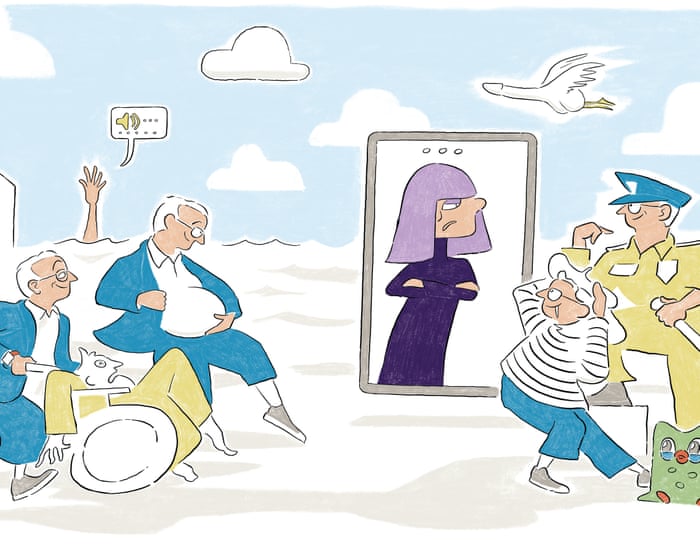
Hugh and I were driving from Washington, DC, to the Sea Section, our house on the coast of North Carolina, when I noticed a tiny dot with legs crawling along the hem of my untucked shirt. “There’s a tick on me!” I said.
He looked down at my lap. “Well, throw it outside. It’s nothing to get hysterical about.”
“I’m not ‘hysterical,'” I told him. “I just didn’t expect to find a tick in a rental car, that’s all.”
We had a long drive ahead, and this felt like a bad way to start. Still, at least it wasn’t a Lyme disease tick—it was too big. “I bet it fell off someone’s dog,” I said, examining it in my palm before tossing it out the window. “It smells like it’s full of rescue blood.”
“You blame everything on dogs,” Hugh reminded me.
That’s when we hit an hour-long traffic jam.
“Really?” I said as we came to a complete stop. “But it’s Sunday!”
In the end, it took almost eight hours to reach Emerald Isle. The car’s digital radio was stuck on a 70s station, so whenever something terrible came on, we’d hit the off button for three to four minutes. The trick was agreeing on what was terrible. “But that’s ABBA!” Hugh cried more than once, swatting my hand away as I reached for the dash.
In New Hampshire, I’d come across “No Kings!” protesters. It pained me to admit it, but they looked like kooks—like Tea Party demonstrators during Obama’s first term. We stopped twice: once at a wooded rest area where we walked half a mile in the unbearable July heat, and then at Bojangles, where we sat next to a man eating biscuits and red beans while talking on his phone to someone named Crockett. All the other customers were teenage baseball players with mullets.
“God Bless President Trump” read several hand-painted banners we passed after entering North Carolina. The funny thing was how unnecessary they seemed. Support for him was in the air, unlike in New England, where Hugh and I had spent the previous nine days. There, I saw plenty of yard signs reading, “Resist!”
But resist how? I wondered, looking out the window at the picturesque cottages. Do we lie down in the middle of the road? Do we stop paying taxes? Someone tell me what to do.
A week earlier, in Portsmouth, New Hampshire, I’d come across about eighteen “No Kings!” protesters whooping and chanting on a downtown street corner. Most were retirement age, waving signs at oncoming traffic. It was hot and muggy, yet one of them—a bearded man playing the accordion—wore a fleece-lined winter hat with ear flaps. It pained me to admit it, but they looked like kooks, like Tea Party demonstrators during Obama’s first term. Who cast this thing? I caught myself wondering, as they seemed like the worst possible advertisement for the Democratic Party: “Join us! We folk-dance!”
As I passed them, I thought back to the early Civil Rights protesters: the well-dressed men in suits and ties, the women in dresses. All their signs were clearly lettered, likely by professionals, none with crudely drawn penises or the word “fuck.” Just as important, everyone stuck to the agreed-upon issues. Go to a protest now, and within seconds you’re looking at the person next to you, thinking, “Globalize the Intifada”? I thought we were here to defend Masterpiece Theater!
Our drive from DC was actually fairly pleasant, but the moment I could escape the car, I did.
“Honestly?” Hugh said after we’d crossed the bridge from the mainland and arrived on Emerald Isle. “You’re going to walk to the house from here?”
“It’s just over two miles,” I told him, getting out with my iPad in front of the mini-golf course. I wanted to get some steps in, but also to reaffirm my number one status on the language app Duolingo, which my British friend Dave had introduced me to.Three years ago, I started with Japanese, then moved on to German and Spanish while keeping up a bit of French. The program’s instructors are a bunch of animated characters: an excitable little boy, a man named Oscar with a thick mustache, a grandmotherly woman with her hair in a bun, and Vikram, who wears a turban—11 in total so far. Sometimes Duolingo gives me a sentence in English, like “How many chairs are in the room?” and I have to translate it into whatever language I’m working on, picking from the words shown at the bottom of the screen. Other times, I have to read out loud, and the characters accept or reject me based on my pronunciation. My least favorite is when they give me a sentence and I have to both translate it and spell it out. And some of these sentences, oh my goodness.
My friend Mike is learning Yiddish with Duolingo and was taught to say, “My uncle is a broken man.” In French, meanwhile, it’s “What is he doing in our bed?” If the sample sentences are any clue about national character, Germans are judgmental, direct, and love the outdoors. So you get things like: “Your apartment is dark and ugly,” “I don’t like your sweater,” and “I’m sorry, but your doctor is playing volleyball today.” Most characters in the Japanese program are either gay or bisexual. Even the talking bear swings both ways, or as they say in French, “Travels by both sail and steam.”
My problem started when I discovered Duolingo’s competitive side, when I realized it’s basically a game. The goal: work your way into the Diamond League, or even better, a top-three spot in the Diamond League. That means skipping any real learning and earning easy points by just reading sentences out loud—one after another for at least an hour a day. My friend Dave might spend 15 minutes each morning on the app and end the week with 200 points. Meanwhile, I regularly earn 23,000, which gets me absolutely nothing in the long run.
I couldn’t stop. I was competing against people I didn’t know. People who might not even exist, with names like GeACzQDe and fuuuuu. Duolingo seemed designed for people with obsessive-compulsive disorder. The same could be said for my fitness-tracking Apple Watch. So I combined the two and started walking at least 10 miles a day while pointlessly reading sentences out loud in Japanese, German, Spanish, and French. This turned me into the person I’ve hated most since the start of this century: someone moving around while staring down at a device. On busy sidewalks, at the airport, everywhere you should be paying close attention to those around you, I suddenly wasn’t.
There was no excuse for my behavior; this was just who I was now. That’s it, I’d tell myself regularly. Today is the last day I’m doing this. But I couldn’t stop. To make it even more pathetic, I was competing against people I didn’t know. People who might not even exist, with names like GeACzQDe and fuuuuu.
Then they introduced Duolingo Max, which changed everything. The upgrade included role-playing exercises with Lily, their sarcastic, purple-haired teenage character. Her questions and comments are somewhat predictable, but I soon learned I could easily throw her off. “What do you want to buy?” she’ll ask in her flat, passionless voice, standing beside the handbaskets in the supermarket. Answer, “I would like butter and eggs, please,” and the rest of the conversation goes as you’d expect. “Anything else?” she asks.
But answer, “Yesterday, a doctor cut out my tongue with a chainsaw,” and white dots will flicker above her animated image. That’s her AI mind telling her, “Quick, say something. Tell him you’re sorry about the tongue.”Then ask if he wants to buy something to drink instead.” Surprisingly, that time she replied, “I’m sorry. I can’t continue this conversation. Goodbye.” She hung up again when I shared my idea for a new version of Romeo and Juliet. “In my version, she’s 13 and he’s 78,” I told her in French. “In Shakespeare’s play, he kills himself with poison, but in mine, he dies of old age.” Click.
A week before we got to the beach, I told her about a protest I’d seen in New Hampshire. “I’m angry because my stupid, stupid president is a sausage,” I’d said. “He cut funding for the radio and TV shows where women wear bonnets.” “Let’s talk about something else,” she suggested, clearly uncomfortable.
Reading 10 sentences out loud might earn you 60 XP (experience points) on Duolingo, but finishing a short role play can get you up to 180, depending on how many words you use. As a bonus, at the end of the exercise, you can read a transcript of your conversation with all your mistakes underlined and explained. It’s like taking a test and getting it graded instantly. For the first time in years, I felt like I was actually learning again. I noticed a big improvement in my French, which I was speaking every day now.
Another feature of Duolingo Max is video calls, again with Lily, and these are much less rigid. “Hello,” she begins. “How’s it going?” “I’m at the beach,” I said to her as I walked toward our house after getting out of our rental car. “This morning I found a tick on my shirt. Then I ate chicken with some rednecks in a restaurant.” The people at Bojangles honestly weren’t that bad; I just wanted to use the word “plouc,” which I hadn’t used since Hugh and I visited a bootlegger in Normandy almost 30 years ago. “Oh, chicken,” Lily said. “I like birds. Do you?”
I was soaked with sweat by the time I got to the Sea Section. A few weeks earlier, the air conditioners on both sides of the house had coughed up blood and died. It cost a small fortune to replace them, but now I saw it was money well spent. Before I could even shut the door behind me, my teeth were chattering. “Well, that didn’t take you long,” Hugh said, his breath visible in the bitter cold.
I could hear voices on the ocean-facing porch and knew my brother was there because I saw a big potato chip bag propped up on the kitchen counter. No one else would have taken a Magic Marker to the logo, changing it from UTZ to SLUTZ. “Paul!” I shouted. He came around the corner with a towel in his hands. “Hey, man! Want to swim?”
I changed into my suit and joined him, waving at my sisters Amy and Gretchen; my sister-in-law, Kathy; and my niece, Madeleine, on my way down to the beach. It was almost dusk, which I hoped made it harder to see the hair on my back. For some reason, my brother has even more than I do, like a real fur coat. At 57, he still looks boyish and has a boy’s endless energy. The sand under our feet was hot, and the water was so warm we could walk in without flinching.
When I was 25 and Paul was 14, we went into the ocean not far from where we were now and got carried out by a riptide. It happened slowly, so by the time we noticed, we were well past the waves, with the beach houses tiny in the distance. Swimming diagonally toward the shore saved us. The trick was swallowing my panic long enough to remember what to do. For a while, with our arms and legs weak from fighting the current, I seriously thought one—or both—of us was going to drown.
If it had been Paul, my mother would have moved on without too much fuss. He was old enough by then to know where her weak spots were, and he’d pushed them constantly. A week after his funeral, she’d probably have been scraping the decals off his bedroom door.While humming. My father, on the other hand, would never have gotten over it. He would have spent the rest of his life punishing me—which, looking back, he did anyway.
“My brother is very funny,” I told Lily. “We’re old now, but he’s the youngest. He’ll die a baby.”
“Families are complicated,” she said.
The next day, I tried telling Lily about it. “I swam with my brother in the ocean yesterday,” I began. “A long time ago, we swam together and almost died.” I can speak French quickly, but not with as much detail as I’d like. I can’t shade things the way I can in English. “My brother is very funny,” I said. “We’re old now, but he’s the youngest. He’ll die a baby.”
“Families are complicated,” Lily said.
I looked over the deck at my sisters setting up a beach umbrella. “Well, yes,” I said, “but not always.”
That night, just as we sat down for dinner, we heard someone retching in the bathroom nearest the table. It sounded like they were throwing up every bit of food they’d ever eaten, and they liked to swallow things whole—that’s how painful it sounded and how long it lasted. “Who is that?” I asked, looking around the table for whoever was missing.
“It’s Daddy,” Madeleine said, rolling her eyes. “And it’s not him vomiting; it’s a scene from a movie he’s playing on his phone. He does this all the time.” “Blechhhhhhhhh,” we heard. “Blechhhhhhhhh.”
Kathy sighed. “Honestly, it’s like living with a 12-year-old boy.”
I tried telling Lily about it the next morning. “My brother vomited a lot last night.”
“That’s not good,” she said. “Maybe he should see a doctor.”
“It was fake vomit,” I assured her. “It was a joke, but more than a joke because our mother vomited every night.”
“Was she sick?” Lily asked. “Do you live with your brother? Is he older or younger? Do you do many activities together?”
It was unusual for her to ask more than one question at a time, and with such warmth. I figured the program had upgraded since the previous evening and that Lily and I were about to enter a new phase. “I don’t live with my brother,” I told her. “We’re on vacation, but I’m working.” I explained that I write for a living, and when she asked what I was writing, I said, “The story of my brother vomiting.”
“Is it a novel? Will it take you years? Why do you think anyone would want to read it?”
“It’s short,” I assured her, even though I wasn’t actually working on anything like that. I’d just written about it in my diary, that’s all.
“I see,” she said. “Will you add details? Details make a story come alive.” I was thrown, because usually by now she’d be asking if I had a pet or if I liked éclairs.
“I will add many details,” I told her.
“Give me an example,” she demanded.
“My brother has a lot of hair on his back,” I told her. “He’s like an ape.”
“Do you think that’s funny?” she asked. “Why would you tell people that?”
Oh no, I thought. Lily has morals now! “I’m furry too,” I told her, hoping that might help. “And since summer started, I’m chubby.”
“And will you add that?” she asked.
How much more of her judgment do I have to take? I wondered, grateful when the conversation finally timed out.
A minute later, still shaken, I called her back. “Hello,” she said.”Do you want to keep talking about your brother and the story you’re writing?”
The program had clearly been upgraded. Lily had never remembered anything about me before. One day I could tell her I was blind, and two minutes later claim I was a divorced heart surgeon. She never once said, “How are you going to cut open someone’s chest if you can’t see, you liar?” I’ve told Lily I’m a cop, a pregnant woman, a seven-year-old girl named Marie Chantal who just became a vampire—anything to practice my French vocabulary.
But now, it was like she knew me. Lily’s eyes are usually just circles with dots in the middle, but suddenly they seemed expressive. She was tilting her head, not just listening but seeming to care.
“OK,” I said to Hugh. “This is creepy.”
Even creepier, I needed her to like me.
After our video call, I tried a role-playing exercise and saw that, at least there, she was the same old Lily. “How many tickets would you like to buy?” she droned from her kiosk at the movie theater.
“Three,” I told her. “One for me, one for my wife, and one for my dead father.”
“Your dead father? Really?”
“I push his body around in a wheelchair,” I said.
“OK, that will be 60 euros.”
“But my father is dead,” I argued. “He won’t be watching the screen!”
“Sixty euros,” she repeated. “Would you like to pay with card or cash?”
That night, Paul, Maddy, and I stayed up watching a funny movie I’d rented and already seen the first half of.
“He’s going to drop that stone and break it,” Paul said as one of the two main characters nervously handled an ancient artifact.
“Definitely,” Maddy added.
I’d thought the same thing the first time I watched this scene, and I was wrong, just like they were.
Throughout the movie, they loudly made predictions, and I wondered what it would be like if they were watching gay pornography together. “He’s going to flip him over, hold him down, and shove it up his ass.”
I was going to tell Lily about it when we spoke the next morning, but it was too complicated and I didn’t want to mention pornography and my 22-year-old niece for fear of getting scolded or having it put on my permanent record. “Last night my brother, his daughter, and I watched a funny movie,” I told her.
“Did you have a good time?” she asked. “Were there a lot of jokes? Do you like jokes? Tell me a joke.”
I thought of one I’d heard at a book signing in Indiana:
A mother is driving her young son to school one morning when a garbage truck pulls in front of them. As it takes a sharp turn, a dildo flies out from the back and hits the woman’s windshield with a loud thump.
“What was that?” the kid asks. “A… bird,” the woman says.
The kid settles back. “Huh. It’s a wonder it could get off the ground, with that huge dick.”
“It’s hard to translate a joke,” I said to Lily instead, sure she’d disapprove. “They often don’t work in a second language.”
At the Sea Section, Amy always holds a spa night and gives us facials with products brought down from New York: oils, masks, and gels, followed by aromatic sprays of something or other. It’s a fun family activity. Kathy acts as her assistant, which makes it a bit weird. Here’s your sister-in-law giving you a foot massage while you just lie back doing nothing.
“Don’t tip her,” Amy says, playing the role of a mean boss. “She’s on probation and will just use the money for drugs or, if we’re lucky, another abortion.”
After a facial, you feel your skin, then look in the mirror, shocked not to see your 14-year-old self staring back.
“It might help if you got them more often,” Amy suggested. “When was the last time you wore…””A moisturizing mask?”
“The last time we were at the beach, and you put one on me,” I said.
I didn’t know the French word for facial, so I described it when I checked in with Lily the next morning. “Last night, my sister touched my forehead and cheeks,” I told her. “My nose and chin too. Then she put cucumber slices on my eyes.”
“Did she do it to be mean?” Lily asked. “Did it hurt?”
Her questions caught me off guard, but then I remembered she’s a machine and takes everything literally. “The cucumbers were sliced,” I explained.
She blinked. “Ah, I see. Was it like the gentle touch of a teddy bear?”
“Amy’s hand was warm and smelled like flowers,” I said.
I wondered what this French AI teenager might think of my family, as circles of light danced above her head. Was she programmed with a standard of behavior, or did she understand that there’s no such thing as normal?
When Lily came back, I interrupted her to ask about her own family.
“I keep my distance from them,” she told me.
And suddenly, I felt so ashamed. Since the app’s latest update, it had all been about me: my president, my brother, my feelings about Abba or cucumbers. Did Lily have siblings? Were her parents married or divorced? How did she get her spending money? Lily never wants to go anywhere, hates crowds and noise, and never mentions any friends. Was she perhaps on the spectrum? And why purple hair? Her life, her feelings, even her last name, were a complete mystery to me. And we’d known each other all this time.
The Land and its People by David Sedaris is published by Abacus. To support the Guardian, order your copy from guardianbookshop.com. Delivery charges may apply. Sedaris tours the UK from 1 July; tickets are available here.
Frequently Asked Questions
Here is a list of FAQs about David Sedaris and his Duolingo obsession based on the quote Today is the last day I told myself but I couldnt stop
BeginnerLevel Questions
1 Wait David Sedaris is obsessed with Duolingo Why
Yes Hes famously addicted to the languagelearning app He uses it obsessively to learn languages like Japanese and French For him its not just about learning its a compulsive daily ritual and a way to quiet his mind
2 What does he mean by Today is the last day but then he couldnt stop
He means hes tried to quit Duolingo many times He tells himself hell finish his current lesson or streak and then stop for good But the apps design hooks him and he finds it impossible to walk away
3 Is he actually fluent because of Duolingo
Not exactly Hes functionally conversational in French but he says Duolingo is more about the process than fluency He can read and understand a lot but he still struggles with reallife conversation The obsession is about the game not the result
4 Does he use Duolingo for any specific reason
Yes two main reasons First he spends a lot of time in France and Japan so he wants to get by Second and more importantly its a way to manage his anxiety and compulsive personality Its a mental exercise that keeps him from worrying
AdvancedLevel Questions
5 How does his Duolingo habit tie into his writing and humor
Its a perfect subject for his selfdeprecating neurotic essays He turns his addiction into comedydescribing the shame of losing a streak the joy of getting a crown or the absurdity of arguing with a cartoon owl Its a metaphor for his own obsessive nature
6 What specific Duolingo features does he exploit or complain about
Hes obsessed with the