Caught between Vladimir Putin’s Russia, Donald Trump’s US, and Xi Jinping’s China, Europe seems to be in a deep crisis, and talk about its future is often full of doom and gloom. But there’s a paradox here. Despite rising nationalism, the climate crisis, and economic slowdown, most people would still agree that Europe has a lot going for it. If you asked Europeans where in the world they’d most want to live, many would still choose Europe over other continents.
The news isn’t all bad either. While much of the political commentary in recent years has focused on the rise of far-right nationalism across the continent, its most famous symbol, Hungary’s former autocrat Viktor Orbán, was just ousted in a landslide election this month.
With this paradox in mind, we teamed up to try to understand Europe’s biggest challenges and opportunities. As scholars, we know a lot about Europe’s foreign and security policy and the digital economy, but we didn’t have all the answers and wanted to bring others into the conversation. We gathered a group of leading thinkers from across Europe, whose expertise covers the economy, the climate emergency, migration, technology, defence, democracy, history, and much more. We captured their thoughts for our new film as they wrestled with the many different threats facing the continent and shared their analysis and ideas.
The collective diagnosis from these experts, laid out in blunt terms, is indeed sobering. They agree that the biggest threat is an expanded war in Europe—potentially spreading from Ukraine to a Russian move on the Baltic states, perhaps by closing the Suwałki Gap near the Lithuanian-Polish border. When it comes to defending itself, Europe is even more vulnerable to an encroaching Russia because of its deep reliance on an increasingly hostile US, whose leadership is already using that power imbalance as a weapon.
“What we’ve discovered to our horror is that we simply can’t depend on the US as a safety net for our security the way we have for the past 80 years,” historian Timothy Garton Ash told us. “So between the Russian aggression against Ukraine and the threatened withdrawal of the US, it comes back to us.”
And despite the election result in Hungary, far-right nationalist populism is still on the rise, threatening democracy as well as principled, forward-looking policies on climate, energy, trade, technology, and migration.
Our goal in gathering these dangers wasn’t to spread doom or alarmism. But a realistic look at the present is necessary for any hopeful view of the future. So what’s the answer? Most of the thinkers we spoke to believe it lies in a stronger Europe. The good news is they think this goal is within reach. “I think we do have what it takes to get there because we are, at the same time, a small yet rich continent that has academic excellence, believes in science, still does climate policies, and is also a place of liberties, freedoms, and culture,” Dutch philosopher Luuk van Middelaar said.
Europe has a large market and a wealth of talent. Its researchers are world-class, and its economy has important areas of excellence. Europe has vast amounts of untapped capital that could be used in better ways to fund innovation. Its societies remain open and peaceful, and, despite all its problems, its democracies are still among the most vibrant in the world.
In key ways, Europe is already addressing its weaknesses. The twin threat from Putin’s Russia and US retrenchment is pushing our governments to invest heavily in Europe’s self-defence. Trump’s protectionism has spurred Europe to strike new trade deals with Latin America, India, Indonesia, and Australia in recent months. The return of global protectionism has alsoThis gave the continent the push it needed to finally remove internal trade barriers and unlock the full potential of a truly integrated EU single market.
But when it comes to Europe’s future, optimism alone isn’t enough to spark change. It has to turn into action—driven by the belief that a stronger Europe not only can be built, but must be.
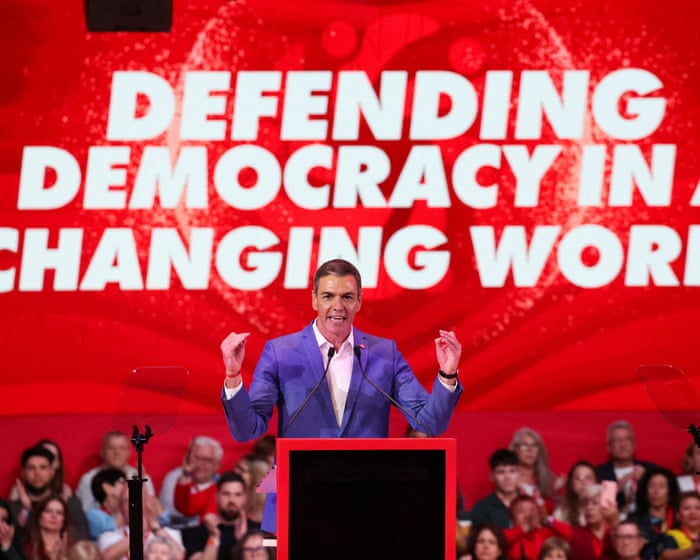
We saw this activism when young Europeans took to the streets to demand climate action or protest the war in Gaza. We saw it at the ballot box in Hungary, where record numbers turned out to challenge Orbán’s authoritarian rule. And we saw it last week in Barcelona, when progressive politicians from Europe joined counterparts from the Americas, Africa, and Asia to create a shared platform for renewing democracy and promoting peace, international law, and multilateral cooperation. Energy is building through protests, voting, and gatherings—and leaders are being called on to seize it.
For Europe to thrive—to be a continent that can deliver security and prosperity while championing freedom and democracy—we need principled and capable leaders, ambitious companies, and, most importantly, engaged citizens who are inspired to speak up. This continent and its future belong to all of us—it needs our collective ideas and support.
Nathalie Tocci is a Guardian Europe columnist. Anu Bradford is the author of Digital Empires: The Global Battle to Regulate Technology. Their film, Why Europe Matters, is released on 24 April 2026.
Frequently Asked Questions
Here is a list of FAQs based on the discussion between Nathalie Tocci and Anu Bradford about Europes crisis and its potential solutions
BeginnerLevel Questions
Q Is Europe really in a deep crisis What kind of crisis are we talking about
A Yes they argue Europe faces a triple crisis an economic slowdown a political identity crisis and a security crisis due to the war in Ukraine Its not just one problem but a pileup of them
Q Whats the good news they mention How do we actually fix it
A The good news is that the solutions are known They propose a radical overhaul of the EUs economy deeper political integration and a true common defense policy The fix is more Europe not less
Q Is this just about the war in Ukraine
A No The war is a major trigger but the crisis is deeper Its about Europe losing its competitive edge to the US and China struggling with aging populations and failing to deliver prosperity to its citizens The war just made all these problems worse
Q Who are Nathalie Tocci and Anu Bradford Why should I listen to them
A Nathalie Tocci is a top Italian foreign policy expert and advisor to the EU Anu Bradford is a leading American professor of European law Together they combine political strategy and legal knowhow to explain how the EU can actually change its rules to survive
IntermediateLevel Questions
Q They say we need a European Green Deal 20 What was wrong with the first one
A The first Green Deal was a good plan but it was too slow and bureaucratic The 20 version would be faster more aggressive and directly tied to reindustrializing Europe Its about turning climate policy into an economic growth engine not just a regulatory burden
Q The EU is famous for needing unanimous votes How would changing that help