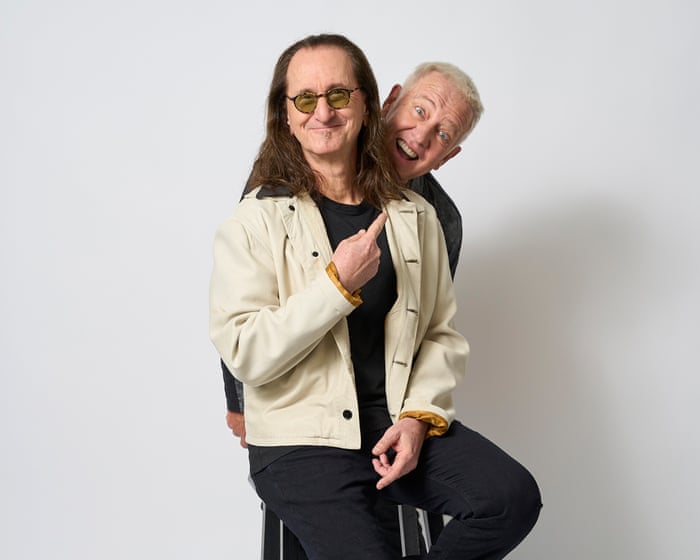
The two men on the sofa, Rush’s Geddy Lee and Alex Lifeson, have known each other for 60 years now. “When we first met in junior high school, we sat beside each other, and we laughed,” says Lee, who is a month older. “He’s the funniest guy I’ve ever known, and I make him laugh, too.” Lifeson, who has been gazing happily at his friend, nods vigorously. “Yeah!” The two gently tease each other and speak with such happy admiration that I feel a warmth from the very start. “Everybody wants to have a bestie like this guy!” Lee says at one point, beaming.
They’re only in this posh London hotel suite because they enjoy each other’s company so much. Lifeson came to Europe for some health checks, and Lee decided to join him. Once here, they thought they might as well talk to some journalists about Rush’s upcoming R50 reunion tour, and the decision to add 24 European and South American shows to the 58 arena dates already announced for North America (they’ll play the UK in March 2027). The interviews were meant to be separate, but they decided it would be more fun to speak together. Honestly, if you ever want to see a model for male friendship, spend time with Rush and feel refreshed.
Their friendship is the reason Rush exists again. The pair had declared they were done following the death of their drummer, Neil Peart, in January 2020, ending a band that had created a unique fusion of prog and hard rock in the 70s and evolved for decades, racking up 14 platinum-selling albums in the US without its members ever falling out. They reformed not because they missed Rush, but because they missed playing together as friends. “It goes back before the origins of the band,” Lifeson says. “When we were in junior high, we would get together and play. Music was what drove us as buddies.”
The decision to become Rush again was born out of jamming, Lee says. “We got sidetracked and started playing Rush songs. When one jam petered out, one of us said, ‘Why don’t we play this song? Can we remember it?’ So we did. And… we couldn’t.”
“We were so bad,” Lifeson adds.
Playing two tribute concerts for the late Foo Fighters drummer, Taylor Hawkins, in 2022 gave them a shot of adrenaline, and they made provisional plans before Lifeson got cold feet and backed out. When the idea of Rush came up again, Lee says, “I told Al: ‘Look, we’re either doing this or we’re not doing it. I can’t talk about it every two years. Because time marches on and I don’t know how much time we have. So if we’re going to do it, we do it now. If we don’t, fine, let’s just not talk about it.'”
Lifeson: “True story.”
There remained one problem: the drum stool. Peart wasn’t just a notable drummer; he was perhaps the most distinctive and technically adept rock drummer of his and most other generations. He was many fans’ favorite member of Rush. And he wrote the lyrics. Lee and Lifeson nod when I suggest that replacing him is a little like telling a young ball player he’s in for Babe Ruth.
“Go out there and take a swing, kid!” Lifeson says, laughing.
The drummer they have chosen is 42-year-old Anika Nilles from Germany. Lee’s bass tech recommended her after working on a Jeff Beck tour she played on. After a video call, she came to Canada last March for a week of auditions.
Usually, when a band recruits a new member, they talk enthusiastically…The group is enthusiastic about the fresh feel that has allowed them to shake up the songs. Did Rush want someone to do that, or someone to just copy Neil Peart’s parts exactly?
“It has to start there,” says Lifeson. “They have to be true to the arrangements because that’s what the fans expect. But we don’t place any restrictions on her. Once she’s comfortable and confident with the arrangements, she’s free to enhance them with her own spirit.”
“And she will,” adds Lee. “But honestly, I don’t think we knew what our expectations were when she arrived. When we started playing with her, something felt off. I thought, ‘This isn’t going to work.’ Those seemingly impossible fills weren’t a problem for her at all. What was difficult was understanding a relationship between the snare, bass drum, and hi-hat that’s different from her training.
“The first four days were up and down. She was nervous and jetlagged, and we were unsure. We had a little chat before the last day—‘I don’t know, Al, is this going to work?’ We talked about all the things we liked about her: her work ethic, her kindness, her deep knowledge and technical ability. There were a lot of positives, so we decided not to be hasty. We went into that last day, and she just fucking nailed it.”
“She suddenly understood what we’d been talking about all week,” Lifeson says. “Not the technical aspect, but the stuff in between the big stuff—the internal dynamics that Neil was so amazing at, the things only another drummer can really understand. It just clicked for her.”
She might have all the chops in the world, but she still has to fit in with friends who have known each other since childhood. Right up until the end, Lee and Lifeson referred to Peart, who joined Rush in 1974, as “the new guy.”
“Yeah, we excluded Neil like that for years,” Lee admits. “But he wanted in—he wanted to prove he could be as goofy as we were, and he was very funny. He sort of barged his way into our friendship, and it worked. Anika is very quiet, and she’s sliding into our friendship in her own way.”
Rush, as the world came to know them, truly began when Peart replaced John Rutsey on drums and took over the lyrics. On their debut with Rutsey, they were a sub-Led Zeppelin heavy blues rock band. But Lee and Lifeson had become obsessed with emulating their prog heroes like Yes and Genesis and needed a drummer who could match their ambitions—that was Peart.
“We wanted to play like bands like that,” Lee says. “We wanted to be that precise, as grandiose as they were, as conceptual. We were carried away by those records, and we wanted in.” That led to a grand series of albums—Caress of Steel, the career-defining 2112, A Farewell to Kings, and Hemispheres—filled with multi-part suites and lyrics straight off the fantasy shelves (“By-Tor and the Snow Dog was a joke!” Lee insists, pushing back on the idea their humor didn’t come through in their music). They were the band that inspired legions of 14-year-old boys to buy Ayn Rand books, and for whom no solo could be too intricate: their instrumental “La Villa Strangiato” was so complex they couldn’t play it straight through in the studio. (Its subtitle: An Exercise in Self-Indulgence.)
As the ’70s turned into the ’80s, synths and smoother textures entered their music—at Lee’s urging—and Peart’s lyrics shifted from the mythical to the personal and human, in songs like the hit “Subdivisions,” about the loneliness of suburban teens. Did it become easier for Lee to relate to the lyrics as they became more human?
“Yes and no. There were times when it was too personal and uncomfortable for me.”I was the one who always pushed for universal themes in our lyrics. After we returned with Vapor Trails—Rush’s first album following the tragic losses in Neil Peart’s life—there were moments that felt very confessional. It was almost too personal for me, and I had to step into the role of the audience and say, “Look, I don’t want to change what you’re trying to express, but let me in a little so it’s not just about your own experience.” That was a difficult conversation to have.
Our friendship is what allowed Rush to navigate challenges that might have broken other bands. By the late ’80s, Alex Lifeson was completely frustrated with his diminishing role as a guitarist in the band. The solution was straightforward: we accommodated him. We returned to being a guitar-driven band, even though it meant moving away from Geddy Lee’s favorite era of Rush and into his least favorite.
In the mid-2000s, Neil Peart decided to completely reinvent his drumming style, taking lessons from jazz drummer Freddie Gruber. That was what he wanted, so we adapted. “It was uncomfortable at first,” Lee admits, “because we just wanted him to flip the sticks and start pounding away. But he was determined not to revert, so we had to adjust our feel. As a bass player, I found it interesting—he developed a rounder, swinging groove. That openness to change was always part of who we were as a band. To resist it would have gone against our nature.”
This shift created new challenges, especially on tour, where Peart had to juggle one set of songs played in his new style and another that required a completely different technique. “I think that’s what ultimately made him such an incredible drummer,” Lee reflects. “He became more ferocious, yet he could swing on a dime.”
When they speak about Peart, it’s not with rose-tinted nostalgia—though Lee, in particular, sometimes slips into the present tense (“how Neil plays…”). The loss runs deep. “I just miss him,” Lee says. “I can’t pinpoint one thing.”
“His laugh,” Lifeson adds.
“Or when he’d call your bluff with an ‘Oh, come on!’” Lee continues. “He was a mentor to me in many ways—a really stimulating person to be around.” He then laughs and glances at Lifeson. “And I loved how Neil would punch him so hard in the shoulder. Or he’d just look at me and say, ‘Hit him!’”
In the end, it all comes down to love—not only the bond between the band members, but also the love from their audience. They’ve noticed a surge in affection since the 2010 documentary Rush: Beyond the Lighted Stage. Lifeson believes people respect their work ethic; Lee thinks fans admire Rush’s unapologetic nerdiness.
I suggest it might be simpler: people are deeply moved by their friendship. Lifeson nods in agreement. Lee adds, “Whenever I post about him on Instagram, or he posts about me, the response is overwhelming. People really love it.”
Their biggest difference lies in how they express emotions.
“He’s really emotional,” Lee says of Lifeson.
“I am,” Lifeson admits. “Too emotional.”
“He can go from zero to a hundred over what seems like an innocent remark,” Lee explains. “I’ll have to say, ‘Al, calm down. That’s not what we’re talking about.’”
“That helps,” Lifeson acknowledges.
“He can really explode—a true Serbian,” Lee says, referring to Lifeson’s heritage. “The only thing that calms him down is to go eat some pork somewhere. And I’m probably too controlling for him.”
“Yeah.”
“And too rational.”
“Yeah, yeah.”Even after 60 years, if they and their wives of 50 years are invited to dinner, it’s best if the hosts don’t seat Lee and Lifeson together, because no one else will hold their interest. They’ll sit with their heads close, lost in their own private conversation. Lee turns to Lifeson. “We did that at Tim’s one night. They had planned this lovely dinner party, and we just ended up alienating everyone.” Lifeson nods like a big, happy Labrador. “That happens a lot!”
Rush’s US tour begins on June 7 at the Kia Forum in Los Angeles. Their South American tour starts on January 15, 2027, at the Movistar Arena in Buenos Aires. Their European tour kicks off on February 19, 2027, at La Défense Arena in Paris, with UK dates in Glasgow, Manchester, and London. Details: rush.com/new-rush-2027-tour.
Frequently Asked Questions
Of course Here is a list of FAQs about the highly anticipated rock reunion and the famous bromance at its center written in a natural conversational tone
General Beginner Questions
1 Wait which rock reunion is everyone talking about
This likely refers to the massive buzz around Rage Against the Machine reuniting for a tour after a decade apart The bromance specifically highlights the iconic friendship between guitarist Tom Morello and bassist Tim Commerford
2 What exactly is the bromance part
Its the deep longstanding friendship and intense musical chemistry between two key band membersoften Tom Morello and Tim Commerford Their loyalty onstage synergy and decades of shared history create a compelling brotherly narrative fans love
3 Why is this reunion such a big deal
The band has been inactive for long periods and their music is more relevant than ever Fans have waited years for a chance to see their explosive politically charged live show again Reunions like this are rare and feel like a historic event
4 Are they releasing new music or just touring
Primarily touring While theres always hope for new material the initial excitement is around experiencing their legendary catalog live again The tour itself is the main event
Advanced FanFocused Questions
5 What makes their friendship so special compared to other bands
Its survived breakups side projects and the pressures of fame for over 30 years Their bond is rooted in shared political ideology a unique musical vision and a welldocumented mutual respect that feels authentic not manufactured
6 Havent they reunited before Whats different this time
Yes theyve had reunion tours in the past This one feels particularly significant because of the extended hiatus and the current global social and political climate which mirrors the era when their music first exploded
7 What are some iconic bromance moments fans talk about
Their synchronized intense stage presence and sidebyside performance style
Interviews where they finish each others sentences about music and politics