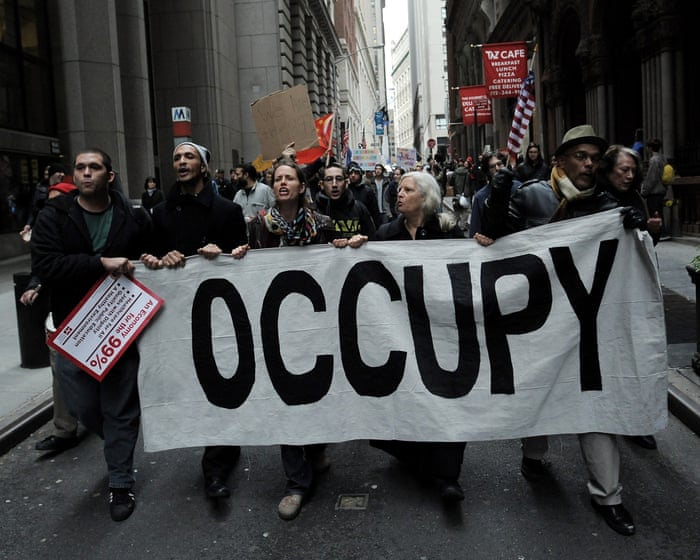
Yotam Marom knows why the Occupy Wall Street movement fell apart 15 years ago. The New York-based organizer and author was a key participant in the nationwide network of encampments and rolling protests that brought tens of thousands of people together. But the movement couldn’t withstand police raids, evictions, a harsh winter, and, as Marom sees it, an internal “politics of powerlessness.” This mindset confused a healthy distrust of institutional power with a failure to build a strong, clear strategy for political change. Occupy splintered within a few short months and never really bounced back.
As he explains in his new book, For Louder Days: Reaching Beyond a Politics of Powerlessness, Marom has seen similar patterns weigh down social movements again and again in his work as an organizer and facilitator. He founded the Wildfire Project, a training organization for grassroots groups, and has worked with groups like the Sunrise Movement (fighting climate destruction), the abolitionist Dream Defenders (pushing for racial justice), the Uncommitted movement (aiming to end Democratic party support for Israel’s war crimes), tenants unions battling landlords, and many others.
A lot has also changed for the broader left and its relationship to power since 2011: a Democratic socialist is now mayor of New York City, and a group of serious left-wing candidates are challenging establishment Democrats for congressional seats.
I first met Marom back in the exciting days of Occupy. When we spoke recently, we talked about what movements have learned, what they still need to learn, and why power must be built through movements, not just through elected officials.
We first met at Occupy Wall Street. That was a hugely eye-opening and lesson-filled time for both of us, and many others. Beyond your personal experience, why do you think it might be important to look back on Occupy now?
We’re in a moment where the left is seeing some wins, including winning actual governing power. I think there’s a pretty direct line from Occupy Wall Street to where we are now. There are plenty of ways we fell short, obviously. But Occupy brought thousands of people into the movement, trained hundreds of leaders, and helped start a bunch of different organizations. It also shifted public understanding of class in this country—it introduced the idea of the 99% versus the 1%. It’s hard to see how you get something like Bernie Sanders’s 2016 campaign without that, or this opening for mass socialist politics, with the elections of the Squad, Zohran Mamdani, and a slate of DSA candidates in New York.
Your key takeaway from Occupy, and from a lot of the organizing work you’ve done since, is the idea of the “politics of powerlessness” and how it hurts movements. What is the politics of powerlessness, why is it a problem, and with that in mind, what do you mean by power?
First, when I talk about power, I mean the power to create a society where institutions are focused on meeting people’s material needs and helping them thrive. We want a strong, multiracial working-class movement that can bring about the world we all deserve.
The politics of powerlessness is a set of ideas and behaviors that turn us inward, away from our opponents (the forces of capitalism and state violence) and the public, and instead toward—and often against—each other. It often looks like a fear of leaders within the movement, a narrow and individualistic way of understanding identity (like race and gender) rather than a systemic one, and a sense of belonging that’s meant to protect our spaces and make the people already in them feel good, rather than one that welcomes the millions of people our movements need if we want to win.
I think a lot of that comes from fear of our much more powerful opponents.We’re up against powerful opponents—billionaires, the far-right government, the police—and it’s easy to feel despair about the state of the world. I grew up in a political generation that didn’t really believe left-wing movements could win. When you don’t think you can win, the natural thing is to avoid the risky, difficult work of building power. Instead, you focus on being right, surrounding yourself with like-minded people, and using your differences as weapons against each other. That creates unhealthy movements that most people don’t want to join, and we end up losing.
But I think we’re in a unique moment right now. We’re seeing some organizations push back against that dynamic—especially this electoral insurgency happening across the country, and particularly in New York with Zohran and the DSA slate. They’re basically saying, “No, we want power. We want to govern. We know it’s risky and complicated, but it’s the only way.”
Organizations that take winning seriously do the hard work of crafting good strategy. They get over their hesitation about leadership. They create structures and processes that make huge numbers of people feel like they belong and are part of the project.
But is there a risk of overstating this moment of winning? We’re still living in a world where power is concentrated in the hands of billionaires, the planet is burning, authoritarian rule is spreading, we can’t stop Israel’s ongoing genocide, and brutal border regimes are in place. I could go on.
Absolutely. Here in New York, where I live, we might feel on top of the world—Knicks in five! Zohran and the recent DSA sweep! Our movements are more mature than they were 15 years ago during Occupy. We have more resources at our disposal now, and we’re a bit more practiced at winning and building organizations that want to win. That’s a huge deal.
But of course, we’re only at the beginning of this path. And across the country, a lot of people don’t feel this way at all. The far right controls the federal government, and they’re gutting the institutions that would allow us to replace them. We’re facing the ticking time bomb of climate change. We’re up against some of the most powerful people who have ever lived, running some of the most violent institutions humans have ever created. We have a very long road ahead.
When movements face serious barriers and real losses, we often feel tempted to shrink—to narrow the playing field so we can feel powerful in our tiny corner instead of powerless in the big, wide world. I think that could happen here in New York, too.
In your book, you describe a specific moment during an organizing retreat with the organization CAAAV (Committee Against Anti-Asian Violence), and how the group shifted toward building a strong strategy, and how difficult that can be.
The book is full of stories, and one of my favorites is about CAAAV, a New York City community organization that organizes Chinese and Bengali tenants in Manhattan’s Chinatown and in Queens.
Years ago, during a strategy retreat, they faced a tough decision: keep doing what they were doing—comfortable, familiar, and righteous—or prioritize some things over others, even though it was painful. Against enormous pressure to maintain the status quo, they decided to shut down a chunk of their organizing in Queens and refocus the people, time, and money they had been spending on a particular campaign in Chinatown. If they hadn’t, they probably would have lost that campaign. But it was heartbreaking. It meant going back to the housing projects in Queens and saying, “We’re closing this campaign down. It’s not winnable, and we’re not going to organize this building anymore.” It also meant that some staff members hired for that work could lose their jobs.Jobs were at stake, but there was a powerful moment when they faced the reality. In fact, a young woman who was at risk of losing her job said very bravely, “No, we have to do this. We have to make this choice.”
Years later, we can see that the choices they made led to their sister organization, CAAAV Voice, becoming one of the early supporters of Mamdani, and then playing a key role in organizing a Chinese and Bengali base for his victory. But none of them knew at the time that this would be the outcome. What mattered then was telling the truth, being willing to disagree with each other, and accepting some losses. That’s what leads to good strategy. It’s what creates organizations healthy enough to carry it out. And it’s also what leads to real change.
Theorists like Anton Jäger have criticized the last 15 years of leftist movements and uprisings for failing to turn this work into mass politics and strong left-wing parties. What kind of structures—institutions, infrastructures—does the left need to gain power, in your view?
Just as we won’t achieve real, meaningful social change by jumping from one big movement moment to the next, we also won’t get it by jumping from one election to the next. That’s not going to happen.
I also dream of “the big party,” but I don’t feel qualified to say exactly what form it should take. What would be wise is to ask, “What would the big party be made of?” We should build those institutions and capacities with or without an overarching structure.
It would consist of the ability to mount an electoral challenge and govern. It would include the capacity to wage campaigns against a boss or a landlord and win concessions. It would provide space to welcome people in, educate them politically, help them meet each other, and build good, healthy social relationships. It would offer a compelling vision for this society. And it would foster a relationship between these different elements—especially the non-electoral power-building part of the movement and the electoral one—so that they truly support each other.
Yotam Marom is an organizer, facilitator, and writer based in Brooklyn, New York, with over 20 years of involvement in movements and experience in facilitation, strategic planning, group dynamics, and conflict work.
Natasha Lennard is a columnist for the Intercept and a professor of critical journalism at The New School in New York City. Her work has appeared in the Nation, Bookforum, Dissent, and the New York Times, among others. She is the author of Being Numerous: Essays on Non-Fascist Life and the forthcoming On Un/Certainty.
Frequently Asked Questions
Here is a list of FAQs about how the Occupy movement influenced the shift from Bernie Sanders to Mahmood Mamdanis political thought in American politics
BeginnerLevel Questions
1 What exactly was the Occupy movement
Occupy Wall Street was a 2011 protest against economic inequality corporate greed and the influence of big money in politics Its famous slogan was We are the 99
2 Who is Bernie Sanders and how does he connect to Occupy
Bernie Sanders is a US Senator and former presidential candidate He took the core Occupy messagefighting for the working class against the billionaire classand turned it into a mainstream political platform
3 Who is Mahmood Mamdani and why is he mentioned here
Mahmood Mamdani is a scholar who studies colonialism revolution and political violence In this context he represents a shift from just talking about US economic inequality to asking deeper questions about how power works globally especially in nonWestern countries
4 Did Occupy actually change American politics
Yes but indirectly It made income inequality a household phrase It paved the way for Bernie Sanders 2016 campaign and pushed the Democratic Party leftward on issues like student debt and healthcare
5 What is the shift from Bernie to Mamdani
Its a move from focusing on domestic economic fairness to analyzing how US foreign policy colonialism and global power structures create injustice Occupy sparked this curiosity about how power works everywhere
IntermediateLevel Questions
6 How did Occupy change the way people talk about the 1
Before Occupy most Americans didnt talk about the top 1 as a political group After Occupy it became common to blame Wall Street and billionaires for problems like the housing crash wage stagnation and political corruption
7 Why do people say Occupy failed but Sanders succeeded
Occupy didnt have clear leaders or a specific policy list Sanders took the same energy and created concrete bills and a presidential campaign He showed that the Occupy message could win millions of votes