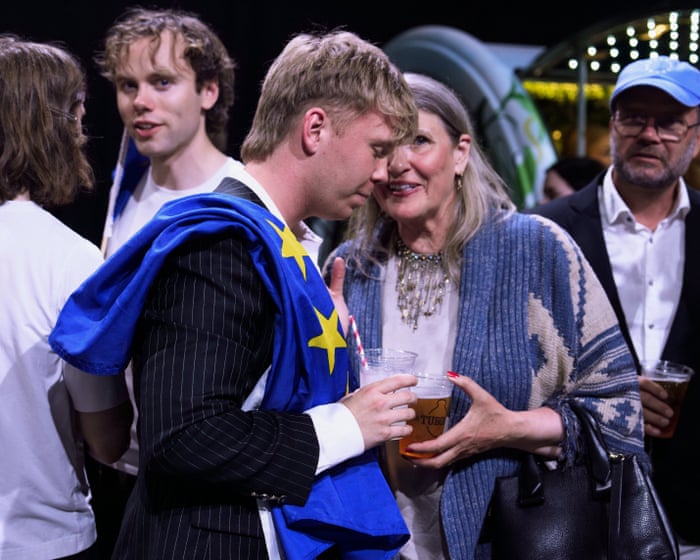
Voters in Iceland have rejected the government’s proposal to begin accession talks with the European Union, following a closely fought campaign that has divided the nation.
After a tense night for both sides, the “no” camp secured 52.8% of the vote, while the “yes” camp received 47.2%. Voter turnout was high at 82.5%.
Once the final results were announced on Sunday morning, the Icelandic government said it would hold a press conference at 1pm local time to “review the results of the referendum.”
The outcome is a setback for Brussels, which had hoped to welcome a wealthy new member and had seemed willing to compromise with Iceland on difficult issues to ease its path to membership. It quickly drew reactions from anti-EU leaders across Europe.
The government in Reykjavík had framed the membership plan as a “now or never” moment, and Prime Minister Kristrún Frostadóttir told voters in August that a “no” vote would put an end to EU speculation.
On Sunday, she told the public broadcaster RUV that she hoped the result would not leave the nation divided.
Kristrún, who campaigned for a “yes” vote at public meetings across the country in the final weeks, said: “I don’t experience this as hurt. I know some people have been in a state of shock, but now I’ve sat with a large group of people across the country and people are completely open to different outcomes.”
She acknowledged that many Icelanders, especially those in rural areas, had worries about how EU membership might affect agriculture, fisheries, and natural resources.
“I promise that we will handle these issues well and keep these concerns in mind,” she said.
Supporters of joining the EU argued that membership could lower high interest rates and provide more security in a world shaken by the war in Ukraine and US President Donald Trump’s comments about annexing Greenland, another Arctic island.
But those against membership said it would threaten Iceland’s sovereignty and its fishing waters. Their victory was celebrated on Sunday by French far-right leader Marine Le Pen.
“At a time when some are pushing for greater federalism and the transfer of sovereignty to the European Commission, this vote reminds us that another Europe is possible, a Europe of free, sovereign nations cooperating voluntarily on matters of common interest,” Le Pen wrote on X.
Nigel Farage, leader of Reform UK, also posted on X: “Congratulations to Iceland on voting to keep their independence.”
Iceland first applied to join the EU in 2009, after a financial crisis hit its small, exposed economy. A Eurosceptic government ended the talks in 2013.
The current government had promised to hold a referendum when it took office, but it ended up happening much earlier than expected.
Geopolitical tensions over Greenland, conflict in the Middle East, and US import tariffs brought urgency to an issue Icelanders had debated on and off for decades.
Hulda Þórisdóttir, a politics professor at the University of Iceland, said she was not surprised by the results, given the tone of the later campaign, which saw misinformation spread and the “no” campaign with significantly more financial backing.
“No won due to a combination of factors: a strong feeling that the EEA [European Economic Area] is all we need, a sense of Icelandic exceptionalism, economic self-interest and a lot of misinformation among the least engaged, for example ‘I don’t want my son to have to join the EU army,'” said Hulda. “But, very importantly, it seems clear to me that the no campaign was much, much better funded.”
Reuters and Agence France-Presse contributed to this story.
Frequently Asked Questions
Here is a list of FAQs about Icelands referendum against starting EU membership talks written in a natural and accessible tone
BeginnerLevel Questions
1 So did Iceland vote to leave the EU
No Iceland is not a member of the EU The referendum was about whether to start negotiations to potentially join The No vote means they will not begin those talks right now
2 Wait I thought Iceland was in Europe Why arent they in the EU
They are geographically in Europe and part of the European Economic Area That means they have access to the EUs single market for goods services and people but they are not a full political member They make their own laws regarding fishing agriculture and trade policy with nonEU countries
3 What was the main reason people voted No
The biggest issue by far was fishing Icelands economy relies heavily on its fishing industry and many people feared that joining the EU would mean giving up control of their fishing waters and quotas to Brussels They were worried it would ruin their main source of wealth
4 Did this vote mean Iceland is now closed off to Europe
Not at all They are still in the Schengen Area and the EEA They still trade and cooperate with the EU they just arent seeking full membership
5 Why did they even have a referendum
Iceland experienced a massive financial crash in 2008 Many citizens felt the EU might offer more stability and a stronger currency to protect them from future economic disasters The government decided to ask the people what they wanted to do
AdvancedLevel Questions
6 What is the difference between the EEA and full EU membership
The EEA gives Iceland access to the single market but requires them to adopt many EU regulations without having a seat at the table to vote on them Full membership would give them voting rights in the EU Parliament and Council but it would also require them to join the Common Fisheries Policy and the Common Agricultural Policy which are very unpopular in Iceland
7 How did this referendum affect Icelands relationship with the EU
It essentially froze the application process The EU has said it respects the result but the previous application was never formally withdrawn This leaves the relationship in a state of limbo