Théodore Abitbol describes himself as a “militant antifascist.” He holds degrees in political science and comparative literature, and his bookshelf ranges from bell hooks’ gender and queer theory to Marxist theorist Mike Davis’s anti-capitalist social analysis. The 34-year-old is a regular at pro-Palestine protests and has spent a decade as a full-time activist: unions, strikes, protests, civil disobedience, and large protest encampments used to block construction projects, known in France as ZAD (zone à défendre).
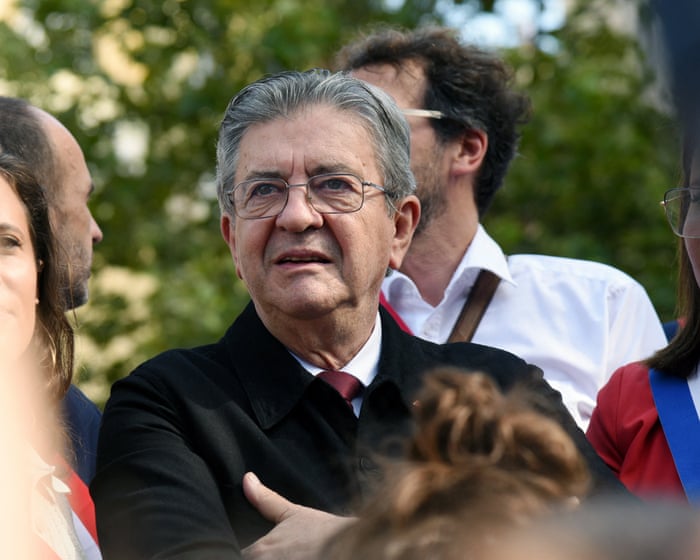
Abitbol should be a guaranteed vote for Jean-Luc Mélenchon, leader of La France Insoumise (LFI), a longtime figure in hard-left French politics and a 2027 presidential candidate who draws significant support from voters under 35. After all, LFI is doing something necessary by focusing on some of France’s most neglected urban areas and giving voters there a voice: Bally Bagayoko faced down racist abuse to win the mayoral race in Paris’s inner banlieue of Saint-Denis. David Guiraud defeated the right for the first time since 1983 in Roubaix, one of France’s poorest large cities. The party’s success in these heavily working-class and minority areas comes from its willingness to redraw the lines around old identity debates and its uncompromising anti-capitalist stance. LFI parliamentarians like Clémence Guetté are actually making innovative and radical proposals, such as recognizing close friendships and extending legal rights to them.
Yet Abitbol illustrates the single biggest voter faultline between two incompatible French lefts: Mélenchon himself. I mainly remember Abitbol, an acquaintance from my immediate post-student days, as being staunchly opposed to Macron’s economic policies. That hasn’t changed. But he also can’t bring himself to vote for Mélenchon, he confided when I reached out to him recently, because of the LFI leader’s positions on Russia, Ukraine, and the EU. “Part of the [French] left retains a cold-war mentality where Russia is an ally against American imperialism, without seeing that Putin and Trump agree on almost everything in their foreign and domestic policies,” he told me.
I don’t believe Abitbol is alone. They might not admit it as openly, but I think there are millions of French voters who also want the kind of break with capitalism and the status quo that Mélenchon is proposing, but have no desire to go where he would take France on foreign and European policy. French presidential elections rarely hinge on discussions of France’s place in the world. But the threat Russia poses to Europe has already dominated the opening days of the 2027 campaign, including a special primetime TV interview with Macron. Mélenchon consistently polls at around 17%, enough to qualify for the second round of the presidential election. The combined non-Mélenchon left, split between the Ecologists, Socialist party, and Communist party, just trails him, with Raphaël Glucksmann leading a divided field with around 10% of a first-round vote. But polling also shows that Marine Le Pen would defeat Mélenchon 69% to 31% in a second-round runoff.
If the divided and fractured French left gets this wrong, it could leave millions of pro-European voters in an impossible position, and ultimately put Le Pen in power.
The term “zombie lie” is a good way to describe much of Russia’s propaganda about Ukraine. That NATO provoked the 2022 invasion by “expanding”; that Ukraine was full of neo-Nazis; that Ukraine was developing chemical weapons in secret NATO labs; that Russia—Ukraine’s former colonizer—has legitimate claims to parts of its territory anyway.
Since the mid-2010s, Mélenchon has consistently advanced many of these claims. In 2014, Mélenchon denounced the Maidan Revolution—when young Ukrainians filled the streets of Kyiv to demand a European future—saying that Russia would have to defend itseHe was against “an adventurous putschist regime in which neo-Nazis wield a thoroughly reprehensible influence.” When Putin annexed Crimea shortly after Maidan, Mélenchon defended it by claiming that “Crimea has always been Russian.” He didn’t stop there. In 2015, in response to Putin’s aggression, France cancelled the sale of two advanced “Mistral-class” helicopter carriers – both are now part of the French Mediterranean fleet based in Toulon. Mélenchon joined Marine Le Pen in decrying the cancellation as the “vassalisation of France to Nato’s bellicose rhetoric,” and accused the then president, François Hollande, of “unbearable betrayal” for having “devalued the worth of France’s word” by refusing to deliver the warships. That is when Mélenchon lost Abitbol and others like him. “It’s easier [for Mélenchon] to grasp at phantoms than it is to face the reality that Russia is waging a hybrid war on us, and that tomorrow it will be a ‘classic’ war,” he says. Mélenchon filled the next seven years alternately invoking international law to condemn the US’s unilateral action in Syria, and dispensing with the same international law when it came to defending or minimising Russia’s unilateral action and war crimes in Syria – which killed, by moderately conservative estimates, 20,000 civilians. All while denying Russia’s former Soviet colonies their right – under international law – to freely choose their alliances by joining Nato. Accepting Georgia’s request for membership would be, he said, an “offensive and stupid provocation.” As for Estonia, Lithuania and Latvia (EU and Nato members since 2004, and some of Ukraine’s largest donors by GDP), Mélenchon’s dismissals have been scathing. “I feel nothing in common with them, it’s the end of the world, even the Romans never made it that far!” he said in 2017. Mélenchon seems uninterested in examining why there would have been such huge interest among Russia’s immediate neighbours in joining a defensive military alliance. Apparently, in Mélenchon’s mind, it couldn’t possibly be because they had just been occupied by an aggressive and territorially expansionist petro-oligarchy – it’s because the US, and to a lesser extent western Europe, are the only ones with agency. It’s little surprise, then, that Putin’s 2022 invasion of Ukraine did nothing to rock Mélenchon’s fixed position. Ukraine was “without a doubt” the aggressor, he claimed, whereas Russia felt “humiliated, threatened, aggressed” by the US’s decision “to annex Ukraine into Nato.” (The invasion, of course, hastened Sweden and Finland’s sovereign decisions to join.) In the four years since Putin’s war, Mélenchon’s personal blog and media appearances have been a grab-bag of the same type of ideas that Xenia Federova, former director of RT France, spewed on the rightwing news network CNews – until France issued an expulsion order and froze her assets. These included bringing Russia “back into the fold” and re-opening the Nord Stream gas pipelines; castigating Zelenskyy as “president of nothing” while promoting the Kremlin’s narrative about his lack of political legitimacy; and haranguing other Europeans for having “demonised Putin.” skip past newsletter promotion Sign up to This is Europe Free newsletter Weekly The most pressing stories and debates for Europeans – from identity to economics to the environment Enter your email Sign up after newsletter promotion Making common cause with “the enemy of my enemy” – whatever the consequences for the less powerful – as a shortsighted form of “realist” foreign policy is certainly nothing new. (Neither, in Mélenchon’s case, does it end at Europe’s borders: “Taiwan is China,” he told French TV in May). But howIs any of this principled, or leftist? After a summer when France burned and burned and burned, how is the frontrunner for the left a man who is calling for reopening the poison-drip of natural gas from a state that has been, for years, waging an undeclared hybrid war on France along with the rest of Europe? It seems Mélenchon, who has wanted to withdraw France from NATO for decades, has not updated his worldview since 1985 when he first held public office. But this is not the anti-American position it once was: it is simply to attack from the inside what Putin seeks to dismantle from the outside.
Mélenchon is not trying to hide his Eurosceptic ideas any more than he has tried to hide his positions on Ukraine. What he loudly said during the first presidential debate, in late August, is also in his programme: he will “assume confrontation with European institutions” and “disobey” EU rules “whenever necessary.”
This is not the way to lead and change an EU that, while imperfect, remains among France’s greatest foreign policy achievements. This is the way to destroy from within the best framework for tackling every modern challenge that transcends borders, from the climate crisis to inequality.
If the new guiding philosophy is that France can decide to “disobey” whenever it sees fit, so can everyone else. How do we imagine the EU maintaining its emissions trading scheme, and the carbon border tax meant to protect it? How will these – or any other European-level policies – survive if, as Mark Carney might say, a member state’s word becomes something “written in pencil”?
The short answer is: they won’t. The EU will enter an institutional death cycle, of which a deteriorating US is only slowly becoming aware. This is what Europe’s far-right nationalists want. Is it what Mélenchon supporters want?
Mélenchon makes no secret of his desire for France to lead some non-aligned coalition of states geographically more remote, with even less coherent common interests than the existing 27 EU countries. What would all these other potential partners conclude if France were to show that it were ready, in a very Trumpian way, to do the very thing Mélenchon accused Hollande of doing? To walk all over its word, ratified in treaty with its closest neighbours, with whom it has shared a political community that France itself built?
When it comes to foreign and EU policy, Mélenchon is barely distinguishable from Le Pen: a nationalist who believes that France is too small to do anything but close in on itself – and look to Russia for guidance. If the presidential contest comes down to Mélenchon v Le Pen in the final round then Abitbol says he would vote Mélenchon, but “with vomit in my mouth.” Pity him and the others like him who might have to choose between two equally disastrous visions of France in Europe and the world.
Alexander Hurst writes for Guardian Europe from Paris. His memoir Generation Desperation is out now
Do you have an opinion on the issues raised in this article? If you would like to submit a response of up to 300 words by email to be considered for publication in our letters section, please click here.
Frequently Asked Questions
FAQs Mélenchon Young French Voters and His Russia Blind Spot
Who is JeanLuc Mélenchon
A veteran French leftwing politician who leads La France Insoumise He finished third in the 2022 presidential election and remains a major figure on the French left
Why does he appeal to young French voters
He promises bold policies they care about lower retirement age higher minimum wage climate action and a strong stance against the far right Many young voters see him as the most energetic antiestablishment voice
What is his blind spot on Russia
Critics say he has repeatedly downplayed or excused Russian aggressionopposing NATO expansion resisting arms deliveries to Ukraine and calling for negotiations instead of confrontation He has also echoed Kremlinfriendly narratives about the war
Why would young voters turn away from him over this
Young French voters tend to support Ukraine and view Russia as the aggressor Once they learn about Mélenchons Russia stance many see it as a dealbreaker that clashes with their values
What does blind spot mean here
It means an area where someone consistently fails to see a problem others clearly seein this case Mélenchons reluctance to firmly condemn Russia
Is Mélenchon actually proRussia
He denies it and says he wants peace and diplomacy But his refusal to call Russias invasion clearly and his opposition to arming Ukraine make many analysts and voters doubt that
Why does NATO keep coming up
Mélenchon argues NATO expansion provoked Russia Most Western analysts reject that framing saying it shifts blame from Putins decision to invade
What do young voters think about Ukraine
Surveys show younger French voters are more supportive of Ukraine and skeptical of Russia than older generations They see it as a fight for democracy and sovereignty
When did this become a problem for him
It intensified after Russias fullscale invasion of Ukraine in 2022 when his calls for peace talks instead of weapons drew sharp criticismeven from allies on the left
Does this hurt him politically
Yes It splits the left alienates moderate and younger voters and gives opponents an easy attack line soft on Putin
Whats the counterargument from his supporters
They say hes consistent in opposing war that diplomacy matters