The night before the biggest day of their lives, the Spain players who were about to win the 2010 World Cup gathered at the Da Vinci Hotel in Sandton, just north of Johannesburg. They drank hot chocolate, ate chocolate croissants, and talked. Sixteen years later, the night before the biggest day of their lives, the Spain players hoping to match their achievement will gather at the MC Montclair in New Jersey and talk too—but this time, there won’t be any chocolate. Some traditions aren’t meant to be repeated.
“I think the nutritionists put a stop to that one!” says Mikel Merino, hopping off the bus, freshly warmed up for the final, and heading into a tactics room at the Melanie Lane training ground, where Spain’s second-to-last day of preparation is about to begin. “We used to have Cola Cao and pastries in the under-19s and under-21s, copying the senior team, but not anymore. Everyone has their own routine, but the main thing is to keep it normal: just another game, something we know how to do, something we’ve been doing since we were five years old and that we love. Treat it as something to enjoy, another day in our lives.”
In this star-powered World Cup, Spain show the value of collective effort and control | Sid Lowe
Read more
Some day. Some year too. “Spectacular,” Merino calls it. “Just the other day we were talking about this: if you had given me the chance, I would have signed up for this—going through the tough moments to have a year like this is incredible. The experiences I’ve been through, and my family too.” A Premier League title, a Champions League final, the birth of his first child, and a World Cup final. And the injury that nearly took it all away. “I’m living every moment with incredible joy,” he says. “Think about where I was a few months ago and where I am now. I appreciate it all the more.”
Spain’s coach, Luis de la Fuente, told Merino he would wait for him, but the stress fracture in his foot was hard to diagnose at first. “When they told me about my injury, I didn’t think I’d be at the World Cup,” admits the 30-year-old. Merino had surgery at the end of January, which actually came as a relief because it meant there was finally clarity—at least they were doing something. He spent two months on crutches. Then he got to work: hard.
Some days he spent alone, other days his wife helped him with lifting and carrying, which he says was backwards—she was pregnant, but showed a strength without which he wouldn’t have made it. He learned that he was strong too, stronger than he ever imagined. Still, he played just 28 minutes between January and the World Cup, flying off and leaving his newborn son, Marco, behind. “Just being here is a victory for me,” he says. “God willing, we can win it.”
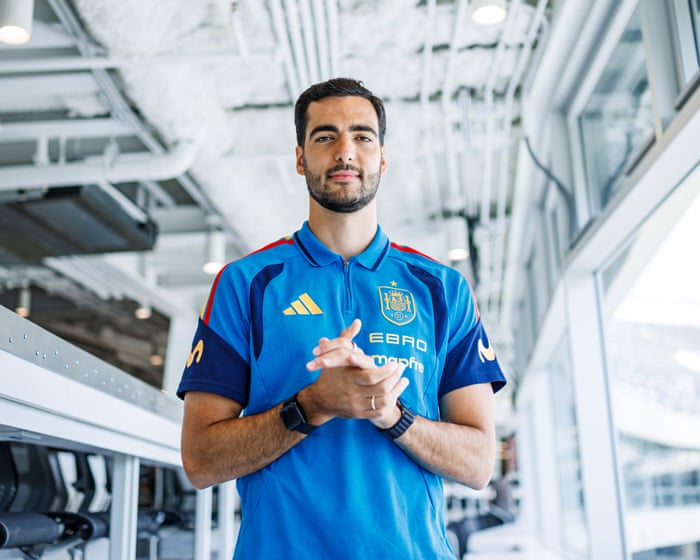
View image in fullscreen
‘Just being here is a victory for me,’ says Mikel Merino. Photograph: Pablo Garcia/The Guardian
That Spain can still win, that they’ve made it this far, owes a lot to him—more than just a super sub. Like Lautaro Martínez, on the opposite side in the final, Merino has been a savior from the bench. “Not even in my wildest dreams did I imagine this,” he says, and yet he sort of did: this is what he prepares for, what he does. He doesn’t just sit there, and he certainly doesn’t sulk; he studies.
At Euro 2024, coming on as a substitute against Germany in Stuttgart, Merino scored the 119th-minute goal that took Spain into the semi-finals. Here, he scored the 91st-minute goal against Portugal that took Spain into the quarter-finals. There was only one problem: his wife and son weren’t there in Dallas. So four days later in Los Angeles, when they were, he did it again against Belgium. The clock showed 85 minutes and 32 seconds when he came on; it read 87:27 when he scored the winner. He had just two touches: almost as important as the goal itself was the alertness to set the ball rolling in the first place.
Mikel Merino comes full circle with Spain in a touching tale of fatherhoodSons and Sons | Sid Lowe
All three goals were celebrated the same way, and now that celebration is famous. Merino ran around the corner flag just like his father, Ángel Miguel, did when he scored a late goal for Osasuna in the same Stuttgart stadium 33 years earlier. If he wins the World Cup, can he finally say he’s the better player? “My mum won’t buy that, not even with a World Cup,” he says, laughing. “I’m proud to follow in my dad’s footsteps, to have learned everything I have from him, and I’ll always respect him… even if I get the medal!”
“Coming off the bench isn’t the ideal plan for any player, but when you join a national team as strong as the one I’m on with Lautaro, you value every chance you get and try to help your team whether you play or not. You focus on the present, accept the situation, and see yourself as the one who can make a difference. I fully believe in myself and my ability: every time I step onto the pitch, I think I can have an impact. In the final, I hope anyone from Spain is the hero. The trophy belongs to all of us, not just the 11 players on the field.”
He continues: “It’s important to have ego as a footballer. With all the criticism from outside, you need it. But you also need humility. Players come to the national team because they’re important at their clubs, and they find a new reality. It’s easy to talk about ‘family,’ but when things don’t go well, when they’re tough, that’s when you truly see it. It’s thanks to Luis and the squad he built, focused on being a good person first and then a good footballer. That helps a lot when you spend so much time together. We know each other very well, we know when to joke and when to be quiet; that’s the strength of the group. After 46 or 47 days all together, we’re still…”
View image in fullscreen: Merino’s late goal proved to be the winner for Spain against Portugal in the round of 16. Photograph: Jessica Tobias/AP
There’s a pause, and Merino laughs. Don’t get the wrong idea. “I wouldn’t say we were eager to spend another two months together,” he says, cracking up. “Thank God, we’re almost done now, but yes, we’re a very strong group. That’s why we’re here.” There may be no more hot chocolate or croissants, but some hang out around the PlayStation, others play Mario Kart or chess, and Dani Olmo and Unai Simón compete on the bus to games. Merino is old school, more into the sobremesa: long conversations after meals, no rush to leave the table, “chatting about life, our kids, the future, holidays.”
“I think a couple of them are planning to go away together after the World Cup,” he says. “Which is… impressive… after all this time. I don’t expect to see anyone!”
That sense of togetherness has deep roots, built on respect and over a long time. After the semi-final, De la Fuente said there was a special embrace with some, a moment of nostalgia allowed to creep in: look what we did. His first title was the European Under-19s in 2015, 11 years ago now. In the middle of Spain’s midfield that day were Merino and Rodri. Simón was on the bench. Ten of the current squad have played under De la Fuente at junior level.
“I was talking to the coach about that the other day because it was the anniversary of that tournament,” Merino says. “We were saying, ‘how we’ve changed.’ But the essence is the same: the essence of the coach, of the players who came through. That’s the strength of the group. There are more grey hairs, more wrinkles, more worries, but the humility and commitment remain.
“Luis has had many of us at under-17, under-19, under-21. That’s so important. Not just for him, who knows each and every one of us and knows what we can give, which is a guarantee for a coach. But for the players too: you’ve experienced everything with him, good and bad, and you don’t…”You don’t have to give him anything new, you know? He already knows what you can offer—you don’t need to pull a rabbit out of a hat. He picks you because he knows who you are as a person and as a player. The team knows he has complete faith in them, and he knows the team would give everything for him.”
That’s why, when Spain lost to Scotland early in De la Fuente’s tenure—a loss that, from the outside, seemed like it would cut his time short—there was still belief. Since then, Spain has lost just once in 37 games, and that was on penalties in the Nations League final. They’ve won a Nations League, a European Championship, and now they’re in a World Cup final too.
“Often, it’s more about believing than what you actually see,” Merino says. “We have a really strong group, a generation of players with a high level of talent. We knew there was potential there—we could see things coming together. Even that night in Scotland, when a lot of people wrote us off or thought this generation wouldn’t succeed, we trusted what we were doing. We knew the group was amazing. And look—it paid off. We were proven right.”
So now it’s Spain versus Argentina. Messi versus Lamine. And that photo. “It’s unbelievable,” Merino says. “The first time I saw it, I thought it was AI—that it wasn’t even real. It’s funny how life works sometimes. It creates these special moments that feel like they’re scripted, but it’s just coincidence. It’s incredible that two of the best to ever play the game—hopefully Lamine will be one of them in the future—share a picture like that. It’s from a couple of years ago now, so I think all the jokes have been made around here. But it’s amazing.
“What can I say about Messi? Just look at how he’s playing, how good he is at 39. I don’t know if this will be his last game or his last final. But it’s an incredible challenge to play against him. It’s going to be an intense game—it has to be, it’s a World Cup final. There will be contact, tough battles, but that’s why there’s a referee: to keep it under control. We need to move the ball quickly. The less time it spends with any of us, the less chance they have to foul.”
And then just play, like any other day, like Spain always has. “I remember what it felt like to watch that 2010 generation make history,” Merino says. “You think about that. You think about being a kid back then, watching players who were idols for me and my teammates. You think about how you dreamed of living that moment one day, how watching them motivated you. And then you realize that now you’re the ones representing your country, you’re the ones this new generation of kids is watching—and it’s something magical.”
Frequently Asked Questions
Here is a list of FAQs based on Mikel Merinos quote The priority is being a good person first and then a good footballer
BeginnerLevel Questions
1 What exactly did Mikel Merino say
He said The priority is being a good person first and then a good footballer
2 Why did he say this
He was explaining his personal philosophy on life and sports He believes that character matters more than talent or success on the pitch
3 Does this mean he doesnt care about football
No It means he thinks being a good person is the foundation He believes that if you are a good person you will naturally become a better teammate and player
4 Is this a common idea in sports
Yes many top athletes and coaches say similar things They believe that respect humility and teamwork are just as important as skill
5 Does being a good person make you a better footballer
It can Good people are usually better teammates listen to coaches work hard and handle pressure and failure with grace This often leads to better team performance
Advanced Questions
6 What does being a good person mean in a highpressure competitive environment like professional football
It means having integrity This includes respecting opponents helping younger players being honest with teammates admitting mistakes and not letting ego or success change your character
7 Can a player be a bad person and still be a great footballer
Yes history shows that talented players with poor character can still win games However Merinos quote suggests that longterm success and a healthy team culture depend on good character
8 How does this philosophy affect team dynamics and leadership
It builds trust When players know their teammate is a good person they communicate better support each other during bad games and are less likely to have selfish conflicts It creates a stronger more united team
9 Does this quote apply only to footballers or to everyone
Merino was speaking as a footballer but the principle applies to any profession or life in general Being a good person first is a universal value
10 What are some practical examples of Merino living this quote
He is known for staying after training to help younger players
He rarely complains to referees or gets into