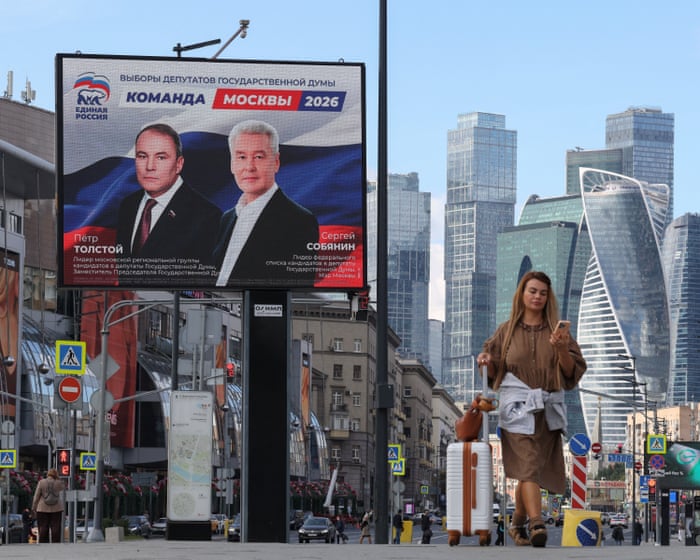
Millions of people will vote in Russia this weekend to choose a new parliament, though the order of events doesn’t matter much. The whole exercise is designed to preserve Vladimir Putin’s control over politics, which means his party, United Russia, will keep its grip on the Duma.
That’s already decided before polls even open, though the exact size of the government’s win won’t be announced until votes are counted. A few seats are set aside for other “systemic parties” that act as Kremlin-approved opposition, propping up the appearance of pluralism. These parties serve as release valves for public frustration and as parliamentary stand-ins when rival factions within the ruling elite want to push Kremlin policy one way or another.
The Kremlin prefers to keep the gap small between United Russia’s official result and a number that would realistically reflect how the public feels about the regime. If the gap is too wide—achieved through too-obvious fraud—it signals insecurity in the Kremlin. Putin’s power doesn’t rest on approval from ordinary Russians, but his authority is sustained by the illusion that he listens and cares. A blatantly stolen election would prove he doesn’t.
Everyone knows the result is rigged, but if the fiction becomes too absurd, it would break a social contract.
This time, making the election look real is harder than usual because of war fatigue. No one can pretend anymore that the “special military operation” in Ukraine has gone according to plan. It was supposed to take weeks and is now in its fifth year. There have been about 1.5 million Russian casualties.
A shortage of volunteers fuels fear that another mobilization of unwilling reservists is coming. Putin has denied that any such draft is needed. The fact that he feels the need to reassure the public at all shows that progress on the front has stalled and the mood at home has worsened.
Ukrainian drone and missile strikes have made the war visible and economically felt thousands of miles from the frontline. State propaganda can’t hide the smoke rising from oil refineries or the lines at gas stations.
There are no accurate opinion polls in an authoritarian state. Russians are reluctant to share their private thoughts with strangers on the phone, especially when criticizing the armed forces is a crime. A more reliable sign of growing dissent is the increasing rate of repression. Last month, Yabloko, a minor liberal party, was barred from the elections on a ridiculous fabricated technicality. The real reason was the party’s campaign slogan—”For peace and freedom.”
Yabloko had previously been tolerated as an irrelevant relic party from the pre-Putin era—not exactly tame, but not threatening either; not worth the risk of turning it into a political martyr. That calculation changed when there were signs that voters were drifting toward the only anti-war banner available. It wasn’t a big movement, but it was enough to convince the authorities that denying the party representation after the vote could be messier than blocking it beforehand.
If banning the opposition lowers turnout, so much the better. The Kremlin seems to have accepted that genuine enthusiasm for the status quo isn’t available. A boring, low-key election that tells a story of submission and stability is the next best thing.
Such is the twisted craft of “managed democracy”—running gangster authoritarianism through a nominally liberal constitution. It requires a mix of performative coercion, tactical concessions, and manufactured consent. The economic rewards of corruption must be spread widely enough to keep the elite quiet. There has to be enough theater of public participation to legitimize the regime. But genuine freedom must also be discredited as a path to chaos.
That’s been an easy line to sell to Russians who remember post-Soviet democratization as a time ofI remember it as the most bitter feature of Russian politics when I lived in Moscow and watched the 1990s experiment with democracy fail. It is the disheartened belief that no politician would ever be driven by a spirit of public service. The only categories are weak and strong, suckers and players. For a nation to succeed, it must be led by a strong player. Constitutions and laws are merely tools for exercising power. The liberal idea that they are sacred as a system for holding governments accountable is the mark of a sucker.
Farage doesn’t put it quite like that. He did tell his party conference last week that an incoming Reform government would declare a “national emergency” to enact a radical agenda within its first 100 days and tolerate no objection from parliament, the courts, or Whitehall. No one can say they weren’t warned.
It isn’t an explicitly anti-democratic agenda, but with populists in opposition, it never is. No one wins elections by promising to cancel future ballots, and as the Russian experience shows, once power is secured, a well-managed vote is a valuable tool for consolidating control.
First comes a process of hollowing out. It is a relentless erosion of trust in independent institutions and a flooding of public debate with corrosive cynicism. It stirs disillusionment and frustration into nihilistic rage against the system, sowing division and amplifying despair to make authoritarian rule sound like release from political paralysis.
Russia was lost down that road long ago. British democracy is thankfully more robust and more culturally embedded. Or so we hope. Resilience is not immunity. The Putin model of corrupt cynicism that dresses authoritarian kleptocracy in a call for national redemption won’t declare its motives in an election campaign. The democratic fightback can’t wait until that election to see how far the poison has spread.
Rafael Behr is a Guardian columnist.
Frequently Asked Questions
Here is a list of FAQs based on the themes and arguments presented in Rafael Behrs article regarding the threat of Putins fake democracy to real democracy
Beginner Questions
1 What is the main point of Rafael Behrs article
The article argues that Vladimir Putins version of democracy in Russia is actually a fake authoritarian system Behr warns that this fake model is a threat because it shows how easy it is to manipulate a countrys politics and fool people into supporting a dictator
2 What does fake democracy mean
A fake democracy is a system where elections happen and people can vote but the results are already decided The government controls the media jails its critics and uses propaganda to make sure the current leader stays in power forever
3 Who is Rafael Behr
Rafael Behr is a British journalist and columnist He writes about politics and current events often focusing on threats to democratic systems in the UK and around the world
4 Why is Putins Russia described as a threat to real democracy
It is a threat because it proves that a leader can stay in power indefinitely by using dirty tricks lies and violence instead of fair elections Behr worries that politicians in real democracies might copy these tactics to hold onto power
5 What is the difference between real democracy and Putins system
In a real democracy the opposition is allowed to criticize the government the media is free to report the truth and if the people are unhappy they can vote the leader out In Putins system the opposition is jailed or killed the media only tells the governments side of the story and voting doesnt change who is in charge
Intermediate Questions
6 How does Putin maintain power if he holds elections
Putin maintains power by controlling the commanding heights of society He uses state television to brainwash the public he jails or poisons his political rivals and he uses police to break up protests The elections are just a show to make it look like he has popular support
7 What is managed democracy
Managed democracy is a term used to describe Russias political system It means the government manages the outcome of elections to ensure the ruling party always wins while still pretending to be a democracy to the outside