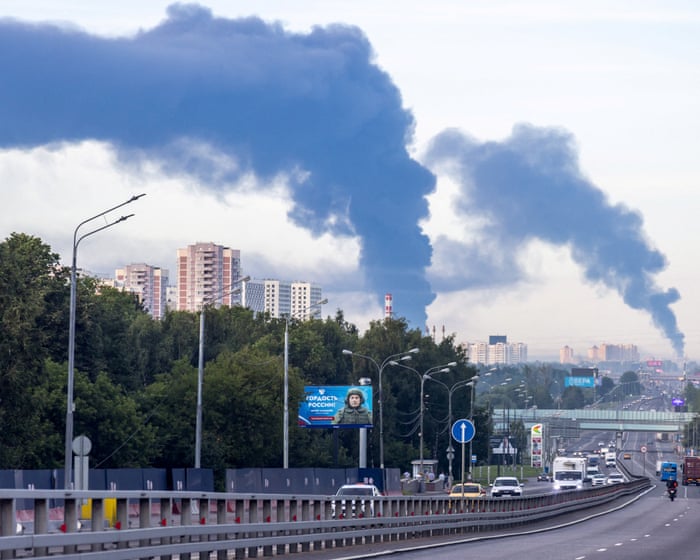
Volodymyr Zelenskyy has warned that Russian airspace is becoming increasingly dangerous for commercial airlines, after Vladimir Putin pledged to intensify strikes on Ukraine’s energy infrastructure ahead of winter. The Ukrainian president said there was no plan to directly threaten civilian flights, but the growing number of attack drones being launched into Russia would need to be “taken into account” by the aviation industry.
“We want to warn every airline that uses Russian airspace, every insurer, and everyone who still relies on Russia’s major airports: Russian airspace is becoming completely unsafe,” he said in a statement.
A sharp increase in Ukraine’s military capabilities over the past few months has enabled its forces to hit targets deep inside Russia. While exact figures on drone launches are hard to verify, Ukraine is already able to deploy several hundred per day, and military sources say the country is aiming for 1,000 drones daily to damage Russia’s economy.
Ukraine’s own airspace has been closed since the full-scale invasion began in February 2022, as Russia can strike anywhere in the country, making airports unsafe for civilians. This year, Ukraine has started bombing oil refineries and warehouses near Moscow and St Petersburg, as well as hitting military and industrial sites more than 2,000km (1,250 miles) from its border.
Concerns about civilian aviation safety in conflict zones remain. In July 2014, a Malaysian Airlines plane was shot down over eastern Ukraine by Russian separatists using a surface-to-air missile launcher, killing all 298 people on board.
Putin dismissed Zelenskyy’s comments as “state terrorism,” saying, “Negotiations are not conducted with terrorists.”
In one of his most detailed updates on the war, the Russian leader told a news conference that Moscow was preparing to ramp up its campaign against Ukraine’s energy facilities this winter, aiming to cut off heating and electricity supplies. “The Russian armed forces have been ordered to prepare and carry out mass strikes on Ukraine’s energy facilities. They are striking us, and they will get a response,” Putin told reporters after a two-day summit in Kyrgyzstan. “I’m not saying we’ll collapse the economy there, but it’s a serious challenge for them.”
When asked whether Russia would strike British military facilities in the UK that produce weapons for Ukraine, Putin avoided the question, saying, “That’s a military secret.”
Earlier, Russia accused the UK of “escalation” and threatened “consequences” after reports that British-made drones were used by Ukraine in long-range strikes deep inside its territory.
Putin tried to emphasize that Russian forces still held the initiative on the battlefield in Ukraine, despite slower progress. He appeared to push back against western intelligence reports suggesting he was receiving an overly rosy picture of the war, saying he relied on multiple sources of information that together gave him an “objective assessment” of the situation.
At one point, however, Putin claimed that Russian forces had captured the Ukrainian town of Sviatohirsk in the Donetsk region. That claim was not supported by battlefield maps from DeepState, a Ukrainian monitoring group. Even some pro-war Russian commentators disputed Putin’s account. “This is simply a lie. Sviatohirsk has not been liberated,” wrote pro-war blogger Alexei Larkin. “The level of the president’s misinformation is critical.”
Russia’s slow progress on the battlefield has fueled widespread speculation at home that the Kremlin might order another round of mobilization, the first since Putin called up around 300,000 reservists in September 2022. Zelenskyy and western officials have been watching these developments closely.Officials have warned that Moscow might be preparing for such a step, though its diplomats do not see it as a sure thing. Addressing the speculation for the first time, Putin dismissed the idea of a new mobilization as “nonsense.” The Russian leader also said he was comfortable working with Donald Trump’s special envoys, Steve Witkoff and Jared Kushner, as part of efforts to negotiate an end to the war in Ukraine, though he acknowledged that talks were “currently frozen, to some extent.” CIA Director John Ratcliffe made a rare visit to Moscow last week and reportedly urged the Kremlin to bring the war to a close.
Frequently Asked Questions
Here is a list of FAQs regarding President Zelenskyys statement about Russian airspace becoming unsafe for commercial airlines
General Background
1 What did Zelenskyy actually say
He stated that Russias airspace is becoming too dangerous for civilian planes to fly in He warned that if a commercial jet is shot down Russia will be to blame urging airlines to stop flying over Russian territory entirely
2 Why is he saying this now
He is reacting to recent incidents where Russian air defense systems were active including a reported shootdown of a Russian military plane near Crimea He argues that the risk of friendly fire or misidentification of civilian jets is now extremely high
3 Is Russian airspace officially closed to Western airlines
Yes it has been closed to US and EU airlines since early 2022 due to sanctions However airlines from countries like China India the UAE and Turkey still fly over Russia to save fuel and time on routes to Europe and North America
4 Isnt it already dangerous because of the war
The war has been going on for years but previously civilian planes were flying at high altitudes far from the front lines Zelenskyy claims the new threat is that Russian air defense systems are becoming more erratic and are targeting aircraft closer to civilian flight corridors
The Risk Reality
5 Has a commercial airline actually been shot down recently
No The warning is preemptive The concern is based on the close calls and the downing of a Russian military Il76 transport plane The fear is that a civilian jet could be mistaken for a military target
6 What happens if a plane flies over Russia right now
Currently flights are operating but the risk is asymmetric If a plane is hit it would likely be a catastrophic disaster Airlines are weighing the financial cost of taking longer routes against the small but growing risk of being shot down
7 Why dont airlines just avoid Russia to be safe
Money and time Flying over Russia is the shortest route between Europe and Asia Avoiding it adds 24 hours of flight time and significantly increases fuel costs which raises ticket prices For many airlines this is a huge financial burden
8 Is the airspace over the entire country dangerous or just certain parts
The highest risk is in the western and