Armenia’s ruling pro-European party has won the parliamentary elections, confirming the country’s shift toward Europe and away from its traditional ally, Russia.
Final results in the small South Caucasus nation showed Prime Minister Nikol Pashinyan’s Civil Contract party securing a slim majority, while the Strong Armenia alliance, led by Russian-Armenian billionaire Samvel Karapetyan, won 25% of the seats in parliament.
The outcome, which will be welcomed in Brussels but viewed with concern in Moscow, strengthens Pashinyan’s position as he pursues his signature and politically sensitive goal: a peace agreement with Armenia’s longtime rival Azerbaijan and the normalization of relations with Turkey.
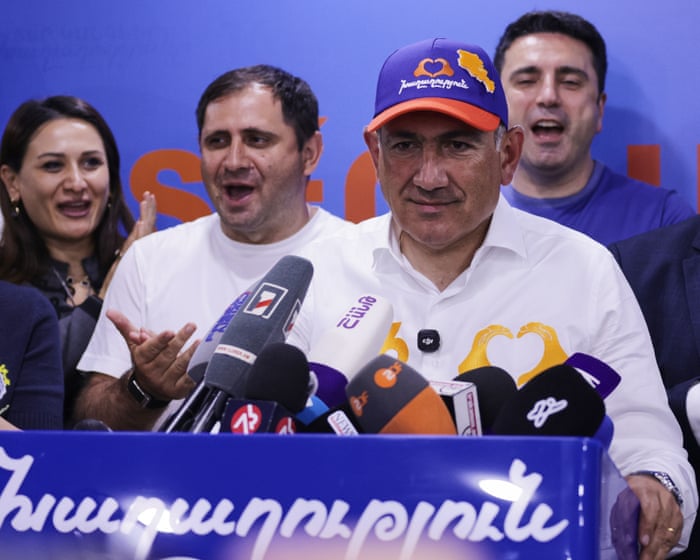
“The people of Armenia voted for peace, regional prosperity, and regional cooperation, and I hope this will be met with a positive response from Turkey and Azerbaijan,” Pashinyan said at his campaign headquarters as the results began to come in.
Pashinyan added that Armenia would continue to deepen ties with the West while maintaining its membership in the Russia-led Eurasian Economic Union.
A former journalist who rose to power during the 2018 Velvet Revolution on a promise to dismantle Armenia’s oligarchic system, Pashinyan has campaigned on a platform of peace. He argues that ending the country’s decades-long conflict with its neighbors would unlock economic opportunities, improve security, and reduce its dependence on Russia.
The prime minister, known for his populist and sometimes divisive rhetoric, has sought closer ties with Europe, suggesting that Armenia’s future lies in deeper integration with the West and expressing hope that the country could one day join the EU.
European leaders were quick to congratulate Pashinyan. In a message on X, European Commission President Ursula von der Leyen hailed his victory as evidence of “a democratic Armenia” that was “drawing ever closer to Europe.” She added: “Armenia can count on us.”
Pashinyan also received an endorsement from Donald Trump, who described him as “a great friend and leader.” The US has taken an increasingly prominent role in efforts to broker a peace agreement between Armenia and Azerbaijan.
Sunday’s vote is the first national election since Armenia lost Nagorno-Karabakh to Azerbaijan in 2023, a traumatic defeat that ended more than three decades of Armenian control over the disputed region.
The opposition has tried to portray the loss as evidence of Pashinyan’s failures, accusing him of surrendering historic Armenian lands to its enemies.
Pashinyan has tried to turn the issue into a political asset. Arguing that Armenia’s pursuit of Karabakh trapped the country in perpetual conflict and dependence on Russia, he has presented the painful chapter as a necessary starting point for a more secure and prosperous future.
Yet challenges remain for Pashinyan, who failed to secure the supermajority needed to call a referendum on amending the constitution. This includes removing references that Azerbaijan says imply territorial claims to Nagorno-Karabakh—a key condition for signing a final peace agreement.
Lilit Mkrtchyan, a shopkeeper from the capital, Yerevan, said Pashinyan’s victory would bring “peace and stability to Armenia.”
“Armenians are tired of war. We want to be an open, European country that develops and prospers, where I don’t have to worry that my son will be called up to fight,” she added.
Pashinyan’s course has put him in the crosshairs of Moscow, which has long exerted influence over Armenian politics and the economy.
Many Armenians became disillusioned with Russia after Moscow failed to come to their aid when Azerbaijan seized Nagorno-Karabakh, despiteRussian peacekeepers are still present in the region.
Nikol Pashinyan with Vladimir Putin in Moscow, October 2024, during an annual summit attended by leaders of former Soviet states. Photograph: Getty Images
The fallout led Pashinyan to suspend Armenia's involvement in the Collective Security Treaty Organization, a group of six post-Soviet states including Russia. This marked the biggest break in relations with Moscow since Armenia gained independence.
Before the election, Russian President Vladimir Putin said Armenia, which hasn't formally applied for EU membership, was following the same path as Ukraine.
Armenian officials and analysts have accused Russia of trying to influence the election through disinformation campaigns supporting pro-Russian candidates, and efforts to fly Armenians living in Russia back home to vote against Pashinyan.
In recent weeks, Moscow has become more direct, imposing trade restrictions on items like flowers, fish, fruit, and Armenian brandy.
Aware of Armenia's heavy economic reliance on Russia and its dependence on cheap Russian gas, Pashinyan promised after the vote to follow a balanced foreign policy, saying there was "no question of choosing" between Russia and the West.
Pashinyan has been boosted by strong economic growth following the influx of Russian businesses and capital after the invasion of Ukraine. This has allowed him to invest heavily in Armenia's regions, where his support is strongest.
Yet observers have also noted his increasingly personal style of politics, and what critics call growing authoritarian tendencies in Armenia, a country that remains a rare democratic exception in a region mostly run by strongmen.
A campaign poster for Strong Armenia. Samvel Karapetyan’s party won 25% of the seats in parliament. Photograph: Karen Minasyan/AFP/Getty Images
Before the elections, Armenian authorities arrested opposition figures, including members of Karapetyan's party, on charges ranging from vote-buying and financial crimes to calls to overthrow the government.
Karapetyan was detained in June and charged with calling for the seizure of power, forcing him to campaign from house arrest.
After the election, Pashinyan said his party's main goal for the next term would be to completely dismantle what he called a "criminal-oligarchic system." He also said leading opposition figures should face criminal prosecution.
On the campaign trail, Pashinyan has sometimes seemed erratic, getting into angry public disputes with refugees from Nagorno-Karabakh, whom he accused of having "run away" from the region instead of staying to fight.
The EU, meanwhile, has largely ignored criticism of Pashinyan and has been open about its support for Armenia moving away from Moscow. This week, Brussels announced an initial €50 million (£43 million) support package to help Armenia withstand Russian economic pressure.
Karen Grigoryan, a doctor who voted for Karapetyan on Sunday, said: "Pashinyan is not the man he was when he came to power."
Referring to the Ottoman-era mass killings of Armenians, which Yerevan and many Western countries recognize as genocide, he added: "We can't just be friendly with Turkey and pretend the past is erased."
Observers say many voters backed Pashinyan largely because the opposition remains widely discredited and closely tied to Russia. Tatul Hakobyan, a popular Armenian commentator, said: "People are choosing the lesser of two evils. The alternatives to Pashinyan are much worse."
Frequently Asked Questions
Here is a list of FAQs about Armenias proEurope party winning the election written in a natural tone with clear simple answers
BeginnerLevel Questions
Q What happened in the Armenian election
A A political party that wants closer ties with Europe won the most votes This means they will form the next government
Q Why is this a big deal
A Because this party is proEurope and wants to move away from Russias influence For decades Armenia was a close ally of Russia
Q Does this mean Armenia is leaving Russia completely
A Not immediately Its a gradual shift The new government will likely reduce military and economic dependence on Russia while building stronger ties with the European Union
Q What does proEurope mean for regular people in Armenia
A It could mean more trade with Europe easier travel and more jobs from European investment It also means the country will try to follow European rules for things like human rights and business
Q How did Russia react to this election result
A Russia is unhappy They see Armenia as a key partner in the region and worry about losing influence They have expressed disappointment and warned about potential consequences
IntermediateLevel Questions
Q What is the name of the proEurope party that won
A The party is called the Civil Contract party led by Prime Minister Nikol Pashinyan They won a landslide victory in the 2021 snap election
Q Why did Armenians vote for a proEurope party
A Many Armenians blame Russia for not protecting them during the 2020 war with Azerbaijan over NagornoKarabakh They feel betrayed and want a more reliable partner like the EU
Q What concrete steps will this government take to move away from Russia
A They will likely
Reduce reliance on Russian military bases
Seek alternative energy and trade routes
Work toward an EU Association Agreement or Deep and Comprehensive Free Trade Area
Join international arrest warrants that target Russian leaders
Q Is Armenia going to join the European Union
A Not anytime soon Its a longterm goal First they need to meet EU standards on democracy economy and law The election win makes that goal more realistic