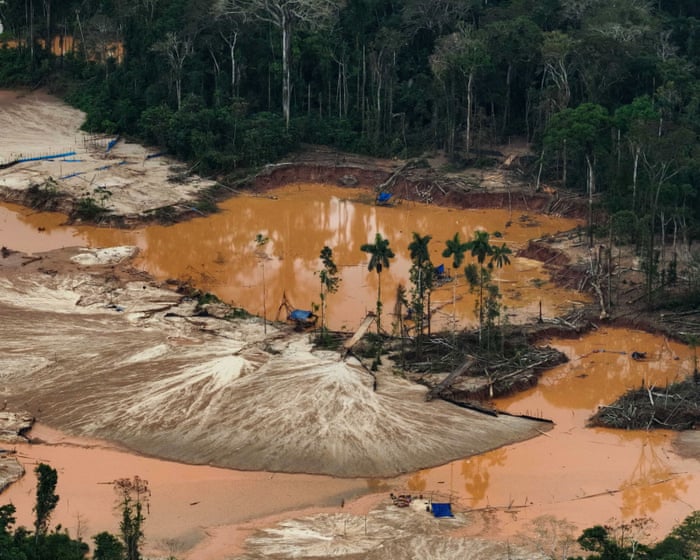
US corporate lobbyists launched a two-year "blitz" to delay and weaken the world's most progressive forest protection law, according to a new investigation by the environmental watchdog Mighty Earth. Major US firms and trade associations—including Cargill, Bunge, Mondelēz and the US Soybean Export Council, along with numerous other US companies and organizations—sought to influence the EU Deforestation Regulation (EUDR) in more than 350 meetings, the advocacy group found. US company representatives and industry groups deny there was a coordinated campaign to derail the deforestation rules, saying their meetings with EU officials raised legitimate concerns about implementation. The EUDR bans imports of commodities such as cattle, cocoa, coffee, oil palm, rubber, soya and wood from deforested land. When the ban was proposed in 2003, the then European environment commissioner, Virginijus Sinkevičius, described it as "the most ambitious legislative attempt to tackle these issues worldwide ever," and some US lawmakers said it should serve as a model for similar rules in the United States. Since then, its official implementation has been delayed twice, and the original goal of rigorously tracing the origin of commodities has been revised so much that some of its initial supporters claimed the policy has been "dismantled." The law will take effect in December. Revealed: VW, Ford and Tesla batteries linked to destructive deforestation of indigenous lands Read more Lobbyists from many countries, including Brazil and several EU nations, are known to have contributed to this dilution. Mighty Earth has provided the most detailed analysis yet of the role of organizations from the United States. It found that 24 major US companies, trade associations and industry organizations discussed the EUDR in at least 173 meetings with members of the European Parliament and 178 meetings with senior European Commission officials between July 2024 and July 2026. The US organizations with the most meetings with the European Commission were the National Alliance of Forest Owners, Advanced Woody Biomass Alliance, the US Soybean Export Council, Bunge, the American Chamber of Commerce to the European Union and Cargill. Cargill had two meetings, Bunge one and Mondelēz eight. Mighty Earth said lobbying was also conducted through the US Congress, the US Department of Agriculture, the Office of the US Trade Representative and the White House. Two weeks after a July 2025 meeting between Trump and European Commission President Ursula von der Leyen at a Scottish golf course, the two sides released a joint statement promising the US special treatment regarding the EUDR. The commission stated that the US "poses negligible risk to global deforestation" (even though many of its biggest financial and trading companies have been repeatedly implicated in the destruction of the Amazon and similar biomes). The statement also said the EU would work "to address the concerns of US producers and exporters regarding EUDR, with a view to avoiding undue impact on US-EU trade." Mighty Earth said its investigation highlighted the need for the EU to adopt greater transparency about lobbying activities and to give civil society more access to ensure balance. "Our analysis found a relentless and aggressive campaign by major US businesses, trade bodies and government officials, going all the way to President Trump, who offered to personally intervene, to further pressure EU policymakers," said Isabel Fernandez, senior adviser for Mighty Earth. "Some of the companies lobbying the EU include the most egregious, who are still linked to the illegal clearing of forests for commodities, such as soy, that make their way into European markets." Earlier this year, a delegation of Trump administration officials went to EU capitals arguing that the law would discourage the US from exporting to the European market because it would raise costs for US producers. In anIn an opinion piece published by Agence France, Andrew Puzder, the US ambassador to the EU, said the law was "sold as a bold strike against global forest loss. In reality it will impose significant regulatory compliance costs while producing inconsequential environmental benefit when enforced against countries that pose no deforestation risk." US corporate organisations said their engagement was designed to better understand and enhance the EUDR.
Brazilian Amazon deforestation falls to lowest on record as pivotal vote looms
The American Chamber of Commerce to the EU said it had raised concerns about EUDR implementation challenges, such as IT system shortcomings and a lack of clarity around companies' obligations. But a spokesperson said its role had been constructive: "AmCham EU has consistently supported the EUDR's objective of tackling global deforestation and promoting sustainable supply chains ... We have asked to allow sufficient time for companies and authorities to prepare and ensure the regulation can be effectively enforced without undermining its environmental objectives."
The US Soybean Export Council said it was focused on ways to support industry compliance with the EU's rules. "USSEC does not seek delay or exemption; rather we favour a transition period as the Regulation comes into force. This would allow companies, control authorities, the European Commission, and the entire value chain to gain experience and learnings on how compliance works in practice, allowing for greater understanding and adaptations to implementation if needed moving forwards," a spokesperson said.
The agribusiness company Bunge said it was committed to deforestation-free supply chains and was investing in monitoring and traceability that had, it said, achieved 100% traceability to farm for both direct and indirect soy sourcing in priority areas of Argentina, Brazil and Paraguay. A spokesperson said: "Bunge supports the objectives of the European Union Deforestation Regulation while observing our own non-deforestation commitment and strengthening responsible sourcing. We are also in contact with relevant EU bodies and national competent authorities via sector organizations and directly to request clarification on certain specific complex scenarios regarding the practical implementation requirements of the EUDR."
Cargill and Mondelēz did not send an on-the-record response to the Guardian's request for a comment.
Frequently Asked Questions
FAQs US Corporate Lobbyists Blitz Against the EU Deforestation Law
1 What is the EU deforestation law
Its a rule that bans the sale in Europe of products linked to recently deforested land It covers things like coffee cocoa soy palm oil beef rubber timber and paper
2 What does the report say US lobbyists are doing
According to the report US corporate lobbyists launched a coordinated push to weaken the lawmeeting EU officials running ad campaigns and pushing for delays or exemptions
3 Why do US companies care about an EU law
Because anyone selling into the EU market must comply US firms in farming food timber and paper would have to prove their goods arent linked to deforestation so the law affects their bottom line
4 What exactly are they asking for
Typically a delay in enforcement simpler paperwork carveouts for certain industries or small producers and softer penalties
5 Whats the main argument against the law
Critics say its costly creates heavy paperwork is hard to verify and could hurt small farmersespecially in countries with weaker tracking systems
6 Whats the main argument for the law
Supporters say deforestation drives climate change and biodiversity loss and the EU wants to stop importing products that fuel it They argue companies already track supply chains and can adapt
7 Is lobbying against the law legal
Yes Lobbying is legal and common in both the US and EU The debate is about transparency and how much influence industry has over rules meant to protect the environment
8 Has the law been weakened or delayed
There have been delays and ongoing political debate Some changes have been proposed and enforcement timelines have shifted Check the latest news for the current status
9 Who is affected by the law
Producers exporters traders and retailers selling covered goods into the EUfrom large agribusinesses to small coffee and cocoa farmers
10 What counts as deforestation under the law
Converting forest to agricultural or other land use after a cutoff date The law also covers some forest degradation
11 How do companies prove compliance
Through