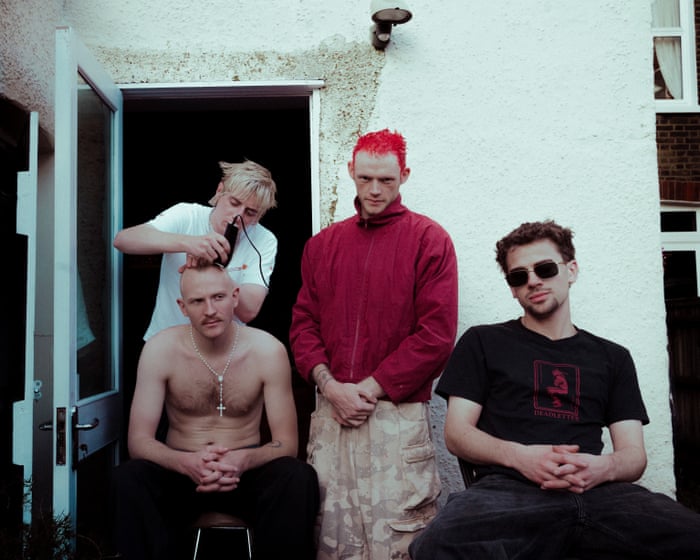
On stage in a Camden pub, Barry Quinlan, the frontman of Irish rock band Bleech 9:3, channels the intensity of Joy Division’s Ian Curtis. He hunches and jerks around the mic stand, his eyes fixed on the back wall, while excited teenagers surge and sway in a circle pit. The gig in mid-May has that same I-was-there energy as early Arctic Monkeys or Fontaines D.C. shows. With major labels signing Bleech 9:3 on both sides of the Atlantic, dozens of festival dates this summer, and a stunning, passionate five-song debut EP, the band will soon be playing much bigger venues than this.
But when I meet Barry and his three bandmates earlier that day, there’s none of that restless energy. Bleech 9:3 brings a calm to the meeting room in their management company’s offices, as staff rush around outside. That stillness is hard-earned: Barry and guitarist Sam Duffy are each other’s sponsor in Alcoholics Anonymous (AA). Quinlan smiles: “It’s an anonymous programme, so we’ll say ‘alleged sponsor.’”
Bleech 9:3 started out as two pairs: Barry and his younger bassist brother James in one band, and guitarist Sam and drummer Luke O’Neill in another. In his previous band, buoyed by newfound sobriety and spirituality, Barry had written “bright, nearly saccharine” songs. But now, “this is the real story that I wanted to start telling.” The name “Bleech” refers to a clean start (though they keep the meaning of the numbers a mystery).
With his voice soaring over grungy guitars, the EP includes autofictional portraits like the nihilist protagonist in Jacky and the doomed romantics in Cannonball. In No Surprise, he sings: “So to change your yesterdays / Call an angel in to sow your heart around your head.” He calls that line “a how-to. Like a book: Sort Yourself Out for Dummies. Seek some spiritual thing to take what’s in your heart and plant it around your head as if it was a garden. Grow love in your mind instead of the barren wasteland there.”
He’s been trying to cultivate his own mindset since his youth. The Quinlan brothers grew up in Dublin “in a house of five kids, a madhouse,” says Barry. Family life was filled with music: “In my granny’s cottage in County Clare, I have an image of these big bulbous glasses of red wine, cigarette smoke, and then these songs and acoustic guitar. It really resonated in my heart.” But, he says, “my dad’s dad was an alcoholic. Mum’s dad was a gambling addict. So we kind of had it coming from both sides. You’re born with that illness.”
Barry, now 28, started drinking in his teens and was in rehab by 20. “I didn’t fight it at all: please put me in somewhere.” But after leaving his residential centre, he quickly relapsed. “That brought me into the real isolation period of my using – I couldn’t do it with my friends because they all knew I shouldn’t be doing it.”
He did another 15-week rehab stint, “and I was drunk after one day being home.” Then, on 22 February 2019, “I went into my last place – please God – and thought: how have I ended up in a place like this again? In that questioning, it all hit me. I was so far away from myself, from everything, and I knew that was all coming for me again, like the bullet had left the gun.”
He let his mind wander, “into the darkness of the room and beyond, into the ether, out into the night: there has to be something. ‘All right, God, you better be real because I’m fucked if you’re not.’ And in that moment, I felt something touch my heart and the obsession to use was taken away.” He decided to do an exercise he’d been asked to do before but never properly engaged with: writing the 10 serious consequences of his addiction. “I went into group therapy the next dI read those things out loud and just burst into tears. It was beautiful. It felt like an exorcism, like finally reaching the shore.
Overconsumption is socially normalised in Ireland. I started drinking when I was young—we all did, at 12 or 13.
Because of Barry’s struggles, his brother James was also sent to rehab at 17. “My parents had already been through nightmare years in the house with Barry, and my sisters too,” he says, sounding more gruff and hesitant than his brother. “We were all… the whole thing was messed up, for lack of a better word. I was starting to show signs too. So they asked, ‘Do you want to go to rehab?’” It didn’t last—unlike Barry and Sam, James and Luke aren’t alcoholics. “The therapist wasn’t convinced; I probably didn’t belong there. But I learned a lot.”
Luke was also affected by the alcoholism around him. “Where we come from, it’s more common than not,” he says. “Overconsumption is socially normalised in Ireland. I started drinking when I was young, we all did, at 12 or 13. And addiction runs in my family. I guess I know how to deal with it well, and I know it should be taken very seriously.” Luke was the first person Sam reached out to when he wanted to get sober. “When Sam called me, I could sense it was just panic. I only wanted to be there for him.”
Sam had long been “incredibly attracted to the idea of just getting messed up all the time, because I was so uncomfortable in my own skin for so long.” Each attempt at sobriety would last a few months, then fail. “When that itch starts telling you to have a drink again, you can never remember how much trouble it caused you before,” Sam says. “Luckily, enough bad things had happened to me, and I’d failed enough times, that the last time the itch came, I said to Barry: I need to do something about this, or something really bad is going to happen.” By then, Barry and Sam had been introduced through a mutual friend, and Barry had “sponsored a whole group of guys” in AA, so he helped Sam through AA’s 12-step programme.
Barry had already passed 1,000 days sober, but it hadn’t been easy. “When you get rid of the alcohol, you’ve still got the -ism, you know?” he says. “I was carrying this sickening feeling all the time.” Trying to understand it, he visited a Buddhist centre near Cork, which had a room with a statue of Buddha on one side and Christ on the other. His earlier spiritual awakening became clearer. “I sat in the middle, not looking at anyone. And then I heard Jesus speak, as clear as day: ‘Come and speak to me.’ I can’t ignore that; I’m not foolish enough to write it off as psychosis. So I did, and since then I’ve felt a presence in my life that I can’t ignore. For me, recovery is proof that there is a God, and addiction is proof that there is a devil. You see the destruction in an addict’s life—to them, to their family: nothing but chaos and evil.”
Similarly, for the first year of sobriety, Sam “was on this ‘pink cloud,’ as it’s called in recovery, this new way of life. Then the first year to second year was very difficult.” He also had a spiritual awakening—common in AA, which encourages belief in a power greater than yourself—but his was different. “I didn’t understand Catholicism at all. I tried it, hard, but in the end I have a belief in a personal God. It is still Christian.”
The AA sponsorship brought them incredibly close: Barry and Sam started making music together, and eventually all four of them left their previous bands. Sam’s girlfriend lived in London, and he realised, “for the band to do this properly, we needed to be here, in front of the industry.” He moved over and started working in a guitar shop; Barry joined him.He got a job at All Saints in Spitalfields, and the other two arrived four months later. Everything they had been through fed into their songwriting, and despite the noise in their self-titled EP, it’s filled with clarity. Luke compares their sound to “lightning and thunder, a big explosion. There was a shared feeling that this group was different – we were smiling more when we left the room.”
Along with their own struggles – “Cannonball” was inspired by Sam’s failing relationship – there are also real-life characters from outside the band. Their most popular song to date, “Ceiling,” was inspired by another addict who was in recovery with Barry and Sam, but later relapsed. “I remember my last phone call with him,” Barry says. “I was saying, ‘Brother, I understand,’ and he said: ‘No man, I don’t think you do.’ Then he hung up, and a month later he was dead. People our age dying from this illness – that’s something that keeps calling to me, keeps coming up in my writing.”
Bleech 9:3 are part of a huge wave of Irish alternative talent today, from Fontaines DC to Kneecap, CMAT, Sprints, and many others. For Barry, Ireland having such a vibrant scene feels hard-won after “the long years of being occupied by another country, where your culture was something that, if you openly shared it, you might be attacked or thrown in prison.”
And the poverty the country has historically faced meant art was created from “very minimal and common things. Anyone can write a poem. Instruments are a bit more expensive, but they were everywhere. You imagine people gathering in the pub, taking shelter – it’s warmer than where they live. People share difficult things through art. You come from the same soil as these people, and you inherit the idea that everyone has the right.”
‘We’ve got to release the dead hand of the past’: how Ireland created the world’s best alternative music scene
The band have been working non-stop; just last week they supported Nick Cave. “I feel empty, dude,” Barry says. “You turn into this machine that comes to life for about an hour every day [for a gig], and the rest of the time you’re just trying to save your energy.” Sam outlines their schedule: “We’re in the middle of a five-week UK tour, then we write the album, then we do 40 festivals. Then in October we record, and then tour again. But how lucky are we, to be tired while chasing our dreams?”
When the album comes, it will “tell the broader story of those years back home,” Barry says. But there are already lifetimes of wisdom and insight packed into their small catalogue so far. Playing them live, Barry says, “is the best test of all: of how true you’ve really been to your art. And I’m so glad we’ve done what we’ve done with those songs, because that’s a little lifeline every day. You get to play them.” Bleech 9:3’s self-titled EP is out now on Polydor.
Frequently Asked Questions
Here is a list of FAQs about the Irish rock band Bleech 93 their quote and their journey with addiction and recovery
BeginnerLevel Questions
Q Who is Bleech 93
A They are an Irish rock band known for their raw emotional sound They recently opened up publicly about their struggles with addiction and their path to sobriety
Q What does the quote Addiction is proof there is a devil Recovery is proof there is a God mean
A Its a powerful way of saying addiction feels like a dark destructive force that takes over your life Recovery on the other hand feels like a miraculous saving grace that helps you get your life back
Q Is the band religious
A Not necessarily in a traditional sense They use God and devil as metaphors for the extreme highs and lows of addiction and recovery The quote is about spiritual experience not organized religion
Q Did all the band members have addiction problems
A The bands public statements focus on their collective experience While they havent named specific members they speak as a unit about the struggles that almost destroyed their music and friendships
Q Are they still making music
A Yes Theyve described their new music as stunning and more honest than ever Their sobriety has unlocked a new level of creativity and focus
IntermediateLevel Questions
Q Why did Bleech 93 decide to go public with their addiction story
A They wanted to break the stigma They felt that hiding their struggles was part of the problem and they hope their honesty helps fans who are going through similar battles It also felt necessary for their own healing
Q How did addiction affect the bands music and relationships
A It almost destroyed them They described missed gigs broken trust creative blocks and nearconstant conflict The band was on the verge of breaking up permanently
Q What specific steps did they take toward recovery