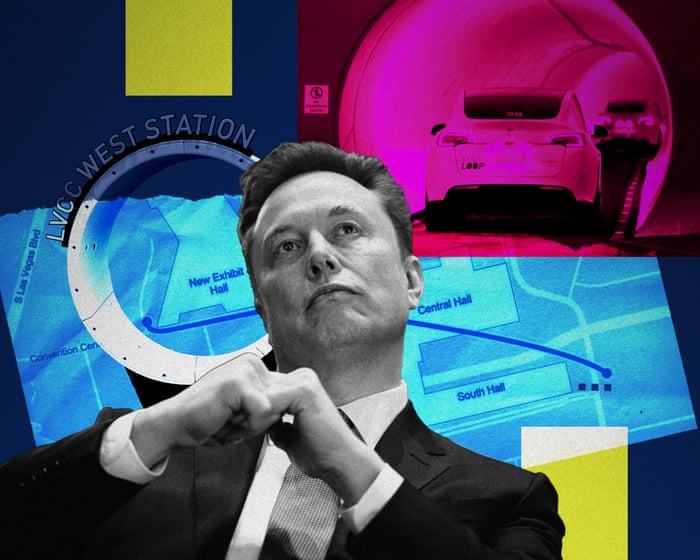
It’s another blindingly bright day in Las Vegas, but I’m 30 feet underground, strapped in for a rocket ride to the future. Actually, it’s a Tesla ride to the future—and not a self-driving one. It’s also pretty slow. My driver tells me the speed limit down here is 30 mph. And it’s short: the trip is over in just a few minutes. In fact, the Vegas Loop is a pretty underwhelming experience—a brief, slow ride through a white-walled tunnel only slightly bigger than the car itself, lined with LED strips that change color every few seconds to add some Vegas glitz. I’d hoped to ask other Loop riders what they thought, but… there aren’t any. I’m the only person here.
This isn’t the futuristic transport solution Elon Musk originally promised. When he first announced this technology in 2017, it came with sci-fi visuals: a car pulling off the street onto an elevator platform, descending into a network of tunnels, and zipping along on an “electric skate” at 200 km/h (124 mph). “There’s no real limit to how many levels of tunnel you can have… so you can solve any level of urban congestion,” Musk said. A few months earlier, with his typical edgy nonchalance, he tweeted: “Traffic is driving me nuts. Am going to build a tunnel boring machine and just start digging…” Soon after: “I am actually going to do this.” He did, and he called it the Boring Company.
The Vegas Loop’s underwhelming nature won’t surprise seasoned Musk-watchers. The all-powerful CEO has built a reputation for overpromising and underdelivering on his big ideas—from self-driving Teslas to intelligent robots to missions to Mars—none of which have happened within his promised timelines. But the Boring Company also shows “Muskism” in action: not just the gap between fantasy and reality, but how the trillionaire’s loyal fans and political influence seem to shield him from scrutiny, criticism, and red tape, giving him a level of control and freedom others don’t have.
In the early days, the Boring Company also reflected Musk’s habit of mixing serious goals with juvenile trolling. In 2018, he raised $10 million by selling 20,000 Boring-branded flamethrowers, plus another $1 million from Boring baseball caps. Musk fans loved it, and so did investors. By 2022, the Boring Company was valued at $5.7 billion. It was building test tunnels in Los Angeles and at its Texas headquarters. It was reportedly involved in projects in cities across the US and beyond: Los Angeles, Washington, Chicago, San Jose, Miami. But one by one, those projects fizzled out. Right now, the only city that has taken up the Boring proposal is Las Vegas—though that’s about to change.
The first three stations of the Vegas Loop opened in 2021, connecting one end of the huge Las Vegas Convention Center (LVCC) to the other—about a mile. Between 2022 and 2025, the network expanded to three nearby casino resorts: Resorts World, the Westgate, and the Encore. You can’t drive your own car into the tunnels. You have to book one of the Loop’s Teslas (standard models, no electric skates) and pick them up at what are basically taxi stands, either above ground or under the resorts. Tickets are $4.25 (£3.15) for a single trip, or $12.50 (£9.30) for a day pass.
It’s not really a loop, either. Some tunnels are two-way, meaning if another car is coming from the opposite direction, yours has to wait for it to come out before you can go in. The system is much busier when there’s a big event, but…There’s a convention going on, the drivers tell me, but today the stations under the LVCC are closed. At its peak, the system might have 160 Teslas running, but today there are only four—which turns out to be three more than needed.
Is this really a viable alternative to public transportation? “It doesn’t have much utility,” says Ray Delahanty, a former traffic engineer and urban planner who now posts on social media as CityNerd. After visiting last year, he made a YouTube video called “The Vegas Loop is getting progressively more stupid.”
“In theory, there are times when surface streets are so congested that an uncongested tunnel underneath could be faster,” he says, but “tourism has really dropped off in Las Vegas,” so there’s less traffic anyway. Plus, he says he usually has to wait 10 to 15 minutes for a ride, so there’s no time saved.
The Boring Company claims its system is cheaper than traditional metro systems because its tunnels are smaller and its operation is leaner, but it’s hard to see how the numbers add up. Setting aside the Loop’s claim that it will one day handle “90,000 passengers per hour,” at its current maximum capacity of six cars per minute, with four passengers per Tesla, that’s 2,400 passengers per hour, or at most 33,600 per day (it’s only open from 10 a.m. to 9 p.m.). For comparison, London’s Elizabeth line alone carried over 240 million passengers last year, or 665,000 per day. Plus, the Loop needs one driver for every four passengers, while one Elizabeth line train with one driver can carry 1,500 people.
“If you took what should be public transportation planning and turned it into a neoliberal nightmare, this is exactly what you’d get,” says Ben Leffel, an assistant professor of public policy at the University of Nevada, Las Vegas. In March, Leffel told legislators at a meeting of the Nevada Regional Rail Transit Advisory Working Group: “The Loop by the Boring Company is the biggest, most absurd transit scam I’ve ever heard of… The Boring Company has been lying to policymakers around the world that their system—Teslas in tunnels—can move more people faster than any kind of rail. And take it from me: that’s physically impossible. So any policymaker they say this to should challenge them to provide even a shred of material evidence that it’s true, but they can’t.”
Why did Las Vegas go for it? Part of the appeal to legislators, Leffel explains, is that the Loop is privately funded. “It’s not paid for by tax dollars; it’s paid for mostly by investors, and a lot of those investors are in real estate,” he says. This means the location of stops is decided by developers, not by the city’s needs. “So we’ve moved away from a proper public rail system that moved more people and gone to a cheaper substitute, where influence over the design goes to the highest bidder.”
Private funding also lets Boring avoid official oversight in Las Vegas and rigorous environmental reviews—which have often caused its projects to fail elsewhere. Musk has publicly said he dislikes environmental regulation. “You have to get permission in advance, instead of, say, paying a penalty if you do something wrong, which I think would be much more effective,” he told the libertarian Cato Institute last year.
Boring has some experience with this. Last October, ProPublica alleged that it had violated environmental regulations nearly 800 times in Las Vegas over the past two years, including “starting to dig without approval, releasing untreated water onto city streets, and spilling muck from its trucks,” as well as minor issues.After missing 689 inspections, a separate report from Fortune claimed that the Boring Company “pretended to comply” after one inspection, “only to keep dumping wastewater once a company manager ‘assumed district inspectors had left the property.'” There have also been reports of employees and firefighters suffering chemical burns and other injuries while working on the project, with penalties that seem to have been very light.
None of this helps solve the real problems faced by US cities like Las Vegas, which rely heavily on cars and are becoming more vulnerable to extreme heat due to the climate crisis. The solution, as other cities have shown, is more trees and fewer cars, which means moving people around using metro or light rail systems.
“Las Vegas is the only large city in the Mountain West region of the US that doesn’t have a real mass public transit system,” says Minja Yan, a former real-estate professional running for Clark County commissioner. “But because our elected officials haven’t been prioritizing public transit, the Boring Company came up with a private project, and our officials were kind of like, ‘OK, maybe it sounds like a cool idea.'” Light rail is also a good option, she says, “but it takes work to make it happen. It takes vision, coordination, and a lot of time.”
Work is now underway to massively expand the Vegas Loop. The city has approved a network of 68 miles of tunnels and 104 stations, connecting the Strip to downtown, the airport, and the 65,000-seat Allegiant sports stadium. As the Boring Company’s website puts it, this “cements the Vegas Loop as a vital piece of the city’s future infrastructure.”
What happens in Vegas is no longer staying there. In July 2025, Nashville, Tennessee, announced it was also committing to a Boring project: the Music City Loop. About 20 stations are planned, but the first 13-mile stage will connect the airport to the downtown convention center and the state capitol. By the time of the announcement, construction had already started, much to the surprise of the public and many local officials.
“We weren’t told what was going to happen at any point until it was a done deal,” says state senator Heidi Campbell, referring to herself and her Democratic colleagues. She describes the process as “unusually secretive. We got a special little memo in our mailboxes the day before the governor [Trump ally Bill Lee] made the announcement. And we weren’t invited to the ceremony or given any details after that. They wanted to keep us in the dark, and they continue to do that.”
Campbell and others have raised similar concerns to those in Las Vegas: that this is more of a “tourist shuttle” than real public transport; that it blocks other transport options; that the city’s geology and water table pose risks; and that if it fails, Nashville—not Musk—will be left to deal with the consequences. “Even if this went really, really well, what you’re doing is still finding a creative way to move cars, not solving congestion problems.”
Last December, there were protests against the Music City Loop outside the courthouse. Campbell believes the project’s approval is a case of politics over practicality in the Republican-dominated state: “The guys I work with are so in love with Donald Trump that anyone close to him is their friend. They feel like Elon Musk is close to Trump, and they’re so excited to do a project with him that they’re not even thinking about the logistics.”
It’s telling that the only places that have taken up Musk’s Boring vision are aligned with him both commercially and politically. Tennessee is already home to Musk’s Colossus data center, which provides computing power for hisGrok AI, SpaceX operations, and the X social media platform are all part of Elon Musk’s business empire. A facility in Memphis and across the border in Mississippi stirred controversy earlier this year when it was revealed to be using environmentally harmful methane gas turbines for electricity.
In Nevada, Tesla’s Gigafactory near Reno opened in 2016 after fierce competition from other states—Nevada reportedly offered $1.2 billion in tax incentives. That deal was largely led by Steve Hill, then director of the Governor’s Office of Economic Development. In 2018, Hill became CEO of the Las Vegas Convention and Visitors Authority (LVCVA), which promotes the city and owns the convention center. He is credited with bringing The Boring Company to Las Vegas and “remains actively involved in expanding the system throughout the Las Vegas Valley,” according to the LVCVA website.
The Boring Company did not respond to multiple requests for comment.
This mix of business and government interests follows a familiar pattern, says Quinn Slobodian, co-author of Muskism (with Ben Tarnoff). The book argues that Musk’s business strategy often involves creating a symbiotic relationship with the state—finding an area where he can establish a monopoly and then benefiting from public funds. This worked with SpaceX, which has long relied on NASA contracts and built on NASA’s state-funded infrastructure, and with Tesla, where over 40% of its revenue in the first nine months of 2024 came from government carbon credits. Even as Musk supposedly helped the Trump administration find $2 trillion in “efficiencies” (another overpromise), a 2025 report estimated his companies had received $38 billion in government funding.
“He really profits from a kind of ‘terra nullius’ environment—where there are as few regulations as possible—and he can quickly move into a relatively empty space and dominate it,” Slobodian says. Just as he did with SpaceX’s rockets and Starlink’s low Earth orbit satellites, Musk likely saw the underground realm as territory to claim. Musk excels at what Slobodian and Tarnoff call “financial fabulism”—”the promise not just of a slightly better product, but of a transformed future where entirely new sectors and markets that didn’t exist before will be created.” Unfortunately, the space beneath our cities isn’t as frictionless as The Boring Company might have hoped, Slobodian notes, since it’s full of physical and regulatory obstacles. There’s apparently another Boring project planned for Dubai, but it’s safe to say Musk’s pipe dream hasn’t taken the world by storm.
Is Musk getting bored with Boring? It now seems like a minor part of his vast empire, overshadowed by his inflammatory social media posts and the much-hyped stock market listing of SpaceX last week, which valued the company at over $2 trillion. SpaceX’s registration statement makes even grander claims: it expects future revenues of $28.5 trillion—”the largest actionable total addressable market in human history.” Growth plans include AI data centers in space, asteroid mining, and “passenger and cargo transport to the moon and Mars.” It might happen one day, just as The Boring Company might one day whisk you beneath Las Vegas in a driverless Tesla at 200 km/h. In the meantime, Musk’s master plan seems too good to be true, yet too big to fail. It could take us to infinity and beyond, usher in a hypercapitalist dystopia, or—like Boring—simply go nowhere, not very fast.
Do you have an opinion on the issues raised in this article? If you would like to submit a response of up to 300 words by email to be considered for publication in our letters section, please do so.Please click here.
Frequently Asked Questions
Here is a list of FAQs about riding the Vegas Loop based on the neoliberal nightmare experience
BeginnerLevel Questions
1 What exactly is the Vegas Loop
Its a system of underground tunnels in Las Vegas where Tesla cars drive you between casinohotels and the convention center Its Elon Musks idea to beat traffic
2 How is it different from a subway or a train
Instead of one big train you get a small electric car for just you and your group There are no conductors no fixed schedules and no ticketsyou just hop in
3 Is it actually faster than walking or taking a taxi
In theory yes because you skip traffic lights In practice it depends If the line is short its very fast If the line is long walking might be quicker for short distances
4 Do I need a special app or ticket
Yes You need the Las Vegas Loop app on your phone to request a ride You pay per ride through the appno cash or card accepted at the station
5 How much does it cost
Prices vary by distance and demand but expect around 5 to 15 per ride Its cheaper than a taxiUber for short hops but not as cheap as a city bus
IntermediateLevel Questions
6 Why do people call it a neoliberal nightmare
Critics say its a private forprofit system that replaces public transit Its not open to everyone equally and it prioritizes tourists over residents It feels like a rich persons toy not a real solution to traffic
7 What happens if the app crashes or my phone dies
Youre stuck Theres no backup plan The whole system relies on your phone working If you have a dead battery you cant get a ride
8 Is the ride comfortable
The tunnels are narrow and dimly lit The car drives on a concrete floor so its bumpy Its not a smooth quiet subway ridemore like being in a basement parking garage
9 How long is the wait
Wait times vary wildly Sometimes you walk right in Other times you wait