Most of the people in Hiroshima never saw or heard any plane. They didn’t hear any explosion either. They just saw a strange flash in broad daylight, or maybe only felt the light from it. But there was a huge explosion.
Mr. Konda’s parents—he’s a member of our church—were waiting for a train at Yokogawa station, about two kilometers (one and a quarter miles) from where the bomb hit. They saw a B-29 and a parachute falling through the air. Before they could even wonder what they were seeing, they passed out. Later, they couldn’t remember hearing or seeing anything. When they woke up, they were lying on the ground, burned and naked. All the houses around them had been flattened. They got up and ran toward the suburbs. Other people rushing along the Koi highway had the same experience.
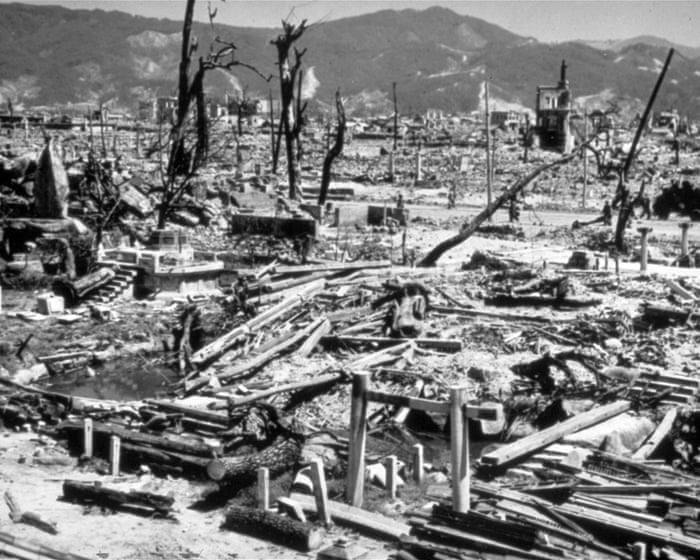
After crossing the Koi and Fukushima bridges, I got to a spot about a kilometer from the explosion. From the suburbs to that point, houses were badly damaged but still standing. But from there to the center of the blast, every house was completely flattened, like toy buildings crushed by a hammer. I could hear painful cries of “Tasukete!”—”Help!”—coming from under the wrecked houses.
People seemed to be buried in the ground. I knew how hard it was to pull even one piece of wood from a collapsed house, because I had helped clear houses before. There was nothing I could do alone to help the people trapped under those houses. Yet people were buried everywhere, here and there.
After I stopped to try to help them, it hit me that my wife, my baby, and my neighbors might be in the same situation. I was the defense coordinator for my neighborhood, and 120 lives were in my care. I had to get back to my post. I ran away crying, saying, “Excuse me, I’m sorry, but excuse me!” I ran like a madman. At Fukushima bridge, I saw Mr. Matsuo, who had been with me when the bomb went off. He came running up, out of breath. “Mr. Matsuo, please excuse me, I have responsibilities,” I said, and kept running.
Everywhere there were terribly injured people. They couldn’t move anymore, so they were lying in the streets. I followed the bank of the Fukushima River, looking for a place where the fire wasn’t so bad. Then I reached Nakahiromachi, a northern neighborhood with lots of farm fields and not many houses.
Everywhere there were pitifully injured people. They couldn’t keep moving, so they lay in the streets. The deeper I went into the city, the more wounded I saw. I grabbed my panama hat and threw it on the ground. In my heart, I cried, “Forgive me!” because I couldn’t understand why I was unhurt. I thought my wife and baby must be injured like these people, maybe buried under our house. I asked their forgiveness for not being there to rescue them.
My usual way home was to take the Misasa Bridge across the Ota River toward central Hiroshima and then go out to Hakushima, but the foot of the bridge and the Hakushima area were on fire. Luckily, the Ushita district on the other side of the river seemed untouched by fire. If I could get past Ushita, my own neighborhood of Noboricho would be just a stone’s throw away.
I made up my mind and jumped into the river. It wasn’t that I was confident in my swimming—I had no other way to reach my goal. The Ota River’s water level changes with the tides. There wasn’t much water, but the current was strong. Naturally, I lost control of my arms and legs. I had already been running nonstop for about an hour.I was completely exhausted. I started swallowing water, and it went up my nose and into my mouth. My body felt heavy, and my head began to sink beneath the surface. My gaiters came loose and dangled around my legs. One of my shoes fell off. I thought I was drowning. I wouldn’t have minded being killed by an American bomb, but drowning felt like a terrible way to go. As I sank, I prayed, “Oh God, please help me. Protect my body until I can save my wife, my child, and my neighbors.” Then I calmed myself down. I took off my gaiters, coat, and my other shoe, and I felt lighter. With all the strength I had left, I swam through the water.
Soon I reached water that was about as deep as I am tall, and I was safe. When I got to the other bank, I couldn’t move anymore. I rested for a while with my head on the ground. After I regained some strength, I stood up and started walking toward Ushita. I was completely naked, and the only thing that set me apart from others was that I had no burn scars.
Since the treasurer of my church lived nearby, I went to his house. But it was also crushed and empty. I prayed for his safety and kept walking through Ushita. I didn’t see anyone else and thought everyone must have already escaped.
Mrs. Tada’s house, where my wife often stayed overnight, was close by, and I thought about stopping in. She usually came home by 6:30 or 7:00 in the morning, but I wondered if she might have stayed until 9 or 10 that morning at Mrs. Tada’s and been saved. Praying, I took a few steps toward the house. To my surprise, I saw my wife carrying Koko in her arms, walking in a line of refugees. She was wearing a blood-stained chemise, her hair was hanging loose around her shoulders, and she looked like a ghost.
I called out to her. She turned around, looked at me, and stood quietly with tears in her eyes. I looked away and asked, “What happened to you?”
She said, “Just as I got home, Mrs. Takaki came to visit. We were talking at the door when we got buried.”
“And what happened to Mrs. Takaki?”
With a sad look, she said, “I don’t know.”
I didn’t feel the slightest joy at seeing my wife and child safe. Instead, I was filled with anger. It seemed unforgivable that a church member who was visiting the parsonage should be killed in an air raid while the pastor’s family survived. Shouldn’t the pastor’s wife have died alongside the church member? I felt accusing thoughts toward my wife.
Later, I learned that my wife had been buried under the house instantly and nearly crushed by heavy wood. She couldn’t breathe for a while and started to lose consciousness. But the screams of Koko, who was still in her arms, brought her back. She struggled with all her strength to save her baby. She calmed herself and noticed a small hole in the attic. Both her arms were pinned tightly in the rubble, but she could move a little and finally managed to free one arm.
She slowly made the small hole bigger. Every time she moved, pieces of broken roofing fell on her head. Koko kept crying loudly. Struggling with all her might, she enlarged the hole and was finally able to push Koko out. Then she did everything she could to free herself and managed to get out.
By then, the house next door was on fire, and smoke was rising. She staggered down the alley with Koko in her arms. She thought about finding someone to help Mrs. Takaki, but every house she could see was smashed and empty. The fire was spreading, and the smoke was getting thick. With the baby in her arms, she couldn’t go back to our house. Finally, chased by fire and smoke, she reached the Sentei gardens. But her thoughts were still with her neighbor.
This is an edited extract from Hiroshima, 8:15: The Lost Memoir by Kiyoshi Tanimoto.Nimoto. It will be published by Ebury on 6 August. To support the Guardian, order your copy at guardianbookshop.com. Delivery charges may apply.
Frequently Asked Questions
Here is a list of FAQs about the newly discovered Hiroshima memoir written in a natural tone with clear concise answers
BeginnerLevel Questions
1 What is this newly discovered memoir about
Its a firsthand account by a Japanese doctor who was in Hiroshima when the atomic bomb exploded He describes the immediate aftermath focusing on the overwhelming number of severely burned and wounded people
2 Who wrote the memoir and why is it important now
It was written by Dr Michihiko Hachiya who ran a hospital in Hiroshima It was recently discovered in an archive Its important because it offers a raw unfiltered medical and human perspective that wasnt widely available before
3 Is it just a list of injuries and deaths
No While it details horrific injuries it also captures the chaos the struggle to provide any care and the emotional trauma of survivors Its a powerful human story not just a medical report
4 How is this different from other Hiroshima accounts
Most famous accounts were written by journalists This is a doctors personal diary written in realtime It shows the collapse of the medical system and the impossible choices doctors had to make
5 Where was this memoir found
It was discovered in a private collection in Japan tucked away in an archive that was not fully cataloged Researchers stumbled upon it while digitizing old documents
AdvancedLevel Questions
6 What specific injuries does the doctor describe that are unique to an atomic bomb
He describes keloids severe radiation burns that didnt heal normally and the flash blindness caused by the initial blast He also notes the strange pattern of burnspeople on one side of their body were completely charred while the other side was untouched
7 Does the memoir discuss the longterm effects like radiation sickness
Yes but not in modern medical terms He writes about patients who seemed fine for a few days then suddenly developed vomiting hair loss and purple spots from internal bleeding He didnt know it was radiation poisoning at the time
8 How did the doctors hospital function after the blast
It was almost destroyed He treated patients