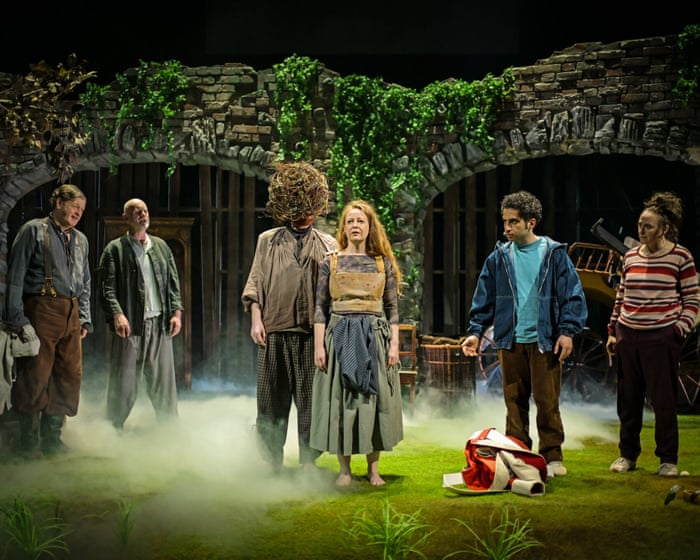
In the early 18th century, a few thousand Germans fled religious persecution and near-starvation in their homeland and ended up in remote rural Irish villages. Known as the Irish Palatines, they were poor, conservative smallholders who couldn’t speak the language and were met with suspicion and violence—precursors to the displaced Syrians and Afghans of the past decade. Their story is told in Refuge, a co-production between Staatstheater Mainz and the Irish company Fishamble. Part love story, part social commentary, it is performed by a mixed cast, mainly in English but with some German interludes. It focuses on a German couple, Hannah and Peter, who have lost one of their two sons to illness and are trying to make a life on farmland on the edge of a small town in Limerick. Their Protestantism and their reluctance to mix with the Irish add to a sense of danger. Peter is driven by another motive. He owes his plot of land to the manor’s (invisible) English squire, Thomas Southwell. The 1st Baron Southwell of Castle Matrix is eager to dilute the locals’ Catholicism and so gives the Germans cheap rent in return for their obedience. Feudal landlord and dependent tenant find common cause. View image in fullscreen Trouble ensues … (from left) Mary Murray, Sabah Qalo, Hannah von Peinen and Holger Kraft. Photograph: Andreas Etter More than 100 German families settled on Southwell’s lands, marrying almost exclusively among themselves. Over a 40-year period, only seven marriages with someone outside the community are recorded. The “pure” German population grew by 500 children. Hannah doesn’t think like the rest of them. She begs her husband to extend an olive branch to the locals, but he refuses. She defiantly does so herself, seeking friendship, and possibly romance, with a local farmer she haltingly calls Mr Ireland. Trouble ensues. The playwright, Deirdre Kinahan, says she seized the topic eagerly: “Immigration—and our response to it—is one of the most crucial yet divisive issues of our age. How do we welcome the stranger, with humanity or anger?” She adds that she knew instinctively the forgotten story of the Palatines would speak to Ireland and Europe’s present predicament. This led her to include the tale of a contemporary young Afghan boy in the narrative. The production has played at the Dublin Theatre Festival and concludes in Mainz, capital of the present-day state of Rhineland-Palatinate and the territory from which most of the original settlers came. Between the two destinations, it made a detour to Berlin at the request of the Irish ambassador, Maeve Collins. “This story of a relatively unknown episode in Ireland’s history with Germany resonates with the experiences of contemporary audiences,” she says. It all began with an English queen. Early in 1709, hopes for a better life were raised when a “Golden Book” began circulating among the Palatinate’s population, bearing a picture of Queen Anne on the cover and promising a prosperous, easy life in America. The idea was to encourage hearty white Protestants to settle in the American territories without unduly depleting England’s population. This was hugely attractive to the Palatines, who had seen their land ravaged by a series of wars waged by the expansionist zeal of France’s King Louis XIV. View image in fullscreen ‘Our response to immigration is one of the most crucial issues of our age’ … (from left) Mary Murray, Sabah Qalo and Hannah von Peinen in Refuge. Photograph: Andreas Etter A group of these Germans petitioned the English queen, accepting her plan. But instead of the anticipated 500, more than 13,000 refugees set sail along the River Rhine to Rotterdam before making the crossing in overcrowded small boats. One in five died on the perilous journey. The rest arrived destitute and were housed in tents in and around London. Such were their numbers that the initially warm reception soon cooled.d. Wherever they went, these Germans faced suspicion, harassment, and violence. By the end of November 1709, the first steps were taken to deport them. The English government chose other solutions. Some were allowed to continue to America. A smaller group of about 3,600 was moved to underpopulated Ireland to increase the Protestant population. It would take several generations before the Palatines began to integrate. Some converted to Catholicism through intermarriage and assimilation, though most remained Protestant (either Methodists or members of the Church of Ireland). One of the best-known families was the Switzers, whose department stores in Dublin, Cork, Limerick, and Galway sold luxury goods for a century and a half before the high-street institution was taken over and renamed. Like the Huguenots – who had fled to England, Holland, and Germany two decades earlier after Louis’s revocation of the Edict of Nantes – the Palatines are now hard to distinguish from the original population. For the play’s cast and crew, the “rediscovery” has been a moving experience. Holger Kraft, who plays gruff Peter, says he came to see the piece less as Irish-German and more as pan-European, with a universal message that “we all have to stick together.” Refuge is on at Staatstheater Mainz on 20 and 21 October.
Frequently Asked Questions
FAQs How Do We Welcome the StrangerWith Humanity or Anger The Forgotten Germans Who Found Refuge in Ireland
1 Who were the forgotten Germans who found refuge in Ireland
They were Germanspeaking refugeesmostly Jewish but also political opponents of the Nazi regimewho fled Germany and Austria in the 1930s and found safety in Ireland Many Irish people today have never heard of them
2 Why are they called forgotten
Because their story is rarely taught in schools or mentioned in public memory Unlike refugees who went to Britain or the US Irelands German refugees stayed small in number and quietly integrated so their history faded from view
3 How many German refugees came to Ireland
The numbers were smallroughly a few hundred before and during World War II Ireland was not a major destination partly because of tight immigration rules and a weak economy
4 Why did Ireland take them in at all
Ireland was neutral in the war and some officials and charities argued that a small carefully chosen number of refugees could be admitted without much cost or risk Humanitarian groups and a few sympathetic politicians pushed for it
5 What does welcoming the stranger mean here
It means how a country treats newcomers who arrive in needwhether with compassion and practical help or with suspicion and hostility The German refugees story shows both responses
6 Did Ireland welcome them with humanity or anger
Both Some refugees were helped by charities employers and ordinary families Others faced suspicion red tape and hostilitysome Irish people feared they would take jobs or were enemy aliens
7 What problems did the refugees face
Strict visa rules fear of being sent back learning English finding work and suspicion from neighbours During the war Germanspeaking refugees were sometimes treated as potential spies
8 What happened to them after the war
Most stayed in Ireland built careers and raised families Some became well known in business medicine and the arts Their children and grandchildren are part of Irish society today
9 Can you give an example of a wellknown refugee
Yesfigures like the photographer and artist refugees or the businessman who founded a wellknown Irish company show how newcomers contributed Ask your local library or Jewish museum in Dublin for specific