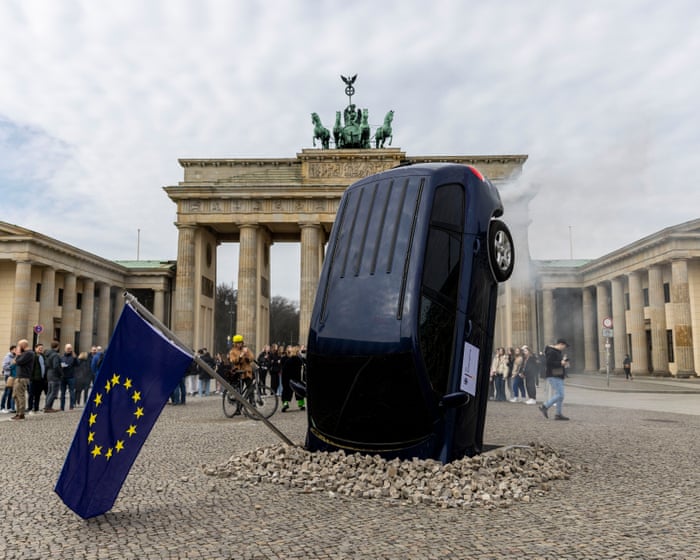
On a cold winter evening in Europe’s automotive heartland, a cyclist who had been fighting for safer streets went out on his bike for the last time. Andreas Mandalka had spent years documenting dangerous driving and poor cycling infrastructure. He measured how close cars passed him and posted videos of clear violations. Though he was quick to remind readers that only a small number of drivers behaved badly, the 44-year-old blogger in Baden-Württemberg, Germany, had grown frustrated with authorities for not taking action. He felt they saw him as a nuisance.
As he cycled down a straight, renovated road that ran alongside a forest path he had flagged as unsafe, with lights on his bike and a helmet on his head, he was hit from behind by a car and killed.
“I went to bed that evening, glanced at my phone, and saw a police report about an accident in our area,” said Siegfried Schüle, a friend of Mandalka’s from a cycling group in Pforzheim. “I immediately had a strange feeling. I reposted the police tweet, typos and all, and just wrote: ‘Andreas, how are you?’ That was my last message to him.”
Mandalka was one of 19,934 people killed on EU roads in 2024, which are among the safest in the world. Traffic accidents cause 1.19 million deaths globally each year.
As carmakers flood the market with bigger, more harmful models, the added pressures of air pollution, climate change, and unstable petrol and diesel prices are fueling new efforts to break society’s dependence on cars.
“It’s not about taking anything away from anyone,” said Schüle, a startup founder. “It’s about giving everyone the same freedom to move safely, even if they don’t have a driver’s license.”
Public health experts struggle to explain the risks cars pose without sounding alarmist. Loud machines in steel cages, most of which burn fuels that pollute the air and heat the planet, zoom past schools, homes, and hospitals. Rubber tires kick road dust and microplastics into the air. The oversized infrastructure takes away space for bike paths, forcing commuters to drive more and exercise less, while limiting room for parks where people can socialize and enjoy nature. Paving over green spaces leads to hotter heatwaves, worse flash floods, and higher stress levels.
“The list goes on,” said Dr. Audrey de Nazelle, an environmental epidemiologist at Imperial College London. But she said part of the problem is that the dangers are so widespread, which makes it harder to reduce car use. Policymakers often focus on isolated fixes, like electric vehicles to fight climate change or added safety features to cut crash deaths.
“In governance, there’s a separate solution for everything, but no way to embrace all the benefits—and that’s what holds back change,” De Nazelle said.
Signs of frustration are starting to show. Mayors around the world feel more confident in reallocating road space to pursue clean air, and many drivers—motivated by money, comfort, health, or the environment—want to get out from behind the wheel. In Europe, an Ipsos poll found that more people than not report walking and using public transport more in the last five years, while personal car use has fallen slightly out of favor. Even in the car-focused US, a study in February found that almost one in five vehicle-owning adults in cities and suburbs are “strongly interested” in living car-free, with two in five open to the idea.
Surprisingly, the latest calls to get off the road have come from energy experts rather than doctors or environmentalists. In March, the International Energy Agency (IEA) encouraged carsharing, driving slower, and working from home to ease the pressure.The shock from soaring fuel prices caused by the Iran war served as a warning. It advised countries not to fight high petrol prices with blanket subsidies—as many did during the last energy crisis—and instead recommended targeting financial support to vulnerable groups.
Average footprint of vehicle models sold in the US by vehicle category
Yet even as the reasons to reduce car dependence grow stronger, the vehicles themselves keep getting bigger. Larger cars waste more fuel, emit more pollution, take up more space, and cause more damage in a crash. In Europe, where most new cars sold are SUVs, the average vehicle weight has increased since 2010 by 9% for combustion engine cars and by 70% for battery electric ones, according to data from the International Council on Clean Transportation, a nonprofit research organization. Beyond the direct harms, the trend toward bigger electric vehicles may have also slowed the shift away from fuel-burning cars by making clean alternatives too expensive for many people.
“Europe is at a crossroads,” said Lucien Mathieu, director of cars at Transport and Environment (T&E), a nonprofit in Brussels. He said the choice ahead was either to manufacture the “compact affordable electric vehicles” that China has started to popularize across the developing world, or to embrace the expensive “mega SUVs and monster trucks” that the US has championed. Official data shows that more than 80% of cars sold in the US are now SUVs, vans, or pickup trucks.
View image in fullscreen
Thousands of pickup trucks like the Ford F-150 are on European streets, bypassing EU safety standards through an import loophole. Photograph: ifeelstock/Alamy
For now, the SUVs clogging European roads are fairly small by North American standards, with the main threat to human health coming more from higher bumper heights than from the extra pollution that added weight brings. But even bigger vehicles are waiting in the wings. Thousands of pickup trucks such as the Dodge Ram 1500 and Ford F-150 have been driven onto European streets in recent years, avoiding EU safety standards through a backdoor process that allows individual vehicles to be imported under less strict conditions. Efforts to close this loophole have been complicated by a US-EU trade deal last year that calls for “mutual recognition of each other’s standards” on automobiles.
The agreement, which has been signed but not ratified—much to Donald Trump’s frustration—is helping carmakers get large vehicles into Europe. In December, the American Automotive Policy Council (AAPC) wrote to US Commerce Secretary Howard Lutnick to protest planned changes to the EU’s import approval process. Last month, in a follow-up seen by the Guardian, the lobby group claimed the latest draft proposal was “a significant trade barrier” that went against the agreement. Among its objections were requirements to test vehicles to European emissions standards, fit them with gas particulate filters, and equip them with pedestrian protection sooner than the AAPC thinks is feasible.
Average weight of vehicle models sold in the US by vehicle category
Carmakers in North America and Europe have tried to justify the shift to bigger cars by saying they are meeting consumer demand for spacious vehicles. Even during a cost-of-living crisis, customers have been willing to pay extra for vehicles that are more expensive to buy and run, with a rise in drivers defaulting on car loans ringing alarm bells on Wall Street. Critics argue that the automotive industry is hiding the role its ads play in creating demand while it chases the higher profit margins that SUVs offer.
View image in fullscreen
Paris and London have only in recent years taken steps to improve public transport, share road space with cyclists, and restrict motorists. Photograph: Bloomberg/Getty Images
Is Europe doomed to follow North America’s trend of bigger cars? There are some signs that the rise of SUVs may be sparking resistance.Car culture, more broadly, has deep roots. A few European cities started reducing car dependency decades ago—like Dutch and Danish cities that removed urban highways and built bike lanes after the oil crises in the 1970s. But other leaders, such as London and Paris, have only recently taken major steps. Their efforts to improve public transport, share road space with cyclists, and restrict drivers are now being cited across Europe as proof that moving away from cars is both possible and desirable.
Yet even in these progressive places, support is mixed. In London, the introduction of an ultra-low emissions zone sparked so much backlash that it became the center of a widespread conspiracy theory, painting “15-minute cities” as a globalist plot for government control. In Paris, whose transformation under former mayor Anne Hidalgo was celebrated worldwide, public votes on pedestrianizing school streets and charging more for big cars to park were won with low, single-digit turnout—even though recent municipal elections showed little desire to reverse course.
Even the IEA’s call to save fuel has been largely ignored outside of Asia, where shortages are most severe. The EU has pushed demand-cutting measures to an annex of “good national practices” in its emergency response package released last month. In the US, the lack of public transport and walkable neighborhoods means few people even have the option to avoid driving.
At the heart of the problem, some transport researchers and campaigners say, is that measures restricting drivers are portrayed as attacks on civil liberties and lower-income households—while the costs of car culture are simply ignored.
“If someone buys a new SUV and parks it on the street, the space is gone,” Schüle said. “As a society, we don’t have a problem with putting that private property in public space—it’s completely accepted. But the moment someone says, ‘Hey, we’d like to build a bike lane here,’ the uproar is huge.”
Frequently Asked Questions
Here is a list of FAQs about the crossroads facing Europes SUV culture written in a natural conversational tone with clear answers
BeginnerLevel Questions
1 What exactly is SUV culture
It refers to the strong preference for buying large heavy Sports Utility Vehicles over smaller cars like hatchbacks or sedans In Europe SUVs now make up over half of new car sales
2 Why is everyone suddenly talking about SUVs and crises
Europe is facing multiple pressures at once high fuel prices climate change targets air pollution in cities and the need to reduce reliance on foreign oil SUVs which use more fuel and materials are seen as a symbol of the problem
3 How do SUVs actually hurt the environment more than a normal car
They are heavier and less aerodynamic so they burn more fuel per kilometer This means higher CO2 emissions and often worse air pollution They also require more raw materials to build
4 Is the government trying to ban my SUV
No not directly No European country is proposing a ban on existing SUVs Instead policies are being introduced to make them less attractive to buy and drive like higher taxes parking fees or stricter emission standards for new cars
5 Whats the crossroads part mean
It means Europe has to make a tough choice Either it keeps letting people buy huge cars or it uses new rules and incentives to push people toward smaller lighter more efficient vehicles
IntermediateLevel Questions
6 Are electric SUVs better for the environment
They are better for tailpipe emissions but they are not a perfect solution They are still very heavy which means they need bigger batteries wear out tires faster and require more energy to charge
7 What specific policies are cities using to slow down SUVs
Several European cities are getting creative Examples include
Paris Tripling parking fees for SUVs
Lyon Charging more for heavy vehicles in lowemission zones