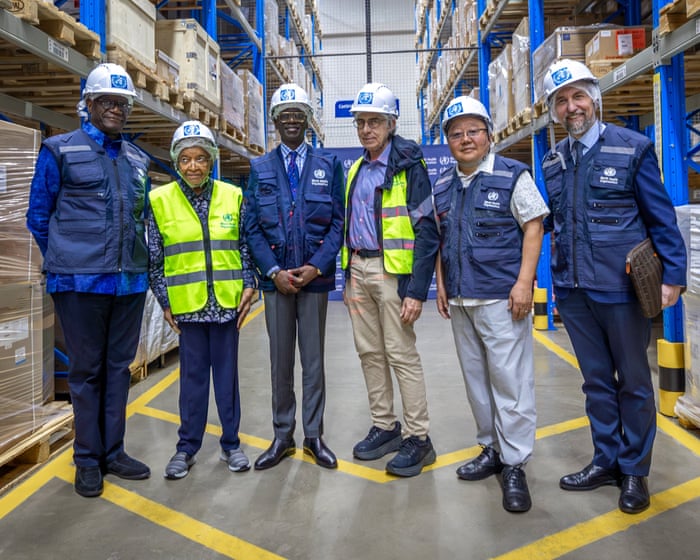
Last Thursday, about a dozen people sat around a boardroom table at the World Health Organization’s emergency hub just outside Nairobi, watching a presentation on a screen. They were told that health workers in eastern Chad had reported several deaths among patients with respiratory failure. Initial samples suggest a new type of bird flu, but confirmation requires sending samples to a foreign lab. International health rules require notification within 24 hours of assessment, but Chad’s government is hesitant to inform the WHO, fearing economic fallout and stigma.
This is a hypothetical pandemic scenario, and the people at the table include some of Africa’s most respected figures: members of the Elders, a group of former presidents and world leaders founded in 2007 by Nelson Mandela. The idea is to use their collective wisdom to tackle global crises.
“We need to work together because we never know where it will happen,” said Denis Mukwege, a Nobel laureate.
This group of Elders, alongside WHO representatives, is taking part in the simulation to better understand how Africa is preparing for the next pandemic, to counter emerging infectious diseases and health security threats, and to help them advocate for better readiness and response.
The group listens to a presentation about how the WHO supports African countries. Photograph: Legend shot it/The Elders Foundation
The first scenario’s challenge is direct: if you were Chad’s head of state, how would you ensure your health minister follows international health rules to report the situation, and what assurances would you need from partners that timely notification would be supported?
Ernesto Zedillo, a former president of Mexico. Photograph: Legend shot it/The Elders Foundation
Ernesto Zedillo, a former Mexican president, gives the first response. He thinks incentives are needed for governments “to do the right thing.” “What will the international community do to reassure governments that this is not only their duty but that they will be acknowledged as being compliant?” he asks, citing South Africa’s experience of being punished with travel bans and restrictions for detecting a new Covid-19 variant during the pandemic in 2021.
On the opposite side of the table, Zeid bin Ra’ad bin Zeid al-Hussein, a former UN high commissioner for human rights, says health policymakers should model their response on what works in other sectors. “What I think we need to do,” he says, “is look at the stronger systems we have—where there is really strong verification—and say, ‘Why don’t we bring the rest of these systems up to meet them?'”
Ellen Johnson Sirleaf, a former Liberian president, says problems complying with international regulations on reporting pandemics often stem from weak healthcare systems. Photograph: Legend shot it/The Elders Foundation
The former Liberian president Ellen Johnson Sirleaf offers a different view, saying the problem often comes from weak healthcare systems in reporting countries that lack the ability to identify and report pandemics properly, and therefore cannot pressure governments to report their findings. “Most times, it is not a lack of political will as much as it is a failure of the systemic capability,” she says.
For about an hour, the Elders go through scenarios and exercises that show real-time decision-making on how geopolitical, climate, and conflict risks can worsen responses to outbreaks. They draw on their collective experience and wisdom from past outbreaks during their time as leaders.
“Outbreaks will continue—how we manage them, that’s the issue,” said Dr. Mohamed Janabi.
The session is preceded by a presentation from WHO personnel about how the organization supports African countries in preparing for, detecting, and responding to health emergencies, and another about a new AI tool.A system was set up to help make decisions about health threats. The simulation takes place during a hantavirus outbreak and – by coincidence, but also as a sign of the growing global danger of disease emergencies – just one day before health officials announce an Ebola outbreak in Uganda and the Democratic Republic of the Congo that has already killed at least 139 people.
Everyone in the room is also aware that negotiators missed this month’s deadline to finalize a global pandemic treaty, first announced during COVID in 2021. The agreement was meant to outline how countries should share information about pathogens that could cause pandemics, and what access they should be guaranteed in return, such as vaccines, tests, and treatments.
The delay in reaching such a treaty highlights the lack of trust between richer and poorer countries, especially in Africa, which faced vaccine inequality and received few doses during the pandemic. Many believe the continent was essentially abandoned while wealthier countries stockpiled vaccines.
During the simulation, the Elders are given another scenario. Chad has finally notified WHO, but only after two weeks, when the situation has gotten much worse. Cases are starting to appear in northern Cameroon, and severe flooding has cut off transport routes, causing further delays in sending pathogens to an international lab. How can WHO and its international partners better prepare for health and climate crises that will increasingly happen at the same time?
To get “a complete picture,” Hussein calls for collaboration between science and climate experts to combine and make sense of knowledge. “Many of us work in both the climate space and even climate science space,” he says. “And I don’t see too many health experts in that space, and I don’t see it the other way around either.”
Sirleaf agrees: “The international integrated system or integrated response is not there yet.”
Speaking afterwards, Denis Mukwege, a Congolese gynecological surgeon and Nobel laureate, points to his country’s response to outbreaks of Ebola and mpox. He says the simulation highlights the importance of multilateralism, quick reactions to outbreaks, and the political will for countries to work together.
“We need to work together because we never know where it will happen. And we need to get all the people to be ready when it happens,” he says. “We need really to understand that when we have the outbreak, it can go far and sometimes it can go beyond our borders.”
Dr. Mohamed Janabi, WHO’s regional director for Africa, says the exercise has offered a glimpse of the frontline reality in Africa, where the organization recorded 146 emergency disease outbreaks last year. “You have seen what we face here,” he tells the Elders. “Outbreaks will continue; how we manage them, that’s the issue.”
Frequently Asked Questions
Here is a list of FAQs about a group of former world leaders practicing crisis response with hard hats AI and a simulated pandemic
Beginner Questions
1 Who exactly are these former world leaders
They are expresidents prime ministers and other heads of state from various countries who now participate in crisis simulation exercises
2 Why would former leaders need to practice saving the world
They arent practicing to lead their countries again They are testing new strategies and technologies in a safe environment to find better ways to handle global emergencies
3 What does a simulated pandemic look like
Its a realistic computergenerated scenariolike a new fastspreading virus The leaders make decisions about lockdowns vaccine distribution and resource allocation and the simulation shows the consequences
4 Why are they wearing hard hats
The hard hats are symbolic They represent a shift from political suits to a disaster response crew It reminds everyone they are now problemsolvers on the ground not politicians
5 What role does Artificial Intelligence play in these drills
AI helps predict how the virus will spread suggests optimal ways to deploy medical supplies and analyzes the leaders decisions in realtime to show which choices save the most lives
Advanced Questions
6 How is this different from a typical government tabletop exercise
Government exercises are often confidential and focused on protocol This group is independent and focuses on failurethey purposely try highrisk ideas to see what happens without political consequences
7 What is the biggest flaw these former leaders have discovered in realworld crisis response
The most common flaw is slow decisionmaking due to bureaucracy The simulation shows that waiting for perfect data often costs more lives than acting quickly with imperfect data
8 Can the AI in these simulations make unethical recommendations
Yes and thats the point The AI might suggest sacrificing one region to save another or implementing extreme surveillance The leaders then have to debate whether the optimal AI answer is morally acceptable
9 What is a specific practical tip that has come out of these drills
One key tip