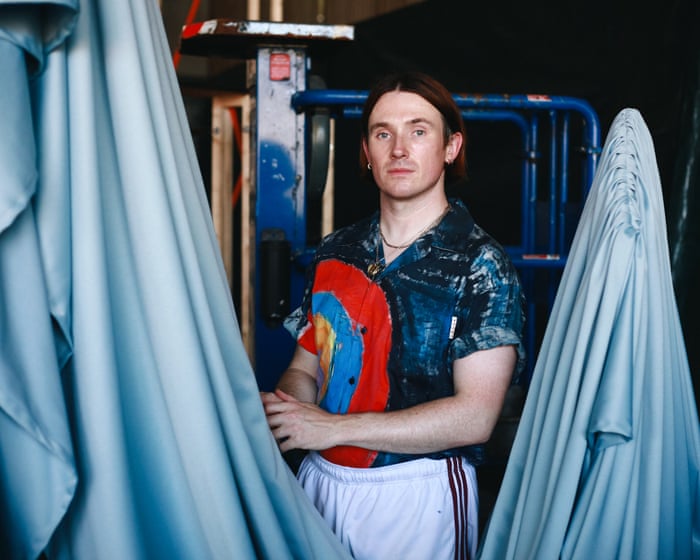
“Just so you know,” Richard Malone says before we start talking, “if you hear any neighing, it’s not me!” The Irish artist is speaking to me from an unusual workspace: a farm in Stradbally, County Laois. There might be the occasional horse wandering in, looking for attention, but the farm also has huge lambing sheds—perfect for Malone to build his latest five-metre sculptures.
“There are lovely lambs everywhere and about 20 dogs running around,” he says with a smile. “Exactly what I’d want around me.”
Malone moved to the farm after being asked to create a sculpture installation for the Council of the European Union’s Justus Lipsius and Europa buildings (Ireland takes on the EU presidency this month). The work is called Cuimhne agus Séadchomhartha (Memory and Monument), and it will feature his colourful fabric creations, which, with their dramatic drapes and folds, almost look like mythical creatures. His goal, he says, is to rewrite what it means to be Irish.
“A lot of artwork in Ireland was mostly made by one type of man,” he says, pointing out how much historical work by queer and female artists and craftspeople has been erased or left unnamed. “It’s like in museums, where what we see is often the result of what British men on grand tours chose. Those men weren’t exposed to types of work involving cloth or stitching. So when they’re discovering, say, the mummies in Egypt, and they’re wrapped in these amazing quilts and fabrics, they just cut through them to get to the gold.”
“What I’m asking is: why aren’t certain stitch samplers or certain quilts collected? Why aren’t certain artists in our curriculum?”
Along with the soft sculptures, Malone is filling the buildings’ presidency suites with work by contemporary Irish artists, makers, and craftspeople: sofas for delegates to sit on, rugs to walk over, vessels made from polished wood. All of this comes from Malone’s background. Born into a working-class family in Wexford, he learned practical skills from his father, a decorator. By age seven, he could drive a car, and he spent his teenage years on various building sites, painting. “I’m very sensitive to colour,” he says. “Because I spent so much time literally watching paint dry.”
Malone didn’t follow a formal education path—instead, he picked up his love of sewing from his grandmother, fascinated by how gender determined who did certain jobs. His work aims to break down such binaries and raise traditional, overlooked crafts to the level of fine art.
After studying sculpture in Carmarthen, Wales, Malone felt like an outsider as a fashion student at Central Saint Martins in London. For a few years after graduating, he found a niche making custom pieces for “wealthy women.” He also got a call from Björk. “My first favourite song was It’s Oh So Quiet,” says Malone, “because as a child you can go really wild to it.” He’s worked with the Icelandic musician many times since, designing the striking dress she wore in the video for Atopos. “We’re on the same wavelength, so it’s all been very natural—no PR involved or brand deals or any of that stuff.”
Still, Malone never felt fully at home in the fashion world. He became disillusioned with peers and celebrities who took on lucrative contracts to promote unethical brands: “All you have to do when they email is say no,” he shrugs. “I think everyone needs a bit more integrity.”
An internship at a luA luxury brand founder opened his eyes to the fashion industry’s major sustainability problems. “So much of how your work is judged [in fashion] comes down to how much you sell. But honestly, given the state of the world, do we really need 100,000 of anything?” He laughs: “I always thought there would be some authority that would say, stop, you’ve made enough now!”
Moving into the art world was challenging – people seemed unsure where to place Malone. But in 2017, he designed a jumpsuit for a MoMA exhibition called Items: Is Fashion Modern?, which helped make the shift smoother. In 2023, he got a call from the Royal Academy of Arts in London: they wanted him to design the centerpiece for their summer exhibition – with only six weeks’ notice. “I could do it because my father taught me how to weld,” he says proudly of the brilliant blue hanging sculpture, titled Filiocht Faoi Bhron, as an Dorchadas (Poem in the Dark About Sadness).
Before he passed away earlier this year, Malone’s father, James, helped with many of his son’s exhibitions: laying down carpet underlays to cover ugly flooring or “thinking about practical things like rusting.” He also helped make the display cases for a show responding to the work of modernist architect Eileen Grey (also from Wexford), which was shown at her iconic villa E-1027 – a building famously vandalized by a completely naked Le Corbusier during what many believe was a fit of jealous rage.
“There’s a lot of red tape around the safety of the building” … Cuimhne agus Séadchomhartha (Memory and Monument). Photograph: Richard Malone
The EU headquarters will be another unusual space for Malone to work with. “There’s a lot of red tape around the security and safety of the building – things like bomb threats and other issues that need to be cleared during a global emergency,” he points out.
Other presidencies, he says, have commissioned “a lot of polished sculptural works, but what I’m putting in is quite fragile and delicate, in contrast with all the glass and steel.”
It’s a bold move. But then again, Malone loves to make us question what we take for granted, to think about how things work and how they could be transformed. And if that means taking on a horse as a studio assistant, then so be it. Cuimhne agus Séadchomhartha (Memory and Monument) is on display at the Council of the European Union’s Justus Lipsius and Europa buildings in Brussels from July 14 to December 31.
Frequently Asked Questions
Here is a list of FAQs about Richard Malones statement and his exhibition at the EU Council based on the article title
BeginnerLevel Questions
Q Who is Richard Malone
A Hes an Irish fashion designer known for his colorful sculptural clothing and his focus on sustainability and local craftsmanship
Q What did Richard Malone say about art in Ireland
A He said that a lot of art in Ireland was created by one kind of man meaning it has historically been dominated by a narrow group
Q What is the vibrant fabric designs thing about
A Malone is showing his unique colorful textile patterns at the EU Council building His work often uses traditional Irish techniques but with a modern inclusive twist
Q Why is this a big deal
A Its unusual for a fashion designers work to be displayed at the EU Council It highlights how fashion and art can be political and it brings Irish craft to a major international stage
IntermediateLevel Questions
Q What does Malone mean by one kind of man in Irish art
A Hes referring to the historical lack of diversity in Irish artmostly white male and often Catholic or nationalist perspectives Hes criticizing who gets to be remembered and celebrated
Q How do his fabric designs challenge that idea
A His designs celebrate queer identity workingclass communities and womens labor Hes making visible the people and stories that were left out of the one kind of man narrative
Q Is his work actually in the EU Council building
A Yes His textiles are being used to decorate the Councils public areas turning the building into a kind of gallery Its part of a cultural program to showcase European creativity
Q Does this exhibition have any political message
A Yes By putting inclusive queer and feministinspired work in a place of power Malone is saying that art should represent everyone not just the traditional elite
Advanced Practical Questions
Q How does Malones work connect to Irish history