A person is shot and nearly dies, experiencing firsthand the fragility of life. Afterward, they suffer flashbacks, find themselves unable to relax or enjoy anything, and become agitated and restless. Their relationships deteriorate under the strain. They are increasingly haunted by intrusive memories of the event.
This could easily describe many patients I’ve seen in the clinic or emergency room throughout my career as a doctor. It is a recognizable portrait of someone suffering from what we now call post-traumatic stress disorder (PTSD). But this isn’t about one of my patients. It is a description of a character from the 7,000-year-old Indian epic, The Ramayana. Indian psychiatrist Hitesh Sheth uses this as an example of how certain states of mind are timeless. Other ancient epics describe what we would now diagnose as generalized anxiety disorder, marked by excessive fear, rumination, loss of focus, and insomnia. Still others depict what sounds like suicidal depression or devastating addiction.
Research shows the human brain has changed little in the last 300,000 years, and mental suffering has likely existed for as long as we have had inner lives. We are all vessels for thoughts, feelings, and desires that flow through our minds, shaping our mental state. While some patterns of feeling are recognizable across millennia, the labels we use to understand the mind and mental health are constantly evolving—which means there is always an opportunity to improve them.
This matters because, by modern psychiatric definitions, the 21st century is witnessing an epidemic of mental illness. The line between mental health and ill-health has never been blurrier. A 2019 survey found that two-thirds of young people in the UK believed they had experienced a mental disorder. We are simultaneously broadening the criteria for what counts as illness and lowering the thresholds for diagnosis. While this might seem helpful if it leads to better care, growing evidence suggests that, as a society, it may actually be making us feel worse.
We have developed a tendency to categorize mild to moderate mental and emotional distress as a clinical problem, rather than seeing it as an inherent part of the human experience. This tendency is relatively new in our culture and isn’t widely shared elsewhere. Psychiatrists who work across cultures note that in many non-Western societies, low mood, anxiety, or even delusional states are often viewed as spiritual, relational, or religious issues—not psychiatric ones. By understanding states of mind through terms rooted in community and tradition, these societies may be more successful at integrating psychological crises into the broader narrative of a person’s life.
In the United States, mental distress is commonly classified using the Diagnostic and Statistical Manual of Mental Disorders (DSM), now in its fifth edition. In the UK and Europe, the International Classification of Diseases (ICD), in its 11th revision, is more frequently used. Both systems have expanded dramatically in recent decades, pathologizing a growing range of distressing feelings and emotions. Other classification systems have also expanded, though they vary in what they emphasize about mental life and conceptions of “normal.”
Frameworks like the DSM and ICD are culturally specific models for how to think about thinking. They are tools, useful only to the extent they help us navigate the challenges of being alive. If they fail to do that, we must question them. With statistics on mental ill-health continuing to worsen, it is clear our current approach to labeling and diagnosis is not working.
For over 20 years, I have worked as a general practitioner (the UK equivalent of a primary care physician). Of the hundreds of millions of GP appointments that take place annually in the UK, 30–40% are primarily related to mental health.Mental health is a vital part of our lives. While we are more than our passing emotions, our mental state shapes our entire existence. It filters every experience and sensation. The mind creates the world we live in and deeply affects our physical health. That’s why psychiatry is a fundamental aspect of every consultation I have. Thirty years in medicine have shown me how difficult life can be for many people, and I’ve learned not to draw a sharp line between suffering of the body and the mind.
When I worked in emergency medicine, I often witnessed defining moments in people’s lives—a car crash, a heart attack, a brain hemorrhage. In such crises, there’s little room for flexibility; rigid, lifesaving protocols must be followed. But when I became a GP, I discovered great freedom in how I conducted each consultation. I learned to adapt my approach to each patient, recognizing that how I engaged was intricately connected to the outcome and was itself part of the therapy. The Hungarian psychoanalyst Michael Balint called this “the doctor as the drug.” I had to judge when to be candid and when to be cautious, understanding what kind of doctor each patient needed. Appointment times were short, but by managing my own schedule, I could bring patients back frequently and get to know them over time.
Dr. M was my first mentor. His consultations were filled with kindness, gentleness, and a sense of tranquility. He wasn’t afraid to let silence fill the room. His great kindness meant his clinics attracted more than the usual share of people who were emotionally and psychologically distressed. No matter how dark the territory—abuse, neglect, addiction—Dr. M always found a way to bring the consultation around to something redemptive, and each patient left happier than they arrived.
After every patient I saw, he asked me to summarize the main complaint and consider the unspoken reasons they might have come. He also asked how I felt after each consultation, speaking to me about transference—how patients inevitably transfer their emotions onto you, and how much you can learn about someone by noticing how they make you feel. It struck me that the ideal state of mind for a clinical consultation was almost meditative: staying engaged and emotionally aware without becoming entangled in paralyzing compassion. For the first time in my medical career, someone was earnestly showing me how to be a good doctor—not just how to master skills, but how to be a healer rather than a technician. Dr. M called it being “an effective GP” in contrast to “another pill-pusher.”
My next supervisor, Dr. Q, was very different. I watched her make referrals and issue prescriptions entirely without kindness. Most people left her room unhappier than when they entered. Technically, the “job” was being done, but something about her manner was all wrong—focused solely on technical aspects, it had lost its humanity, and her encounters lacked any sense of healing. A sign of how little she valued her own skills was that she seemed unsure what to teach me or how to help me learn from observing her clinic. In the end, she simply told me which drugs to avoid prescribing to stay within the practice budget.
I worry that our models of mental healthcare are increasingly built for a world dominated by clinicians like Dr. Q, who approach mental health consultations as an opportunity to follow tick-box protocols from the DSM or ICD and score blunt, context-free online questionnaires. As pressure mounts to standardize and quantify care, the human element—the healing relationship at the heart of medicine—risks being lost.As pressure on the NHS grows, there is precious little space left for the humanity, curiosity, and humility of clinicians like Dr. M.
In my work, I meet people whose lives are blighted by anxiety and fear, who are depressed or manic, who have been traumatised or abused, who are psychotic or addicted. This work requires me each day to ask questions about the nature of consciousness, mood, and what makes a life meaningful.
I have met people in their 80s who, through our conversations, have realised that the root of their unhappiness lies in a sense of being neglected as an infant, almost a century ago. I have met others who have come to see that their overeating, obsessive cleaning, or alcoholism are attempts to fill an emptiness that could be better addressed in healthier ways.
Conscious experience is a flowing, dynamic river of influences—sometimes dominated by memory, sometimes by anticipation, sometimes by immediate perception. This means it can be gently guided toward health. During my GP training, I realised that some people remain in roughly predictable mental states their whole lives, while others cycle between radically different states of mind. The word “doctor” means “guide” or “teacher.” Sometimes I guide my patients through landscapes familiar to me; at other times, my patients guide me.
These mental landscapes can be perilous: our states of mind can imprison us, make us want to die, or convince us we are invulnerable. They can torment us with visions and voices, distort how we see our own bodies and those of others. They can make sleep impossible, sink us into addiction, and rob us of focus, self-control, or contentment. They can destroy families, make communication impossible, and prevent us from loving or being part of the very communities that could sustain us. Almost any aspect of mental life can go wrong, and how we understand these disturbances has huge implications for finding our way back to ease.
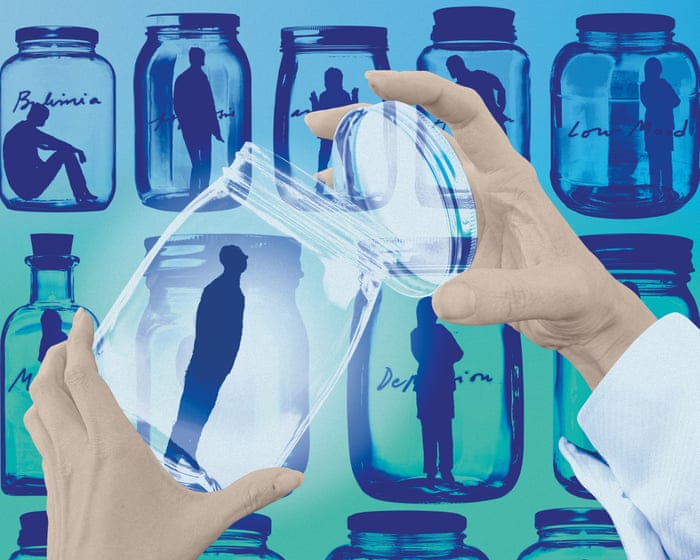
Alongside the expansion of diagnostic manuals like the DSM and ICD, it has become routine to talk about mental suffering as caused by discrete disorders. I am encountering more people who believe the labels we give mental suffering are fixed realities, based on hard neurological evidence, and therefore determine a kind of fate. Yet, even among these same patients, I see growing unease with mental health labelling and an increasing awareness that such labels can become self-fulfilling. Many are surprised to learn that the terms we use—and that our culture enthusiastically exports worldwide—were not derived from lab science but were decided in committee rooms by groups of Western doctors.
Many people now use “mental health” interchangeably with “mental illness”—as in, “I’m here for my mental health, doctor.” This language has had real benefits: it has destigmatised emotional and mental distress, encouraged people to seek help, and fostered communities of support. But medical words are powerful, and labels can become self-fulfilling spells that curse as often as they cure. Today’s worrying statistics on deteriorating mental health may reflect long-overdue recognition of widespread illness, or they may signal a trend toward pathologising normal human experience.
As a GP, I cannot simply pick a side in this polarised debate—my job is to help the patients who come to me, whatever perspective they bring. But the first ethical principle of medicine is “do no harm,” and I worry that some of the labelling my profession so enthusiastically embraces may ultimately do more harm than good.more harm than good.
Although the suffering caused by mental distress is as serious as any physical suffering and can sometimes be life-threatening, history shows that our ways of understanding it change over time. The word “emotion” took on its current meaning in the 1830s; before that, people more often spoke of “sentiments,” “spirits,” or even “humours.” I imagine a day will come when the simple lists of psychiatric diagnoses in today’s DSM and ICD will seem as overly confident as old phrenology charts, which claimed that a person’s traits could be measured by the shape of their skull.
Around the world, different cultures view mental disturbances in completely different ways—sometimes with better outcomes. Shekhar Saxena, a former director of mental health at the World Health Organization, once said he would rather be diagnosed with schizophrenia in Ethiopia or Sri Lanka than in the West. In those countries, he explained, there’s a greater chance of building a life that continues to feel meaningful, of making sense of your experiences, and of staying connected to your community.
Human culture is steeped in language. We rely on concepts to understand the world, and different languages and cultures approach thinking, feeling, and being in different ways. The psychoanalyst and writer Clarissa Pinkola Estés once summarized some of the alternative ways her clients had described their mental states over the years—far from the lists in the ICD. They spoke of feeling “dry, fatigued, frail, depressed, confused, gagged, muzzled, unaroused. Feeling frightened, halt or weak, without inspiration, without animation, without soulfulness, without meaning, shame-bearing, chronically fuming, volatile, stuck, uncreative, compressed, crazed. Feeling powerless, chronically doubtful, shaky, blocked, unable to follow through, giving one’s creative life over to others, life-sapping choices in mates, work or friendships, suffering to live outside one’s own cycles, overprotective of self, inert, uncertain, faltering, inability to pace oneself or set limits.”
It’s a rich inventory—immediately recognizable and very different from any textbook list—and far more helpful to me as a clinician. Pinkola Estés believed that forcing her clients’ experiences into a rigid, one-size-fits-all table of diagnoses would dishonor the depth of what they were going through—and wouldn’t help them heal.
In my own clinical practice, I no longer use those categories. Instead, I try to acknowledge that there must be countless states of mind—perhaps as many as there are people who experience them, multiplied by the moments of their lives. I speak in terms of distress, pain, and suffering, rather than labels. Every state of mind influences every other: some kinds of anxiety breed delusions; some forms of neurodiversity bring on anxiety; emotional trauma can worsen addiction; addictions can fuel depression, and so on. We don’t experience our mental lives in isolated chunks, but as flowing streams of experience. Your mind is part of nature, and nature’s rule is that everything flows.
In medical school, my tutors spoke of Charles Sherrington’s work with hushed awe. He was the first to use the word “synapse” to describe the connections between brain cells, and the first to recognize how networks of brain cells work together in concert, communicating in circuits or loops. One famous passage of his imagines the change that comes over the cerebral cortex as it wakes from sleep:
“The great topmost sheet of the mass, where hardly a light had twinkled or moved, becomes now a sparkling field of rhythmic flashing points with trains of travelling sparks hurrying hither and thither. The brain is waking and with it the mind is returning … Swiftly the head mass becomes an enchanted loom where millions of flashing shuttles weave a…”A dissolving pattern, always meaningful yet never permanent.
Sherrington described the brain as an “enchanted loom,” weaving conscious experience at a time when factory looms were among the most complex machines. Yet from today’s perspective, his neurophysiology was primitive and offered few clues for relieving mental illness.
The discovery in the 1950s and 1960s that certain drugs could alter mental states gave rise to the idea that adjusting chemicals in the synapses between brain cells could cure mental distress. This is misguided, flawed science, and has been proven incorrect. A 2023 study published in Nature reviewed all the evidence and concluded that “the huge research effort based on the serotonin hypothesis has not produced convincing evidence of a biochemical basis to depression … We suggest it is time to acknowledge that the serotonin theory of depression is not empirically substantiated.” This is a profoundly significant finding, but it has not yet been fully absorbed into our broader culture. As a society and a medical community, we have yet to emerge from the blind alley that the serotonin theory of mood led us down.
In the 1990s, as the human genetic code was deciphered, there was great hope that genetic markers for mental disorders would soon be found. Instead, we have discovered hundreds of genes that may be partially involved, each interacting with others in bewildering ways; even identical twins do not express the same genes at the same time. In less than a century, we have moved from a model of brain function as an enchanted loom, to one of synaptic chemistry, to one of genetic determinism, to the modern view of the brain as a “connectome” of circuits and loops with varying bandwidths, like a computer—which, I predict, will eventually be disproven in turn.
A century from now, our current approach will likely seem at best quaint, at worst barbaric. Despite billions of dollars in research spending by both governments and pharmaceutical companies, we still have little understanding of how shifts in mood are governed at the neural level—neither the fleeting spirits that come and go daily, nor the background moods that shift slowly, often imperceptibly, over months and even years. It is fascinating that each theory over the past century has mirrored the high technology of its time.
Doctors speak of “constellations” of symptoms, as if the body were a galaxy and diagnosis simply the imposition of stories upon the patterns of nature. In medical school, I was taught to understand mental experiences using constellations of symptoms that point to a specific mental health diagnosis with its own label—depression, generalized anxiety, obsessive-compulsiveness, attention-deficit, schizophrenia.
But as a GP, what I see in the clinic is never a set of labels, but unique blends of strengths and vulnerabilities, with vast areas of overlap between different conditions. I have come to see how mental suffering exists in thousands of gradations, from minor unhappiness to suicidal depression, or from mild suspicion to psychotic paranoia. In mental illness, symptoms do not point to causes: one person may withdraw to bed, unable to leave the house, due to a paralyzing crash in mood, while another might withdraw out of terror of what lies beyond their front door. One person could develop anorexia from an obsession with food or thinness, while another develops it because a traumatic, abusive childhood left a legacy of needing to control what goes in and out of the body.
The best psychiatry focuses on strengths rather than weaknesses. I have come to appreciate more fully how just a little of certain traits—such as obsessiveness, elation, or rumination—can be helpful, while an excess is usually harmful.Anxiety can be harmful in excess, but a little keeps us safe. When it grows overwhelming, we must learn to manage it. Our minds’ ability to imagine and distort reality points to a core human trait: creativity. Yet when that ability runs wild, it can ruin lives. (Psychotic illness, where reality itself feels distorted, carries a higher suicide rate than depression.)
A person prone to high spirits and boldness can enrich a community—we need rule-breakers and dreamers who believe anything is possible. But if those feelings spiral into mania, they can destroy relationships and careers. A student labeled with ADHD might disrupt a classroom, yet that same energy and multitasking can be a gift in other situations. Even low mood is, at heart, a painful sense that life should feel better. Every mental health issue I encounter stems from a tendency that, in milder form or a different context, could enhance well-being rather than harm it.
If we treated labels more flexibly, recognizing they oversimplify human complexity, could we build a society more accepting of difference? Might that reduce stigma, foster hope, and open more paths to recovery? With each patient, I explore what helps them become “unfragile”—able to bend with life’s challenges rather than break. Our minds are not brittle, but dynamic, creative, and adaptable. Change isn’t just possible for the mind; it’s inevitable. To counter the mental health crisis, we need fewer rigid categories and more curiosity, kindness, humility, and hope.
Frequently Asked Questions
FAQs Are We Diagnosing Mental Illness Too Often
BeginnerLevel Questions
What does it mean to diagnose mental illness too often
It means applying clinical labels to people whose emotional distress or behavior might be a normal reaction to life circumstances a temporary struggle or a personality difference rather than a disorder
Why is overdiagnosis considered a problem
It can lead to unnecessary medical treatment make people see themselves primarily through a sick lens overlook social or environmental causes of distress and divert resources from those with severe mental illness
Isnt getting a diagnosis helpful
Yes often A correct diagnosis can provide validation access to effective treatment and a path to feeling better The concern is about diagnoses that are incorrect or unnecessarily applied
Whats the difference between normal sadness and clinical depression
Normal sadness is typically linked to a specific event comes in waves and doesnt completely shut down your ability to function or feel moments of pleasure Clinical depression is more persistent pervasive and significantly impairs daily life often with physical symptoms like changes in sleep and appetite
Can a diagnosis ever be harmful
Yes A label can lead to stigma selfdoubt and a sense of being permanently broken It might also lead to treatments with side effects that arent needed if the core issue is situational
Advanced Practical Questions
What are the main forces driving overdiagnosis
Several factors pressure for quick solutions in short medical appointments the influence of pharmaceutical marketing the need for insurance companies to have a code for reimbursement and a cultural tendency to medicalize human suffering
How does the current diagnostic system contribute to this
The DSM uses checklists of symptoms This can make diagnosis seem like a simple tally potentially missing the persons unique story strengths and context Boundaries between normal and disordered are sometimes arbitrary
What is medicalization and how does it relate
Medicalization is the process of defining a life problem as a medical condition requiring treatment While helpful for clear disorders it can pathologize normal human experiences like grief shyness or childhood exuberance
Are some diagnoses more prone to overuse than others
Yes Conditions like ADHD