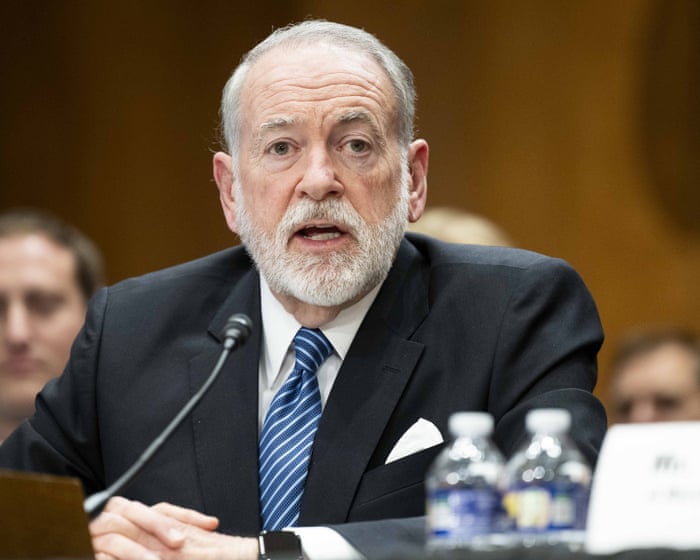
Arab and Islamic nations have jointly condemned comments made by the U.S. ambassador to Israel, Mike Huckabee, after he suggested Israel has a biblical right to a vast portion of the Middle East. Huckabee, a former Baptist minister and staunch supporter of Israel, made the remarks during an interview on Tucker Carlson’s podcast.
In the episode released on Friday, Carlson questioned Huckabee about a biblical verse sometimes interpreted as granting Israel the land between the Nile River in Egypt and the Euphrates in Syria and Iraq. In response, Huckabee stated, “It would be fine if they took it all.” However, when pressed further, he clarified that Israel is “not asking to take all of that,” calling his earlier statement “somewhat hyperbolic.”
The backlash intensified on Sunday as more than a dozen Arab and Islamic governments, along with three major regional organizations, issued a joint statement denouncing the ambassador’s comments as “dangerous and inflammatory.” The statement, released by the United Arab Emirates’ foreign ministry, was signed by the UAE, Egypt, Jordan, Indonesia, Pakistan, Turkey, Saudi Arabia, Qatar, Kuwait, Oman, Bahrain, Lebanon, Syria, and the State of Palestine, as well as the Organization of Islamic Cooperation, the Arab League, and the Gulf Cooperation Council.
They argued that the remarks violate the UN Charter and undermine efforts to de-escalate the war in Gaza and advance a political solution for a comprehensive settlement. Earlier, several Arab states had issued individual condemnations. Saudi Arabia described the ambassador’s words as “reckless” and “irresponsible,” while Jordan called them “an assault on the sovereignty of the countries of the region.” Kuwait decried a “flagrant violation of the principles of international law,” and Oman said the comments “threatened the prospects for peace and stability” in the region.
Egypt’s foreign ministry reaffirmed “that Israel has no sovereignty over the occupied Palestinian territory or any other Arab lands.” The Palestinian Authority stated on X that Huckabee’s words “contradict U.S. President Donald Trump’s rejection of Israel annexing the West Bank.”
On Saturday, Huckabee posted twice on X to clarify his position on other topics discussed in the interview but did not address his remark about the biblical verse. Meanwhile, the speaker of the Israeli parliament, Amir Ohana, praised Huckabee on X for his overall pro-Israel stance in the interview and accused Carlson of spreading “falsehoods and manipulations.”
Frequently Asked Questions
Of course Here is a list of FAQs about the controversy surrounding Huckabees comments on Israeli land designed to be clear and accessible
BeginnerLevel Questions
1 What exactly did Mike Huckabee say
He stated that the land of Israel belongs exclusively to the Jewish people citing a biblical covenant and suggested that any division or concession of this land is against Gods will
2 Why are people calling his comments dangerous
Critics argue that dismissing Palestinian claims to land and rights based solely on religious doctrine undermines peace efforts fuels extremism and ignores the political and humanitarian realities on the ground They see it as a rejection of a twostate solution
3 Who is Mike Huckabee and why do his comments matter
He is a former governor former presidential candidate and a prominent conservative political commentator and evangelical Christian leader His views carry significant weight with a portion of the American electorate and can influence political discourse and policy
4 What is the biblical covenant hes referring to
Its the belief held by some Christians and Jews that God promised the land of Canaan to the descendants of Abraham in an eternal covenant as described in the Hebrew BibleOld Testament
5 Is this just a political disagreement or is it bigger
Its both It sits at the intersection of US domestic politics foreign policy international law and deeply held religious beliefs making it a highly charged and complex issue
Advanced Practical Questions
6 How do Huckabees comments relate to the broader US debate on Israel policy
They highlight a major divide One side emphasizes unwavering biblicallybased support for Israeli sovereignty over all disputed territories The other side prioritizes a negotiated twostate solution based on international law and mutual recognition viewing the former approach as an obstacle to peace
7 Whats the difference between a religious claim to land and a legalpolitical one
A religious claim is based on scripture and faith A legalpolitical claim is based on modern international law UN resolutions historical presence and bilateral agreements The conflict often arises when these two types of claims are presented as mutually exclusive