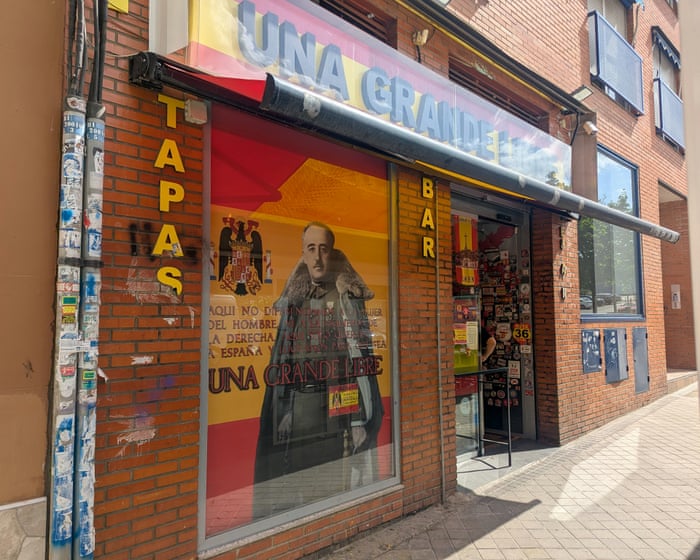
A sign above the entrance to a bar-restaurant in Madrid’s Usera neighborhood reads “Una Grande Libre.” This was Francisco Franco’s slogan for Spain—one, great, free—and it’s paired with a large portrait of the dictator displayed on the window.
The exteriors of El Cangrejo in Ciudad Real and Casa Pepe in Despeñaperros are a bit more subtle, but not by much: they’re flashily decorated in the red and yellow of the Spanish flag. The historical symbols on display, like the yoke and arrows of the Falange and the Eagle of San Juan, leave no doubt: it’s 2026, and you’ve come across one of Spain’s bars and restaurants that proudly celebrate Franco and his dictatorship.
These unsettling and unusual places tell a vivid story about how Spain deals with its past—or fails to. They seem even more confusing given Pedro Sánchez’s recent historical memory laws, and they raise the question: how do these places still exist?
Portraits of the dictator are a must in these restaurants. For example, you’ll find them on the tables at Ávila’s El Rincón Nacional, alongside the 1kg steaks they serve. Una Grande Libre has a stone bust of Franco on display, plus many pictures of him on the walls. Restaurante El Cangrejo has the most unique version I’ve seen: they’ve Photoshopped El Caudillo into a Real Madrid shirt. After a meal of rustic Spanish food, order a coffee, and you’ll find the sugar packets pay tribute to the 1981 attempted military coup. You might even hear the Francoist anthem Cara Al Sol playing on the speakers. The owner, José Antonio Delgado, is known to play it several times a day—and he answers the phone with “Arriba, España” (“Arise, Spain”), another Francoist motto.
View image in fullscreen: Interior of the Una Grande Libre bar-restaurant in Madrid. Photograph: Abbas Asaria
Casa Pepe even has a shop attached, where, besides a variety of cheeses and cured meats, you can buy all kinds of memorabilia for the dictatorship-nostalgist in your life: tote bags with Franco’s face, or tins of pimentón de la Vera (Spanish smoked paprika) designed like the Francoist flag.
Most of these places are roadside bars along the motorway, which (along with the year of Franco’s coup, 1936) inspired Ruta 36, a US-style highway pilgrimage. Some of these bars will even give you a free meal if you arrive with a stamp from each bar on the route.
Spain has too rosy a view of Franco’s regime. Let’s remind ourselves of its horrors | Giles Tremlett
Read more: Una Grande Libre stands out from the others. Partly because it’s near the center of Madrid, not in the middle of nowhere, and partly because its owner is Xiangwei Chen, a Chinese immigrant who has not only opened a bar honoring the nationalist dictator of his new home but even named his son Franco. He’s become a minor public figure in Spain, known as “el chino facha” (the Chinese fascist), a nickname you can find written on wine bottles in his bar.
These bars offer a glimpse into what modern nostalgia for the dictatorship looks like at street level. But they also highlight the long timelines and repeated setbacks faced by Spain’s historical memory movement—even when the law is on their side.
And the two are connected. Chen appeared on the news in 2019, for example, when Franco’s remains were finally moved to Mingorrubio cemetery, eight years after the Zapatero government first proposed it. Franco’s previous resting place, the Valley of the Fallen (as it was then known), marked by the tallest cross in the world, was a memorial he commissioned for those who died fighting for his “glorious crusade” to take power. His burial site there served as a shrine for Spain’s far right.
Chen was also awarded the title of “knight of honor” by the National Francisco Franco Foundation in 2016, an organization created to honor his legacy.After his death in 1975, it’s surprising enough that such an organization exists at all—especially if you try to imagine a German equivalent. But even more shocking is that it received €150,000 in public grants during the José María Aznar years, and donations to it were partially tax deductible. Abolishing the Franco Foundation was a key goal of the 2022 Democratic Memory Law, which was finally signed into law last month, three and a half years later.
[View image in fullscreen: Food served at the Una Grande Libre bar-restaurant in Madrid. Photograph: Abbas Asaria]
This isn’t the only part of the law that has taken years to take effect. The continued existence of the Ruta 36 bars should also be at risk in theory. Looking at the law’s wording, you can’t help but wonder how they’ve managed to keep operating so openly. The Democratic Memory Law requires the removal of any symbols that glorify the dictatorship or its key figures from “publicly accessible spaces,” which includes bars and restaurants.
But lawyer Eduardo Ranz tells me the reality of enforcement is very different: “Under this law, only the Ministry of Democratic Memory can launch an investigation into these places. What I don’t understand is why, in the last four years, they haven’t done so, even though these establishments are breaking the law. Removing these Francoist symbols is one of the government’s most important unresolved issues.”
Despite many setbacks for the historical memory movement—most recently, the overturning of a €10,001 fine against the Falange for its public tributes to pre-Franco dictator José Antonio Primo de Rivera—there have been some advances since the 2022 law. For example, the Valley of the Fallen has been renamed and repurposed as a site of “democratic memory,” with plans for a museum there.
However, as the secretary of state for Democratic Memory, Fernando Martínez López, admitted last October on the law’s third anniversary, there is still “a lot to do”—from implementing it in schools to recovering and identifying more bodies from mass graves.
Spain’s network of Francoist restaurants and bars is a constant, real-world reminder of this. So until something changes, you can still see a 2-meter-tall picture of the Spanish dictator proudly displayed in a restaurant window in the nation’s capital.
Abbas Asaria is a food writer and chef based in Madrid.
Frequently Asked Questions
Here is a list of FAQs generated based on the articles theme written in a natural conversational tone
1 I thought Spain banned Franco symbols Why are there still cafes and shops named after him
The 2007 Law of Historical Memory and the newer 2022 Democratic Memory Law ban the public display of Francoist symbols on public property Private businesses like cafes are generally not forced to change their name or decor unless they are considered to be glorifying the dictatorship in a way that violates public order or dignity laws Many of these cafes operate in a legal gray area
2 What exactly is banned now Can I still buy a Franco tshirt
You cannot buy a Franco tshirt from a governmentrun gift shop or see a statue of him in a public square However selling such a tshirt in a private shop is not automatically illegal The ban targets exaltation of the dictatorship So a private vendor selling a tshirt as a historical novelty might be okay but a shop with a big Viva Franco sign and fascist imagery could face fines or closure
3 Why dont the police just shut these tacky cafes down
Its complicated The laws are quite specific A café owner can argue the name Café Franco or the old photos on the wall are historical decoration or nostalgia not political endorsement The police and courts have to prove the café is actively promoting or glorifying the dictatorship which is a higher legal bar than just having a tacky name
4 Isnt this just a loophole How do these cafes get away with it
Yes its a significant loophole The laws were written to target official public displays of the regime They are much weaker when it comes to private commercial spaces Enforcement is also inconsistentsome local councils are proactive while others ignore the issue especially in areas where Francoist sympathies are still common
5 Wait are these cafes actually popular Who goes to them
Yes some are surprisingly popular The customers are often a mix of
Hardcore Francoists Elderly people nostalgic for the regime
Curious tourists People who find the kitsch and the history bizarrely fascinating