On a graffiti-covered backstreet in Sarajevo, a path leads past an overgrown garden to a white door. Behind it is the registered office of a company that is about to secure contracts worth over $1 billion. AAFS Infrastructure and Energy is close to winning a deal to build and run a pipeline across the Balkans, bringing fossil gas shipped from the US to replace Russian supplies. “This could be the most important infrastructure project ever in Bosnia and Herzegovina,” says a top official from the country, who, like others, asked to remain anonymous to discuss sensitive talks.
The company has no track record of attempting anything on this scale. What it does have is personal ties to Donald Trump. One of AAFS’s representatives is a Washington lawyer who has worked for the Trumps on political cases. The other is the brother of the president’s former national security adviser. Both were part of a campaign close to Trump’s heart: the effort to overturn his loss in the 2020 presidential election.
A Guardian investigation, based on interviews with current and former Bosnian and US officials, leaked documents, and corporate records, has looked into this obscure company that has been thrust into the global fight for energy dominance. It offers a glimpse of how international relations are changing under a presidency that blurs the line between government policy and enriching the ruling family and those around them.
“There’s a logic, in our current world, to having people connected to the administration involved in big economic projects or investments,” says a former senior US official in the region. “It’s unsavory, but so much of my country’s politics is unsavory these days.”
In the former Yugoslavia, the stakes go beyond who might get rich. US intervention could undermine the peace deal it brokered in 1995 to end a war that killed 100,000 people, many of them Muslim Bosniak civilians massacred by Serb paramilitaries. A generation later, Bosnia’s ethnic leaders are still jockeying for advantage. US officials have made it clear to Bosnia’s leaders what the Trump administration wants: approval for AAFS’s pipeline.
When the Guardian knocks on AAFS’s Sarajevo door, a woman calls down from an upstairs window that its local representative will be back soon. Amer Bekan arrives a few minutes later. A large, middle-aged man, he says AAFS’s office will move to a big building with 100 employees. Bekan’s online CV calls him an “investor and entrepreneur with extensive experience.” He has also tried politics. After coming last with 116 votes in a 2016 run for mayor in central Sarajevo, another campaign in 2020 led to accusations of abusing elections for personal gain, which he denied.
Bekan registered a Bosnian company called AAFS in 2021. It only hit the big time after he brought in his American partners last year. Neither he nor they will say how they were introduced. Bekan’s AAFS is now owned by a US company of the same name, registered in November. Located in a tourist district by the Potomac River, the address AAFS gives for its Washington office sits between a Lebanese restaurant and an Irish pub. A sign identifies it as the premises of Binnall Law Group.
Jesse Binnall is a leading lawyer fighting the Maga cause. He was an aide to the 2016 campaign that carried Trump to the White House. In 2020, he was a leading voice undermining Joe Biden’s victory. He declared: “Donald Trump won … after you account for the fraud and irregularities that occurred.” He defended Trump and his oldest son, Donald Trump Jr., against a lawsuit.A lawsuit that sought to hold them accountable when rioters tried to overturn the election results by storming the Capitol building.
Get in touch
Contact Tom Burgis about this story
If you have something to share about this story, you can contact Tom using one of the following methods:
Secure Messaging in the Guardian app
The Guardian app has a tool for sending tips about stories. Messages are end-to-end encrypted and hidden within the routine activity that every Guardian mobile app performs. This stops anyone watching from knowing you’re communicating with us at all, let alone what you’re saying.
If you don’t already have the Guardian app, download it (iOS/Android) and go to the menu. Select ‘Secure Messaging’. To send a message to Tom Burgis, choose the ‘UK Investigations’ team.
SecureDrop
If you can safely use the Tor network without being watched or monitored, you can send messages and documents to the Guardian through our SecureDrop platform.
Finally, our guide at theguardian.com/tips lists several ways to contact us securely and discusses the pros and cons of each.
Show more
View image in fullscreen
One of AAFS’s representatives is a Washington lawyer, Jesse Binnall, who has worked for the Trumps in political cases. Photograph: Greg Nash/UPI/Shutterstock
Since Trump returned to power last year, Binnall has secured a $1.25 million settlement from the Justice Department for Michael Flynn, who briefly served as national security adviser in the president’s first term. Despite admitting he lied to the FBI about secret contacts with Russia, Flynn claimed he was wrongfully prosecuted.
Binnall also got to know Flynn’s brother Joe, a healthcare entrepreneur. They were fellow campaigners in the effort to discredit Biden’s victory. Flynn served as president of one of the movement’s best-funded groups, the America Project. And he was an adviser to Trump’s 2020 and 2024 presidential campaigns.
The White House referred questions to the State Department, which said: “The Southern Interconnection gas pipeline, which has been a [US government] priority for the past three administrations, will expand and diversify Bosnia and Herzegovina’s energy sector. It will give BiH greater control over its energy supply by providing access to market-based natural gas and reducing dependence on a single, unreliable source.”
Flynn and Binnall’s qualifications for a Balkans infrastructure project aren’t immediately clear. But since they joined, the project has had full support from the Trump administration.
View image in fullscreen
The address AAFS gives for its Washington office sits between a Lebanese restaurant and an Irish pub, and a sign identifies it as the premises of Binnall Law Group. Photograph: Joseph Gedeon/The Guardian
No competitive tender process
Binnall, Flynn, and Bekan’s initial talks with Bosnian officials last autumn were about a $300 million renovation of two airports. Then the Bosnian officials suggested they take on a much bigger project: the Southern Interconnection pipeline.
The US has long supported the plan to connect Bosnia to a gas terminal on Croatia’s coast, which would reduce Vladimir Putin’s influence in southern Europe. During Biden’s time, the idea was for Bosnia’s state gas company to run the project. But the competing interests of Bosnia’s ethnic factions caused repeated delays.
While some Bosnian officials were wary of handing the project to foreign private interests, others saw hiring a company linked to Trump as a chance to break the deadlock.
Time was running short. Bosnia is a candidate to join the EU, and Brussels has set a September 2027 deadline to stop buying gas from Russia, which currently supplies all of Bosnia’s needs.
Some senior Bosnian figures calculated that hiring an American company could help not just energy security but also broader safety in a region where war is still a living memory. As Bekan says: “The US government protects its investments.”
Yet some analysts fear Bosnia risks swapping one bully for another. No one seems willing to risk angering Trump, even ifThis means they are putting their hopes for a vital new energy pipeline into a project that has never shown it can actually get the job done.
Jesse Binnall secured a $1.25 million settlement from the Justice Department for Michael Flynn, who served as national security adviser during the president’s first term.
Photograph: Carolyn Kaster/AP
When asked who the shareholders of AAFS are, Bekan says Binnall and Flynn, plus others he won’t name. He suggests the money could come from “investment funds in the United States,” but says he can’t give more details.
Binnall says: “We are the right team for this. No other group has both a presence on the ground in Bosnia and strong support in America. We’re excited to take this step because we believe Bosnia and Herzegovina is the future.”
A confidential AAFS proposal seen by the Guardian says the pipeline will cost €300 million (£260 million), with another €900 million (£780 million) for three power plants. The funding will come from equity and debt, not from the Bosnian state. It doesn’t say what returns Flynn, Binnall, and others involved expect for themselves.
In March, new Bosnian legislation named AAFS as the pipeline contractor. There was no competitive bidding, which is the usual way to make sure contracts go to a capable bidder at a fair price.
Transparency International said: “Setting up such a practice in a country with one of the highest corruption levels in Europe would lead to disastrous results in carrying out strategically important projects like the Southern Interconnection gas pipeline.”
Days later, as the Guardian revealed, the EU’s ambassador privately warned Bosnia’s leaders that they should consult with Brussels on any changes to energy policy, to “avoid missing out on opportunities for further integration, as well as financial opportunities.”
The US is not backing down. “This partnership strengthens energy independence and ends reliance on Russian gas,” its embassy in Sarajevo posted on X in April. “A new era for energy security in the Western Balkans has begun.”
But any new era won’t start until the Southern Interconnection is built. For that to happen, the Trump administration will need the friendship of a man who wants to break the country apart.
An ultranationalist wants to tear up the peace agreement
Milorad Dodik, the ultranationalist leader of Bosnia’s Serbs, was until recently treated as an outcast by Washington.
The Biden administration accused Dodik of abusing his public office “to accumulate personal wealth through graft, bribery, and other forms of corruption” and expanded sanctions against him and his family. “His divisive ethno-nationalistic rhetoric reflects his efforts to … divert attention from his corrupt activities,” a US Treasury statement said. Dodik called the sanctions “lies.”
When Trump returned to the presidency, Dodik launched a multimillion-dollar lobbying campaign to win the Trump administration’s support and have the sanctions lifted. The lobbyists portrayed Dodik’s Serb nationalists as Trump’s allies against Islam. One of them was Michael Flynn, who earned $100,000 for a month’s work.
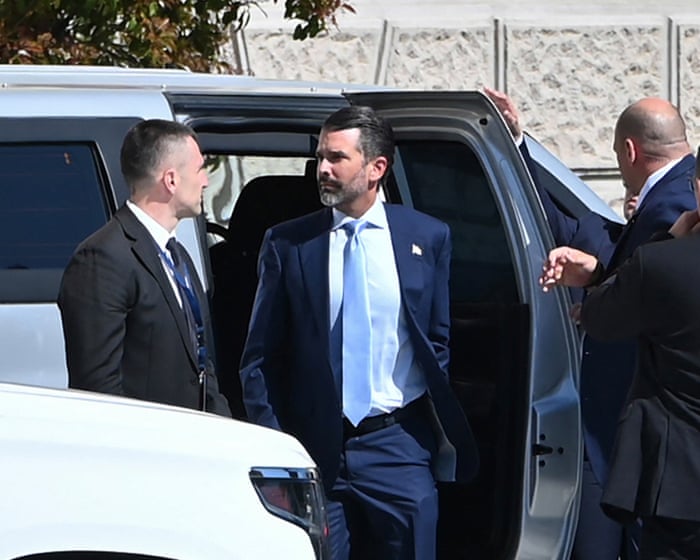
In October, without explanation, the Trump administration lifted the sanctions. On April 7, Donald Trump Jr., who manages the family business empire, landed in Banja Luka, the main city in the Serbian part of Bosnia, for an event in his honor.
Dodik’s son, Igor, gave Trump Jr. a warm welcome. “Your presence says a lot,” he said. “We depend on you and rely on you. In return, you, America, and the Republican administration led by your father will have a reliable, truthful, and Christian ally in this part of the world.”
Michael Murphy, a former US ambassador to Bosnia, says Dodik is trying to win favor in Trump’s circles as he seeks to tear up the 1995 peace accord by declaring the Serb region independent.Dependent. “He wants them to get behind his bigger plan. To make that happen, he can’t mess with the pipeline.” He adds that those who support him are “playing with fire.”
Under Bosnia’s power-sharing system, the Serbs could block the pipeline. Dodik, who remains their leader even after stepping down from his official role, has every reason to do so. Like Hungary’s recently defeated Viktor Orbán, Dodik is an ally of Putin. Not only does Bosnia’s current pipeline bring in Russian gas, boosting Putin’s influence in the Balkans, but it also runs through Serbian territory, giving them control over energy supplies.
However, a senior Bosnian Serb politician says: “I saw this myself: the Americans here have one top priority, and that’s the pipeline. They’re very, very serious about it. Dodik, like everyone else, was told: Don’t mess with this project.”
Trump Jr. didn’t mention the pipeline or AAFS during his event. But he praised the benefits of buying American gas. “That’s a no-brainer,” he said. “You can solve so many problems—both in business and, frankly, geopolitically—with this one issue. I think it’s a major opportunity.”
On April 21, shortly after Trump Jr.’s visit, Dodik indicated he wouldn’t block Binnall and Flynn’s plan. That leaves the Trump associates’ takeover of a key European energy project nearly complete.
Additional reporting by Joseph Gedeon in Washington.
Frequently Asked Questions
Here is a list of FAQs about the situation ranging from basic to more detailed questions
BeginnerLevel Questions
Q What is this company and why havent I heard of it before
A The company is a relatively small private energy firm Its not a household name like Exxon or Shell Its been largely unknown because it doesnt have a major public profile or stock market listing
Q How is the company tied to Donald Trump
A The connection is typically through business partners former administration officials or family members who have worked with or for the company The specific ties vary but they often involve people who served in Trumps White House or have done business with his organization
Q Where exactly are these energy contracts
A The contracts are in the Balkans region of Europe specifically in countries like Albania Kosovo and North Macedonia These are for building power plants and energy infrastructure
Q Is this a big deal
A Yes A 1 billion contract is enormous for a littleknown company Its also significant geopolitically because the Balkans are a strategic area where the US China and Russia all compete for influence
Q Why would a small company get such a huge deal
A Thats the central question Critics argue the Trump ties gave the company credibility and access Supporters say the company simply had a good business plan and local connections
Advanced Deeper Questions
Q What specific energy projects are involved
A The contracts include building a large gasfired power plant in Albania a wind farm in Kosovo and a solar project in North Macedonia The total value is around 1 billion
Q Are there any legal or ethical concerns
A Yes Watchdog groups are asking whether the contracts followed proper bidding procedures There are concerns about potential conflicts of interest if the companys Trump ties helped it bypass normal competition
Q How is the US government involved
A The US government through agencies like the ExportImport Bank and the International Development Finance Corporation sometimes backs overseas energy projects The question is whether these agencies are supporting this specific company
Q Could this affect US foreign policy in the Balkans