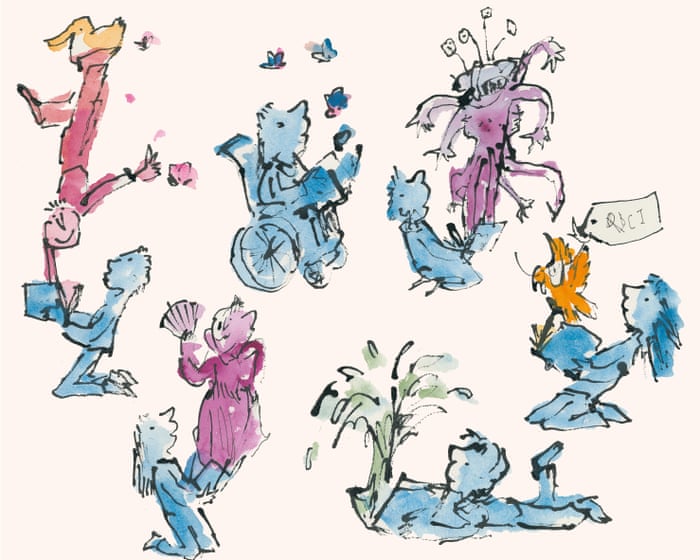
The Quentin Blake Centre for Illustration, opening next month in London’s Clerkenwell, is spread across a sprawling 17th-century industrial complex. It’s being promoted as the largest institution of its kind in the world—a permanent national home for an art form that influences everything from children’s books and political cartoons to animation, fashion, advertising, and digital culture. Part museum, part gallery, and part creative lab, the centre is a remarkable effort to bring illustration out of the shadows and finally put it at the heart of British cultural life.
View image in fullscreen
The Gruffalo by Julia Donaldson and Axel Scheffler. Illustration: Axel Scheffler
Eventually, the centre will house Blake’s own massive archive: 40,000 drawings by one of the UK’s most famous and instantly recognizable artists. Now 93, Blake has spent 75 years bringing the words of some of our most beloved authors to life. Roald Dahl is the big one, of course—you can’t think of Dahl without picturing Blake’s lively, dip-pen drawings—but the list also includes Michael Rosen, John Yeoman, Sylvia Plath, and Voltaire, as well as Blake’s own books. In other words, it’s hard to find anyone with the same authority.
“More needs to be done to recognize the importance of all illustration as an art form,” Blake explains. “What’s especially wonderful about it is that it’s a language everyone understands.”
For years, illustrators have been overlooked, seen as people who come in to decorate after the house is built. But that couldn’t be further from the truth. When you think of The Twits, you probably picture Blake’s wild, scratchy drawings. To imagine Funnybones is to see Janet Ahlberg’s deceptively simple pictures before Allan Ahlberg’s words. Go on any of Forestry England’s Gruffalo walks, and it’s Axel Scheffler’s designs—not Julia Donaldson’s text—that jump out at you from between the trees.
“We’re a bit in the shadow,” says Scheffler. “Our books are called picture books, so we’re an important part of the process. It’s a very underestimated art form, the author and illustrator creating something together. It’s hard to separate.”
“The shortest time I’ve ever spent writing a picture book was an hour, typing it into my phone on a plane,” says author-illustrator Sarah McIntyre. “But they always take at least three or four months of intensive work to illustrate—nine or more hours a day, six days a week.”
View image in fullscreen
Oi Frog! by Kes Gray. Illustration: Jim Field 2014
McIntyre has done more than most to highlight how badly illustrators are overlooked. A decade ago, she launched the Pictures Mean Business campaign to push for illustrators to get proper credit for their work. In doing so, she helped clear up a misunderstanding about what a picture book really is.
Having written them myself, I know how specific they are. Almost always 32 pages long, and almost always read to a child by a caregiver before the child can read alone, most picture books exist at the exact point where text and illustration meet. Remove either part, and the whole thing falls apart.
“I think illustrating a story is one of the most basic human instincts,” says Huw Aaron, whose book Sleep Tight, Disgusting Blob won the Waterstones children’s book prize this year. “We don’t know if people were dancing or singing 40,000 years ago, but we do know they were making comics about people chasing cows, because they’re all over cave walls.”
The things an illustrator can do to a text are as varied as they are wonderful. Jim Field, illustrator of Kes Gray’s Oi Frog! and Rachel Bright’s The Lion Inside, sees illustration as an extra layer. “I’m not trying to do exactly what the w”Words are just saying things,” he says. “I’m trying to weave in extra subplots or let the reader learn more about the character.”
Matty Long, creator of Super Happy Magic Forest — a series that has moved from picture books to chapter books to television — puts it even more bluntly. “If the words are just describing the picture, then why have the words at all?” he says. “I want the images to do most of the storytelling.”
[Image: I Want My Hat Back by Jon Klassen. Illustration: Walker Publishers / Jon Klassen]
But sometimes an illustrator can go even further. In I Want My Hat Back, Jon Klassen pulls off the magic trick of telling two different stories at once. Read without the pictures, the book is simply about a bear fruitlessly asking about his lost hat. But the illustrations add a context that slightly contradicts this. The bear, so polite in the text, is actually driven by murderous revenge.
“It seems like that’s where the truth of the thing should live,” says Klassen about the tension between words and pictures. “I usually end up putting a half-truth in the words, or leaving a lot out. I think that works well with kids because, when the text is clearly wrong, they can see that the pictures are telling the truth.”
Long before a child can decode written words, they’ve already learned a lot about the world through images. “I saw Quentin Blake talk about visual literacy, and he illustrated this brilliantly,” explains Ed Vere, creator of Waffles & Julius and an illustrator who has spent years working with teachers through his Power of Pictures program. “He asked some children what ‘indignant’ meant. Of course, nobody knew. Then he quickly drew an indignant old lady, and every child understood exactly. It wasn’t just ‘angry’ or one of those black-and-white emotions. They all got the subtleties from his drawing.”
For Sophy Henn, creator of the Happy Hills series, this is why the idea that picture books are just a stepping stone to “real” books is so wrong. By getting two streams of information, she says, “you’re learning emotional awareness, you’re learning empathy, you’re learning to think critically. In the world we live in today, that’s incredibly important. I wish more people knew that picture books are actually a more complex form of reading.”
[Image: Sleep Tight, Disgusting Blob by Huw Aaron. Illustration: Huw Aaron]
“Children have the most sophisticated little minds,” says Lauren Child, creator of Charlie and Lola. “They might be small, but they’re really big thinkers. They’re so visually smart in ways that adults aren’t. We use visual cues and aesthetics our whole lives, but we lose that edge we had when we first arrived.”
A picture book might be the first time a child can identify and name a big emotion they’re feeling. Nadia Shireen’s book Barbara Throws a Wobbler uses bright, colorful images to show feelings that go beyond the written word. “There’s a part in the book where Barbara actually talks to the Wobbler, and it gets very metaphysical,” she says. “I had to ask my editor: ‘Is this crazy? Are we expecting three-year-olds to go on a psychological journey?'”
Sometimes, illustration can even turn a book into a storytelling tool, letting children become co-authors. In Jon Burgerman’s Splat!, for example, readers get to blast the main character in the face with new and disgusting objects on every page turn. “I wanted to make a book that could only be a book,” says Burgerman. “I really celebrated the form of a picture book, and I wanted to make something that couldn’t be done in any other way.”
Meanwhile, Is This a Plum? by Dan Ojari and his son Finn makes clever use of cutouts.To hide objects in plain sight. “Someone sent me a video of their kid, who can’t read yet, and they’re telling the story to their parents because the words are so simple,” Ojari says. “It has that feeling of ‘I know more than my parent, and I’m going to trick them.'”
If all this makes picture book illustration sound pretty impressive, the process itself often starts in the least impressive way possible: with a doodle. “The drawing has to come first,” says Long, holding up an early sketch of a Super Happy Magic Forest character that, even in its early stage, still manages to capture all the key traits of the character’s personality. “I have to convince myself that there’s an idea worth pursuing, and I do that through the drawing.”
“I drew the first picture of Hiccup 30 years ago. It led to 12 books, a movie series, and a theme park. Just a little pencil drawing!” says Cressida Cowell on How to Train Your Dragon.
Sue Hendra does the same, showing me her first sketch of the character Supertato, which she created with Paul Linnet and turned into a mini empire of 15 books and counting. Her sketch shows a potato flying over a city. Unsure about writing a book about what looks like an apocalyptically large potato, the sketch taught them that they needed to rethink Supertato’s world. “Paul suggested a supermarket, because it’s a miniature city with products from all over the world coming in. It created this lovely boundary that felt really safe and secure.”
“If I had my notebook, I’d show you the first picture of Hiccup that I drew 30 years ago,” says Cressida Cowell, author and illustrator of the How to Train Your Dragon series. “It was of this little Viking trying to live up to his father. That was the very first seed of something that grew into 12 books, a movie series, and a theme park. Just a little pencil drawing!”
Characters are also everything for Jamie Smart, whose Bunny vs Monkey books are at the heart of the current comic book boom in publishing. Their appeal is huge, and much of it comes from how easy the characters are to recreate. “When I do workshops for kids, I always start at the very beginning. I say, ‘Draw a square and draw a circle, and now you can pretty much draw any character in Bunny vs Monkey,'” he says. “For a child, telling stories can be pretty intimidating because you have to know all the words you’ll need. But if you can tell a story with a couple of lines and a smiley face, what a gift.”
Arguably, nobody knows this better than Rob Biddulph, whose Draw With Rob videos—teaching children step by step to copy his artwork—made him a national treasure during lockdown. “I think it’s the thing I’m most proud of in my career,” he says. “Sure, it was on a screen, but you can use that screen to do something practical and physical. Kids were watching me on YouTube, but they were actually doing something on a piece of paper that they could then stick up on the fridge.”
If picture books ask a lot of children, they also often demand an unusual act of trust from the adults who create them. “I think an author and an illustrator need to share a similar sense of things—a sense of humor, a sense of drama,” says Blake. “But it’s better if their views aren’t exactly the same; one needs to complement the other.”
View image in fullscreen: Funnybones by Allan Ahlberg. Illustration: Penguin Random House
When illustrating someone else’s work, the first thing Blake does is study the manuscript closely. “First of all, I need to get to know the characters as well as possible and imagine what they look like,” he says. “After that, it’s about finding suitable moments that will attract the reader but not give away what the writer has planned. For example, there’s a dramatic moment in Roald Dahl’s Matilda where the dreadful MissTrunchbull hits Bruce Bogtrotter over the head with a plate. I showed her lifting the plate above the poor boy, leaving the dramatic moment for Roald himself to finish. That’s a skill in itself. Maxwell Oginni illustrated My Rice Is Best, which came out last year and got a bunch of award nominations. But he comes from an animation background, where every… I can’t speak for other authors, but the first time I get artwork from my illustrators—Nicola Slater for picture books, Vincent Batignole for chapter books—is often when a story starts to feel more like a real book. They both love adding background details, like shopfronts, references, and unimpressed background characters, which give the stories a richness they wouldn’t have otherwise. And they still surprise me. “I love to add references to my favorite films, video games, or manga,” says Batignole. “Plus, I think there’s at least one Spice Girls reference in every book I’ve ever worked on.” Honestly, that’s news to me.
“I don’t tell anyone this, but I create a backstory for every character,” Slater reveals. “It might not affect the story at all, but it helps set the scene and their motivations, and it shapes how the book goes.”
“The best children’s writers know they can leave a lot to the illustrator,” explains Nick Sharratt, who has illustrated books for Jacqueline Wilson, Michael Rosen, and Julia Donaldson. “Sometimes you have to let the pictures do their job.”
A much higher-stakes author-illustrator relationship is the one between Lydia Corry and Sally Gardner. That’s because Gardner is Corry’s mom. Even though they worked together on the lovely Tindims series, it wasn’t always that way. “When I was much younger, I illustrated a tiny picture on the front of her book I, Coriander, and she really didn’t like it,” Corry says. “Now she has the painting in her house, but she was so attached to the story, and the visual idea was all in her head. So you do get nervous about whether it’s what the author wants.”
One way to ease those nerves is to do everything yourself. There are plenty of authors who illustrate their own work, giving them a level of control over the finished product that the rest of us will never have.
Best known for his Bunny vs. Monkey series, Jamie Smart loves that this approach leaves less room for readers to misinterpret things, especially when making a comic. “I’m literally saying, ‘Here’s this character, here’s this joke, here’s this bit of story,’ and it’s all laid out for you to see,” he says.
But even author-illustrators have limits on their control. “When you publish a book, you’re giving it up completely,” says Debi Gliori, creator of classics like No Matter What. “You can’t stand behind people and say, ‘I think you should slow down,’ or ‘I think you should read that part in a squeaky voice.'” Although illustrations can be used for almost anything, nearly everyone I talk to comes back, sooner or later, to the same key quality: joy. “I am very serious about being silly,” says Hendra, seriously. “Humor is so underestimated, especially for children. But if you give a child a love of being silly, it’s like a survival skill.” And this theme runs through many of the illustrators I spoke to. Sarah Horne, who has illustrated books for Sam Copeland and Gianna Pollero, sees her job as “bringing some silliness and joy into books,” while Smart’s wild energy makes him want to “stretch all the characters out and push them out of the panels.” McIntyre says that one of the most talked-about details in her Adventuremice books is…A picture of a character sitting on the toilet, with a tiny poo floating off into space. That doesn’t really need words.
For some, it’s a chance to reconnect with memories of reading bedtime stories to their children.
But even silliness takes skill. When Sue Hendra finishes a book, she reads it over and over from different perspectives—a child, a teacher, a tired parent—to make sure the rhythm works. Lauren Child keeps tweaking her books right up until the deadline. “I’ve just finished a picture book, and we were still cutting words out until the very last minute,” she says.
Rob Biddulph does the same, removing any words that the pictures can show more clearly. “I write the story as a poem, so it’s tempting to put everything that happens into the verse,” he says. “But an illustration can get the exact point across. Pictures paint a thousand words, as they say.”
The opening of the Quentin Blake Centre shows how far we’ve come in recognizing our amazing history of illustration and the huge amount of talent we’ve produced. But there’s still progress to be made. “Did you know that, unlike writers, illustrators still don’t have easy access to sales data?” asks McIntyre. “While Julia Donaldson is a proven bestselling author, Axel Scheffler doesn’t have any numbers for their books together. He doesn’t carry that sales data with him. This has a big knock-on effect on how illustrators are seen.”
One thing that came up again and again in these interviews was how much of a privilege it is to create books for children. For some illustrators, it’s a chance to revisit memories of bedtime stories with their own kids. For others, it’s the joy of seeing a book worn out from being read so much. Some see illustration as an intellectual challenge, others as a way to make sense of the world. But they all agreed on one thing: never underestimate children.
The last question I ask Blake is why characters made for children can stay in the public’s mind for decades. “We feel we can relate to them,” he answers. “In a way, they become our friends.” The Quentin Blake Centre for Illustration opens on 5 June. qbcentre.org.uk
Frequently Asked Questions
Here is a list of FAQs about the topic I Am Very Serious About Being Silly Childrens Illustrators Talk About the Art of Storytelling written in a natural conversational tone with clear simple answers
BeginnerLevel Questions
1 What does I am very serious about being silly actually mean
It means that making funny playful or absurd art for kids is not a joke It takes hard work skill and careful thought to create something that feels light and fun
2 Who is this book or topic for
Its for anyone who loves childrens booksparents teachers aspiring illustrators writers or anyone curious about how picture books are made
3 Is this a book about drawing techniques
Not exactly Its more about the thinking behind the drawingshow illustrators use silliness to tell a story connect with kids and solve creative problems
4 Why do childrens illustrators need to be serious about being silly
Because making a silly moment believable and funny requires careful timing character design and understanding what kids find genuinely amusingnot just random goofiness
5 What kind of stories do these illustrators talk about
They share behindthescenes stories about how they created characters chose colors and added funny details that make kids laugh and keep them turning pages
Intermediate Questions
6 How do illustrators balance silliness with a meaningful story
They use silliness as a tool not a distraction A funny character or scene can make a serious message easier for kids to understand and remember
7 What are some common mistakes new illustrators make when trying to be silly
Trying too hard to be funny Forced silliness feels fake The best silly moments come naturally from the characters personality or the situation
8 Can you give an example of a seriously silly illustration trick
Yes using a characters facial expression that doesnt match the situationlike a dog looking very serious while wearing a silly hat That contrast creates humor
9 How do illustrators know when a silly idea will actually work
They test it on real kids They watch for genuine giggles confused looks or if a child asks to see the page again That