On a Sunday morning, Zurich can feel like the day after Armageddon—so empty and calm, even though it’s Switzerland’s biggest city. But then church bells ring out across the lake basin, and a jogger trots by like a polite deer in aerodynamic sunglasses, and you know everything is fine in this proudly flawless place, where little is left to chance and the authorities even track the city’s pigeons with GPS.
Swiss people know they’re lucky. A highly diverse economy keeps salaries high and income inequality relatively low. A British friend once told me our supermarkets feel like the gourmet hall at Harrods. The government makes it easy to do business. Hiking trails are maintained by armies of volunteers. The downside is our reputation as a nation of humorless control freaks, but there are benefits to trains running on time. In a restless world, Switzerland remains a place where you can breathe easy.
The problem with luck, of course, is that you become afraid of losing it. But fortune tends to make conservatives of us all. Yet how do you preserve what you cherish?
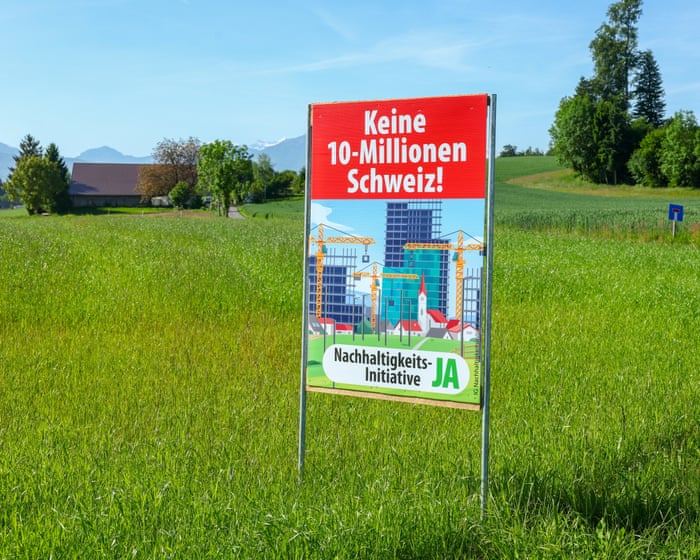
The far-right Swiss People’s Party (SVP) offers an answer: freeze the country. On June 14, Swiss voters will decide whether to cap the permanent population at 10 million. That threshold could be reached sometime between 2033 and 2041. Polls suggest the vote will be very close.
Switzerland’s population has indeed grown quickly. Over the last 25 years, it jumped from 7.2 million to 9.1 million, with about four-fifths of that increase driven by immigration. The SVP, the country’s largest political party, blames this for rising rents, crowded trains, and “density stress.” It’s a reminder to democrats across Europe that a healthy economy won’t stop the far right. There will always be voters who blame immigrants for whatever problems arise. For their leaders, the boat is always “full”—a metaphor famously used by the SVP’s predecessor party when its justice minister, Eduard von Steiger, compared Switzerland to a “small, crowded lifeboat with limited capacity” in 1942 to justify turning away Jewish refugees.
By most measures, Switzerland isn’t especially crowded. Population density in Zurich is lower than in sprawling Berlin and less than a quarter of that in packed Paris. Living space per person is above the European average. Rents have risen, sure, but so have wages. In 2006, the average household saved about 10% of its income after taxes, housing, and consumption. By 2023, that figure had climbed to about 18%.
There are real growing pains. Low-income earners spend a slightly larger share of their income on rent than 20 years ago. But that’s simply an argument for building more, especially Swiss-style public and cooperative housing, not for closing the borders.
The SVP’s framing of immigration as the culprit for strained infrastructure is also a bit rich, given the harmful policies it supports: weakening tenant protections, deprioritizing rail investment, and championing the low-tax policies that attract corporations and wealthy foreigners in the first place.
Coherence may not be valuable in politics. But if the initiative is so dangerous and the debate about it so divisive—it’s opposed by every other party in parliament—it’s also because it’s about much more than migration: it’s a Swiss Brexit by stealth.
If this referendum passes and the population then exceeds 10 million, Bern would be required to end its agreement with the EU on the free movement of people. The agreements linking Switzerland to the EU’s single market would become null and void, opening the way to the SVP’s long-held dream: reimagining Switzerland as a deregulated, buccaneering hub trading freely with the world. A sort of Alpine Dubai.
It’s a fundamentally unserious fantasy. The heyday of free trade is over. Swiss exports to Asia have dropped by 6%.Since 2022, sales to the US have dropped by 25% this year due to tariffs. Whether you like it or not, 51% of what Switzerland sells goes to Europe, which remains by far its most important growth market for exporters.
If there’s one nearly undisputed lesson from modern economic history, it’s that open societies win. Openness to immigration was long the US’s defining strength. Japan’s strict immigration policy explains its weak growth and the fact that its average effective retirement age for men is 69.5 years.
Switzerland’s remarkable rise from a poor farming region to a high-tech economy over 200 years tells the same story. With no natural resources, Switzerland became wealthy by offering a stable economic climate that attracted foreign innovators. Nestlé, Swatch, and pharma giant Novartis—these iconic “Swiss” companies were all founded or built by immigrants.
But beneath the economics lies something even more troubling. What makes the Dubai model so appealing to the radical right is that abandoning EU treaties would not only let the SVP cut immigration but also strip foreigners of their rights entirely. For example, they’ve proposed barring German and French workers from bringing their families. Switzerland would join the ranks of autocratic states that deny foreigners what conservatives claim to value most: a family-centered life.
The real miracle of Switzerland’s long economic success is that it avoided the “Buddenbrooks trap.” In Thomas Mann’s novel, each generation of a wealthy German family grows more comfortable, self-absorbed, and emotionally fragile, losing the pragmatism that built their fortune. Switzerland, in contrast, has stayed disciplined and adaptable.
Maybe that tradition is fading now. If the vote is as close as polls suggest, it’s because even many center-right voters believe they can afford the decadent dream of standing still.
What’s certain, though, is that freezing the country won’t preserve it. It would do the opposite—tearing down the very openness that made it prosperous. History isn’t kind to societies that confuse preservation with paralysis.
Joseph de Weck is an associate fellow with the German Council on Foreign Relations and writes for Guardian Europe from Zürich and Paris.
Do you have an opinion on the issues raised in this article? If you would like to submit a response of up to 300 words by email to be considered for publication in our letters section, please click here.
Frequently Asked Questions
Here is a list of FAQs based on the article and sentiment expressed by Joseph de Weck regarding Switzerlands perceived pointless referendums
General Context
Q What does Switzerland getting tired of being prosperous mean
A Its a sarcastic way of saying that Switzerland is so stable and wealthy that its citizens have started voting on minor nonurgent issues just for the sake of having something to decide on
Q Who is Joseph de Weck
A He is a SwissFrench journalist and author who often comments on Swiss politics and society particularly its unique direct democracy system
Q What is a pointless referendum according to De Weck
A A referendum that addresses a symbolic or niche issue rather than a pressing national crisis The idea is that when a country has no real problems it invents small ones to vote on
The Why Behind the Trend
Q Why do Swiss people keep voting on things that seem trivial
A Because the system allows any group to force a national vote if they collect 100000 signatures When the economy is strong and life is good people have the luxury to focus on ideological or cultural pet projects
Q Is Switzerland actually in trouble or is this just a joke
A Its a critical observation not a literal crisis Switzerland is still one of the richest most stable countries in the world De Weck is pointing out that this comfort leads to political boredom
Q Whats an example of a pointless referendum that supports this idea
A The 2014 vote on whether to limit immigration created massive economic headaches More recently votes on banning factory farming or on specific financial regulations are seen by critics as solutions looking for a problem
Practical Political Implications
Q Does this mean Swiss democracy is broken
A No but it highlights a flaw direct democracy can be hijacked by fringe groups or used to solve problems that dont exist wasting time and money
Q How much does a national referendum cost
A Millions of Swiss Francs Critics argue that voting on niche issues is an expensive luxury for a country that already works well