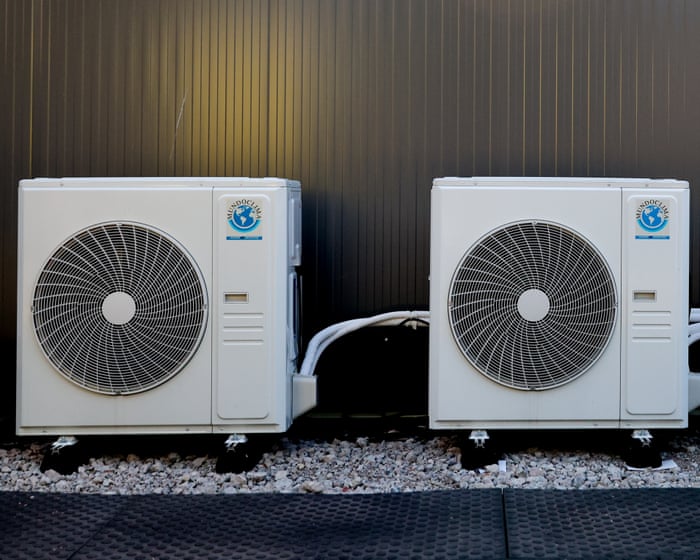
On Sunday, as the afternoon heat in eastern Brandenburg hit a staggering 41.7°C (107°F) — a record high for Germany — Mario, 65, took some precautions but didn’t panic. Two years ago, a severe heatwave had pushed him to buy something few Germans own: an air conditioning unit.
“Summers are slowly getting warmer,” says the retired handyman in Neuzelle, near the German-Polish border. His bungalow is now one of the 6% of German homes with a fixed air conditioner. “And as you get older, the heat becomes harder to handle.”
Europe is struggling through its worst heatwave on record, and as it prepares for more scorching weather, the lack of air conditioning has drawn more criticism than any other solution that governments have been slow to promote. This emerging culture war has frustrated health experts, who want more AC for vulnerable groups but are cautious about widespread use in private homes.
“Much of Europe’s investment has rightly gone into long-term solutions like shade, insulation, and cooling centers, rather than mechanical cooling,” says Hans Kluge, head of the World Health Organization’s Europe office. He recommends a careful approach to air conditioning that protects those at high risk. “Both have a role to play.”
Studies suggest that adaptation efforts have reduced deaths by 75% for the kind of heat considered extreme two decades ago, but heatwaves have since become even hotter. According to WHO estimates, more than 200,000 people died from heat in Europe over the last four years, and calls for faster action are growing. The record-breaking June heat is likely to cause thousands of deaths — possibly even tens of thousands — far more than what troubles countries like the US, which is also facing a historic heatwave but uses AC to cool 90% of homes.
Expert advice to install air conditioning where it’s most needed — in hospitals, care homes, schools, and public transport — has support across the political spectrum. But in recent days, accusations that mainstream parties are blocking AC to protect the environment have taken over the debate.
The day after Germany’s heat record was broken, Marc Bernhard, construction spokesperson for the far-right Alternative for Germany (AfD), said his party would stop people from being “sacrificed on the altar” of mainstream climate ideology, like energy efficiency ratings. “Climate hysteria is leading to more heat-related deaths due to ideological construction errors, such as avoiding air conditioning.”
This was a sharp shift from the party’s views just a year ago, when its health spokesperson, Martin Sichert, downplayed death tolls and dismissed the government’s “heat panic.” It also contrasts sharply with the AfD’s strong opposition to heat pumps, which became an unlikely target for the political right three years ago.
In France, Marine Le Pen’s National Rally — which has fought against energy-efficient building renovations and tried to block wind turbines and solar panels — has made air conditioning a key focus while attacking policies aimed at stopping global warming.
The tense debate in Europe has been fueled by commentators in the US, who point to Europe’s lack of AC as proof of a poor, misguided, and overregulated continent. “Europeans should just install air conditioning,” reads part of a chatbot-generated post on X that was boosted by Elon Musk and has been viewed nearly 20 million times. “The American approach to summer was correct all along.”
Air conditioning is standard in wealthy countries from the…From the US to Japan to Australia, but only about 15% of the 3.5 billion people living in hot regions own an air conditioner. As temperatures and incomes rise, the demand for cooling around the world is set to skyrocket. In Southeast Asia, the International Energy Agency expects the number of air conditioners to increase ninefold between 2020 and 2040 under current policies.
Experts point out that air conditioning has downsides. Blowing hot air into surrounding streets can worsen the urban heat island effect, and the energy use raises the risk of blackouts. But its climate impact in Europe is small and will likely shrink further, as the continent gets less than 30% of its electricity from fossil fuels, and more than a dozen countries plan to phase them out of power grids within a decade.
Meanwhile, while planning laws in some places have made it hard to install air conditioning in private homes, there’s little evidence that red tape or climate concerns are the main reasons for low adoption rates across Europe.
In fact, as carbon emissions have heated the continent twice as fast as the global average, the extra heat has increasingly pushed people in Europe’s warmest regions to cool their homes mechanically. The share of households in Italy and Spain with air conditioning has quickly grown to over half; in France, it has risen to 24%, with up to 48% in hot southern provinces and as little as 10% in cool northern ones.
In Germany, which has some of the lowest air conditioning use in Europe—partly due to a high number of renters—some homeowners feel that even June’s record-breaking heat wasn’t disruptive enough to justify buying one. “We’d consider getting air conditioning if summers keep getting hotter, but when it’s just a few days, we can handle it,” says Gabriele Werner, who works at the tourist information office in Neuzelle, near where the weekend heat was at its worst.
When the Guardian visited Neuzelle and the neighboring district of Neißemünde, where nearly half of voters backed the AfD in the last election, the most common reaction to the weekend’s scorching heat was indifference, along with some outright denial.
“Climate change is just a word that gets blown up,” says Reinhard Lange, a retired electrician whose 150-year-old house sits down the road from the weather station in Coschen, which provisionally broke Germany’s national heat record on Sunday. “When I was a child, it was also warm. It just wasn’t played up.”
Kluge says Europe’s strong emergency response during the recent heat saved lives—with red alerts, school closures, and quick opening of cooling centers—but more could be done to ensure regular contact with isolated older people, who make up most of the deaths. “The priority now is making sure air conditioning reaches people who need it for medical reasons, while continuing to build infrastructure—trees, green roofs, cooler buildings—that protects everyone, including those who simply can’t install a unit in their home.”
Other experts have gone further, supporting air conditioning in social housing due to growing inequality between those with cooling and those without, as well as the rise of energy drains that harm society.
“We’re currently using a lot of our energy and water resources during heatwaves to cool data centers,” says Dr. Chloe Brimicombe, a climate scientist at Oxford University who studies extreme heat. “Lives are more valuable to us than AI—or at least they should be, right?”
Frequently Asked Questions
Here is a list of FAQs about Europes intensifying debate over air conditioning written in a natural tone with clear direct answers
BeginnerLevel Questions
1 What is the heat panic debate in Europe about
Some people think Europeans are overreacting to heatwaves by rushing to install air conditioners They call it heat panic because they worry this reliance on AC will make the climate crisis worse and increase energy use
2 What does it mean when people say we are being sacrificed at the altar of cooling
It means critics believe we are harming the planet just to stay comfortable for a few hot days They feel we are sacrificing climate goals energy security and traditional building designs for the quick fix of air conditioning
3 Why doesnt Europe just install more air conditioning like the US does
Historically Europe didnt need it Buildings were designed to stay cool naturally using thick walls shutters and shade Now many people worry that installing AC everywhere would massively increase electricity demand greenhouse gas emissions and urban heat island effects
4 Is air conditioning bad for the environment
Yes in two main ways First most AC units run on electricity often from fossil fuels creating carbon emissions Second the refrigerants used in many ACs are powerful greenhouse gases that can leak into the atmosphere
5 Arent heatwaves dangerous Dont we need AC to survive
Yes heatwaves kill thousands of people each year in Europe especially the elderly and sick So AC can be lifesaving in extreme heat The debate is about how much AC we need and how we use itnot whether it should exist at all
AdvancedLevel Questions
6 What is the passive cooling alternative that Europeans are promoting
Passive cooling means designing buildings to stay cool without energy This includes using thick insulation external shutters reflective roofs crossventilation and planting trees for shade Many argue we should invest in this instead of just buying AC units
7 How does the urban heat island effect make this debate worse
Cities trap heat because of concrete asphalt and lack of green space When everyone runs their AC the units pump hot air back outside