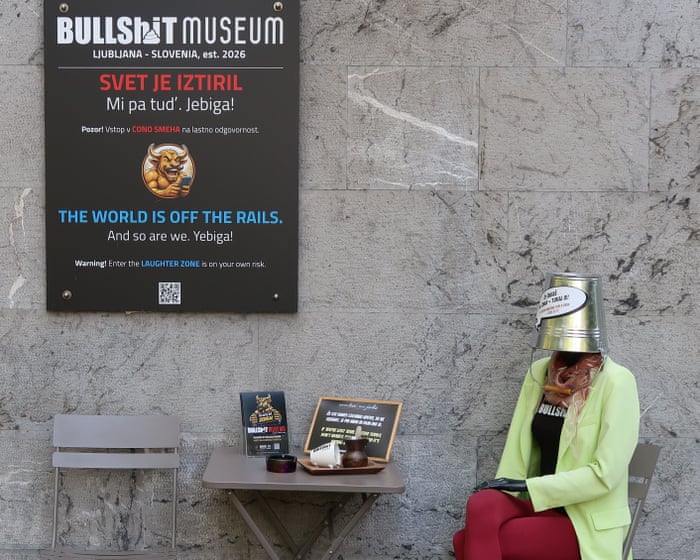
On the main riverside promenade in Ljubljana, Slovenia’s capital, tourists stop to take photos of a mannequin with a bucket on its head. Dressed in a pistachio jacket and red leggings, the figure sits at a table in front of a house in the historic Old Town, staring at a spilled cup of Turkish coffee—a drink popular among Slovenes and other people from the Balkans and central Europe, with whom they once shared a country until it broke apart in the early 1990s. A large sign in the background reads: “Bullshit Museum: The world is off the rails, and so are we. Yebiga!”
Yebiga, which roughly translates to “fuck it” or “screw it,” is the running theme of the museum, which opened in May. It consists of five small rooms filled with mannequins wearing odd accessories, AI-generated images of laughing characters and scenes that accompany some of the jokes, and framed or cardboard displays. The word captures the essence of Balkan humor, says the museum’s founder, Borut Kokelj, who wears a T-shirt that reads: “What part of yebiga don’t you understand?”
“Even when there’s no money, no jobs, and nothing is settled, everything can be solved with humor,” he says. “And for that to work, humor must have no filter.”
Although the museum presents itself as the home of “Balkan” humor, it mainly focuses on the joke culture of the former Yugoslavia—the socialist federation that included the Balkan countries now known as Slovenia, Croatia, Serbia, Montenegro, Bosnia and Herzegovina, and Kosovo.
Formed after the first world war, Yugoslavia was a political project aimed at uniting southern Slavs and some non-Slavic minorities under a shared identity and language, then officially called Serbo-Croatian. But the genocidal wars that came with Yugoslavia’s collapse in the early 1990s showed that the idea of a single Yugoslav nation lacked deep roots. Since then, the region’s different nations have continued to define themselves through distinct religious identities—Catholicism, Orthodoxy, and Islam—as well as separate dialects and languages.
“Balkan” humor, the museum suggests, may have been the glue that held Yugoslavia’s cultural mix together, and it’s fitting that some of the jokes on display play directly on the issue of language. “A fool is a fool in both the Cyrillic and the Latin alphabets,” reads a large poster at the entrance, using both scripts: Cyrillic, linked to Serbs and Orthodox Christianity, and the Latin alphabet, used by other, mostly non-Orthodox nations of the dissolved state.
The armed conflicts that shaped the region are also reflected in the exhibition, though indirectly. There’s wordplay on the title of the controversial 1996 Serbian drama Lepa Sela Lepo Gore (literally “pretty villages burn nicely”), about a group of surrounded Serbian soldiers during the Bosnian war, here turned into the absurdist line Lepa jela lepo goje (“Fine food fattens you up well”).
The role and power of women in society also seems to be a unifying theme. “Starleta is the first Balkan mythical being with the body of a woman and the head of a turkey,” reads an “encyclopedic” definition of a “starleta”—a woman who seeks fame and wealth through nothing more than her (plastic surgery-assisted) beauty. “She wanted to marry a prince, but a horse had more money,” reads another, playing on the word konj (horse), which isUsed in many former Yugoslav countries to describe a “man.” Kokelj, who has gathered around 25,000 jokes from the region over the years, said he avoided loading the exhibition with politically charged humor. “If we were to display all the truly ‘Balkan’ jokes, we probably wouldn’t have opened,” he admits, referring to jokes that directly touch on religion, ethnicity, or national symbols.
The selection also skips jokes that make fun of a specific group or feature characters tied to a particular ethnicity. There are no jokes here mocking the supposed “laziness” of Montenegrins (like this one from a local magazine’s humor section: “What does a Montenegrin say before going to bed? ‘Rise, earth, so I can lie down'”). I only found one AI-generated “ethnic” meta-joke: it plays on the stereotype of Slovenes as a nation eager to seem the most “elegant” and “European,” thereby setting themselves apart from the rest of the region. In it, a Slovenian man tells a joke “the Slovenian way,” using harmless euphemistic curses like “three hundred hairy bears,” while his “Balkan” counterpart holds nothing back when it comes to colorful insults.
Overall, most of the jokes deal with everyday life and its absurdities. “Life is neither nail polish nor acetone,” reads one. “We had it better, and we still complained. Now that things are getting worse, we’re complaining again,” says another. Others focus on romance: “Love is when you look like a sack of potatoes, but she sees you as fries.” Another recurring theme is laughing at yourself: “Amateurs make mistakes, but we, the experienced ones, create catastrophes.”
There seems to be one thing that holds the exhibition together to this day, though: rakija, the famous Balkan fruit brandy. It’s served to visitors as they enter the museum and is described in one exhibit as “the first aid of every Balkan household.” It’s also central to defining the infamous yebiga, which one exhibit explains like this: “The Balkan way of saying: what are you going to do? Maximum feeling, minimum energy. It usually goes with rakija, a cigar, and a song that hurts more than it should.”
Frequently Asked Questions
Here is a list of FAQs about the article and the museum itself written in a natural curious tone
General Background
Q What is the Bullshit Museum in Slovenia
A Its a small satirical museum in Ljubljana the capital of Slovenia It displays everyday objects that are bullshit meaning useless overhyped or badly designed products alongside art that comments on modern nonsense
Q Where did the quote If we displayed every Balkan joke wed never have opened come from
A Its a quote from one of the museums founders in the article They used it to explain that they had to be selective about what they put on display because there are so many absurd and ridiculous things in the Balkans to choose from
Q Is the museum a joke or is it a real place
A Its a real physical museum you can visit but it has a humorous and ironic theme Its not a joke in the sense of being fake its a serious space dedicated to playful criticism
Q Why would someone visit a museum about bullshit
A For a laugh and a different perspective Its a fun way to reflect on consumerism bad design and the absurdity of everyday life Its more about entertainment and social commentary than traditional history
The Exhibits Content
Q What kind of objects are actually in the museum
A Things like a selfie stick for dogs a useless box that turns itself off and other novelty items that are pointless or overengineered They also have a section dedicated to fake news and political propaganda
Q Is it offensive Does it make fun of Slovenia or the Balkans specifically
A Its not meant to be meanspirited The museum pokes fun at universal human folly but it does have a special section on Balkan stereotypes and regional quirks The founders say the local jokes are the best but they kept it lighthearted
Q Are the exhibits in English or Slovenian
A The museum is very touristfriendly Most of the descriptions and labels are in both Slovenian and English so you wont get lost