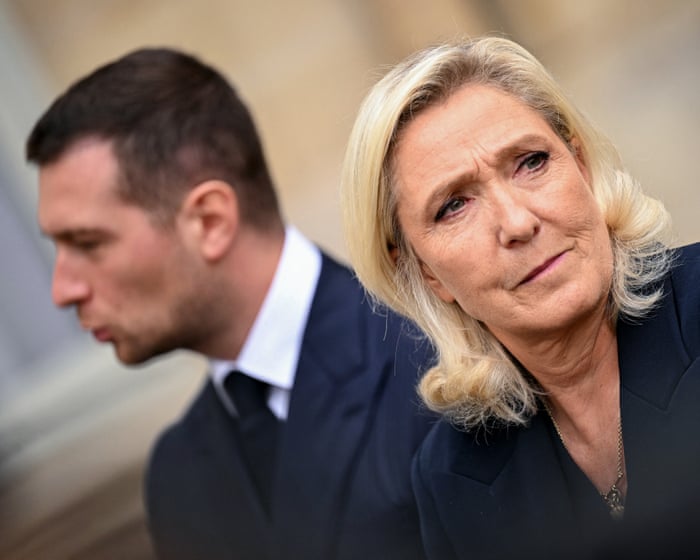
France has always admired a fighter who comes back from the brink. Charles de Gaulle, François Mitterrand, and Jacques Chirac all bounced back from political defeats to become presidents. There’s a real chance Marine Le Pen could be next.
Now that the Paris appeal court has lifted the ban that stopped her from running for office, the far-right veteran has a double advantage in next year’s race for the French presidency. She’ll campaign, as she always does, as an outsider and a critic of the political establishment—even though she’s held elected office continuously since 1998. She can also now present herself as a “miraculous survivor,” a “mother courage,” and a “battling granny,” as senior French political figures, including former ministers, described her to me in recent talks in Paris.
Le Pen will be a much stronger candidate than her young deputy, Jordan Bardella, might have been. The other candidates were wary of Bardella, but they didn’t fear him. They do fear a Le Pen who’s come back from the dead.
Her party, the National Rally (RN), has a new campaign slogan: “Renaissance.” The party says the rebirth of Le Pen’s political career signals the rebirth of France.
You might almost think Le Pen was cleared of fraud on July 7. She wasn’t. The judges essentially decided that voters, not courts, should choose the president. They reduced her five-year ban from electoral politics—imposed by the Paris criminal court last year—to time already served.
She’s now a twice-convicted embezzler of over €4 million in EU funds. If her final appeal to France’s highest court is heard quickly and rejected, she might have to campaign next spring wearing an electronic ankle tag.
And yet. Two opinion polls since her reprieve suggest she could beat any possible opponent in the two-candidate second round next year.
Earlier polls were almost as good for Bardella, but there were reasons to think he wouldn’t hold up. The two-week second-round campaign traditionally tests whether candidates can not just govern France but represent it. Voters will ask: do they have presidential stature? Bardella will turn 31 in September. He’s been an RN party insider since dropping out of college at 19. Would voters be able to picture this talented but smooth-talking young man going head-to-head with a Vladimir Putin or a Donald Trump?
That question—presidential weight—matters especially for older voters. Of the 50 million registered French voters, 28% are over 65. Unlike younger people, they turn out in large numbers.
A recent Ifop poll showed Le Pen beating former prime minister Édouard Philippe—the strongest of the many candidates hoping to carry Emmanuel Macron’s centrist torch—by 54% to 46% in the second round. She had almost the same lead among voters over 65. It’s the first time any poll in any national election has put the RN ahead with the “grey vote.”
Bardella was also popular with older voters, but his appeal to both young and old was starting to fade. He comes from a working-class Italian immigrant family but had begun to show a Nicolas Sarkozy-like taste for the high life, including, reportedly, a romance with an heiress from Italy’s leftover nobility.
Le Pen was born into a wealthy family and a political dynasty, but she cultivates an image as a gruff-voiced champion of the people—a single grandmother living with her best friend, a cat breeder, and above all, a survivor.
There’s another issue, though, that’s crucial for older voters: economic stability. Le Pen’s weak TV debate performances on the economy in 2017 and 2022 helped Macron beat her.
The RN’s economic policies remain a muddled mix of high social spending and low taxes, free markets and state meddling. Bardella tried to push the party toward a more traditional right-wing, low-tax stance and a more reformist approach to the EU, taking inspiration from Italy’s prime minister, Giorgia Meloni.Past newsletter promotion
Free newsletter | Weekly
Sign up to This is Europe
The most pressing stories and debates for Europeans – from identity to economics to the environment
Enter your email
Sign up
After newsletter promotion
But Le Pen’s return means a return to “Marinomics” and a policy of undermining the EU from within. With France €3.5 trillion in debt and constantly on the edge of a fiscal crisis, the idea of a far-right government may unsettle older and wealthier voters.
Le Pen will have an obvious response. She’ll say Macron fooled you twice with all his clever talk. Look where that got you: another €1 trillion in debt. It’s time to give a down-to-earth woman a chance. I could hardly do worse.
But she could. Much, much worse.
A President Le Pen or a President Bardella would push France and the EU into dangerous new territory. Bardella, at least, seemed aware of how hard it is to be so openly anti-EU and to try to govern with slogans. Le Pen does not.
A Le Pen presidency starting next May is not guaranteed. But it is, for the first time in seven decades of the family’s political involvement, a real possibility. The comfort blanket for mainstream parties on the right, left, and center – the idea that a 31-year-old, slightly more pragmatic President Bardella was unlikely – has been taken away.
Mujtaba Rahman is the managing director for Europe at Eurasia Group, a political risk research and consulting firm.
Frequently Asked Questions
Here is a list of FAQs about Marine Le Pens political resurgence and the increased threat she poses written in a natural accessible tone
General Background
Q I keep hearing about a comeback Wasnt she already a big deal in French politics
A She was but she had a rough patch After losing the 2022 presidential election to Emmanuel Macron her party was in debt and she was dealing with legal issues Many wrote her off Now she has reinvented her image her party is polling at record highs and she is the clear frontrunner for the 2027 presidential election That shift from fading to favorite is why its called a comeback
Q Why is she considered a greater threat now than before
A In the past her farright policies scared off mainstream voters Now she has normalized her party She focuses on everyday issues like the cost of living security and immigration using softer language Shes no longer seen as an extremist but as a viable alternative to the current government That makes her much more electable
Q Is she actually leading in the polls
A Yes For the 2027 election most polls show her winning the first round and either beating or being in a dead heat with any mainstream candidate in the second round No farright candidate has ever been in this strong a position this early
Her Strategy Image
Q How did she change her image to become more popular
A She used a strategy called dedemonization She kicked out the most radical and racist members of her party changed the partys name from the National Front to the National Rally and stopped talking about leaving the EU or the euro She now focuses on a patriotic message rather than an ethnic nationalist one
Q What are her main campaign promises now
A Her core promises are strict immigration controls prioritizing French citizens for jobs and social housing lowering taxes on fuel and energy and cracking down on crime She frames these as protecting the everyday French person from globalization
Q Is she still antiEU