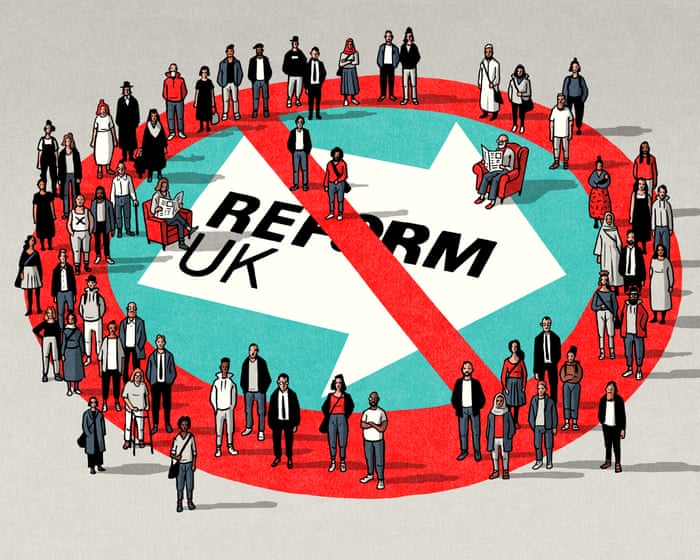
Who can stop Nigel Farage? Which voters would actually bother to dig out their ID and make the trip to the polling station to take him on? Over the past year, these two questions have come to define British politics. From Runcorn and Helsby to Caerphilly and Aberdeen South, with countless flimsy leaflets claiming “Only X can win here,” parties have been scrambling to position themselves as the main opposition to Reform. Those battles have produced figures like Hannah Spencer and Andy Burnham; they’ve crushed Labour in Wales and pushed Keir Starmer out of Downing Street.
These questions still hang over Britain now, in what is easily Farage’s summer of disasters. He’s facing a fresh-faced prime minister, leading a team that keeps bickering with itself, and ahead of him looms a parliamentary inquiry into whether he should have declared a £5m gift from a generous crypto billionaire on the other side of the world. Look at these turquoise clowns, the Westminster pundits chuckle. Check out that Burnham bounce, the analysts marvel.
And despite all that, Farage’s side is almost level with Burnham’s in the polls. Constituency-level analysis suggests that if an election were called tomorrow, Reform would jump from eight seats to somewhere between 100 and 200. Among the Labour MPs swept out by a turquoise wave could easily be the party chair, Bridget Phillipson, the chancellor, John Healey, and the justice secretary, Alex Norris, who’s in charge of the prisoner release programme.
A hard-right organisation that has a strange but reliable pull on former British National party members may have a lower electoral ceiling than many feared; but its floor is still high enough to help deny Burnham an outright majority. A party that wants Trump-style deportation squads on British streets, to further restrict the right to protest, and to slash social security might still lead the next government, or at least become the official opposition.
Anyone worried about that prospect needs to understand who those anti-Farage voters are and what could get them off their sofas at an election. That’s why I was glad to get an exclusive look at the first-ever study of the anti-Reform electorate. Published today by anti-racist campaigners Hope Not Hate, it’s based on a large survey by Focaldata of nearly 9,000 Britons. These are people who, if a snap election were called tomorrow, could be persuaded to go out and put their “x” against a Reform opponent. They’re some of the most important voters in the country, and they’re probably not who you’d expect.
If I say “anti-Reform army,” who do you picture? Maybe a bunch of left-wingers who live in cities, waver between Zack Polanski and Andy Burnham, and ask their baristas for fancy milks. That’s half of them, and, the study shows, they skew young, minority ethnic, and graduate. But the other half aren’t on the left at all. The joint-largest group in the Farage resistance is what Hope Not Hate describes as “right-wing on cultural issues and very right-wing on economics.” Think driveways, tidy lawns, a fondness for Ludwig. Their worry isn’t that the turquoise troops will be conservative – it’s that they won’t be conservative enough, instead bringing chaos. One other key demographic fact in the fight against Farage: women just don’t like what he stands for. Analysts have known about that weak spot for years, and it’s partly why in Makerfield the Reform candidate’s saloon-bar sexism helped sink his chances.
Perhaps you’ve also noticed a curious omission in this little list of black marks against Farage’s name. To any question in Britain today, Reform reliably provides one answer: it’s the immigrants’ fault. Housing? Immigrants. Welfare? Immigrants. Oh, and small boats. Yet many who dislike Reform don’t object to its anti-migrant rhetoric. Those comfortable right-wingers I just mentioned were vital in denying GB News regular Matt Goodwin a victory in Gorton and Denton earlier this year, according to one local campaigner whoI spent weeks knocking on doors there—but not for the reasons left-wingers might assume. “Racism doesn’t offend them; they just see it as tacky.” That one-liner exposes a serious flaw in mainstream politics and media: they’ve made racism more socially acceptable than it’s been in over 40 years. Keir Starmer with his flags, Yvette Cooper and the bunting she claims to use for home decor, Shabana Mahmood telling “white liberal hecklers” to “fuck right off”—look at what you’ve achieved, and despair.
I draw two big lessons from this important study. First, what works against Reform in one seat won’t necessarily work in others. During the Caerphilly showdown, Cardiff University’s Dr Jac Larner kept getting calls from London-based media asking what they should learn from Plaid Cymru’s win. He doesn’t think there’s much to take away. “Plaid can offer voters an alternative political identity: progressive, working-class, and Welsh. In Scotland, the SNP can still do that.” But in England, nationalist politicians wear red corduroys, get funded by foreign billionaires, and go on about remigration for brown and black people.
Here’s the other conclusion: opponents of Reform share with its supporters a deep disgust for Westminster. Pollsters find they’re twice as likely to be unhappy with mainstream politicians and media. Writing about Hope Not Hate’s analysis of Reform voters last year, I noted that very few were unreachable by other parties—it’s just that most politicians didn’t bother to try. With Starmer’s Labour, it was a condescending pat on the head and almost no effort to tackle urgent issues like the cost of living.
Farage returns to our screens next week as the Reform party conference kicks off. Expect the usual triumphalism and speeches promising that tomorrow belongs to them. That’s not true, of course. Voters might back Farage or Burnham, but they’re mainly lending their support, not committing it. The compromises the new prime minister has started making this week—on council housebuilding and needless dithering over nationalising Thames Water—won’t stir much anger now. The ones who’ll care are the left-wingers who helped get Burnham into parliament, and for now they might be pacified by a few token gestures. But if Labour’s strategy is basically to do what Starmer did, just with better PR and more social-media buzz, it’ll get the same result: a disaster, not just for Labour, but for everyone else.
Aditya Chakrabortty is a Guardian columnist.
Frequently Asked Questions
Here is a list of FAQs based on your topic The tone is neutral focusing on the public perception of Nigel Farage and the nature of political popularity
BeginnerLevel Questions
1 What is the main point of the article Does Nigel Farage have any idea what people actually think of him
The article argues that Nigel Farage is out of touch with the general publics perception of him It suggests that while he may believe he is a popular workingclass hero the author claims the public actually views him with skepticism distrust or outright dislike
2 Why would Nigel Farage be unhappy about this article
Because the article directly challenges his selfimage and his narrative of being a man of the people If the authors claims are correct it would mean Farages political strategy is based on a false premise which is a damaging critique for a populist leader
3 Is this article a factual news report or an opinion piece
It is an opinion piece The title uses subjective language and presents a personal argument based on the authors observations and interpretations of public sentiment rather than objective polling data
4 What is Nigel Farages public image generally speaking
He is a highly polarizing figure To his supporters he is a straighttalking champion of Brexit and British sovereignty To his critics he is a divisive populist who exploits immigration fears and disrupts mainstream politics for personal gain
AdvancedLevel Questions
5 What specific blind spots does the article likely accuse Farage of having
The article likely accuses him of confusing his core base with the general electorate It probably argues he mistakes the loud cheers at his rallies for widespread national approval ignoring the silent majority who find his rhetoric divisive or his personality grating
6 How does the cult of personality around Farage affect his ability to gauge public opinion
Leaders with a strong cult of personality often rely on a feedback loop of loyalists who agree with them This creates an echo chamber where dissenting voices are filtered out making it genuinely difficult for the leader to distinguish between the enthusiasm of their inner circle and the actual mood of the country
7 Why is electability a key factor in this discussion
The article likely points out that