“I’ve been very promiscuous,” Sunil Gupta says, looking back on his experiments with photography since the 1970s. Born in India, raised in Canada, and settled in the UK in 1978 after two years studying in New York, Gupta has spent five decades documenting and describing queer lives. In his work, he has quietly searched for new ways of seeing, exploring how photography can blur the line between fiction and reality, between public space and intimate, secret moments. His work examines how we love and relate to one another, set against constantly shifting politics and society. He photographs with love—but not without risk. An exhibition in India was once shut down by the government, and in his early days in the UK, while working with fellow photographer Tessa Boffin, he remembers curators “physically shrinking away when we walked into the room—two queers in leather were too much for them! But we were quite aggressively upfront about our sexualities; we weren’t shy about it.” Ahead of his retrospective at Kettle’s Yard in Cambridge, Gupta discusses 10 landmark images from his career.
1. No 43 from Christopher Street
This is almost the only photograph in the series that prominently features a person of colour. At the time, it was unusual to see Asian people on Christopher Street in New York, and I saw a bit of myself in the person on the right. The two in the foreground are very much what I remember from that time: you get the hair and clothes because you want to look the part, and you find someone to hang out with. Behind them is the counterpoint: the regular gay guys who parade up and down Christopher Street—but here, they’re in the background. I also like the lone figure farther down the street—there’s something about the loneliness of cruising on the street.
2. From Towards an Indian Gay Image
This picture is defining because I had gone back to Delhi for the first time. I grew up next to this tomb, which is why it keeps reappearing in the work. I was trying to find a way to photograph gay men in Delhi, but this was around 1982—nobody would be in a picture. There was complete silence around homosexuality. Even people who went out to have sex in public places—there was no chitchat, no language around it. So I began taking headless pictures, but it wasn’t really going anywhere. Still, I liked this one, and it made my degree show at the RCA. When I graduated, I made a living freelancing. I went to The Guardian, and they asked, is there a story? I said yes, then ran home and wrote a story, and they published it in the paper—so this is also my first published picture.
3. From Trespass Series 1
I made these montages on the first Apple computers that had lo-res scanners. I had a lot of fun with it. I printed them very big in a coffee shop in Soho. The discussion at that time, in 1992, was the opposite of Brexit—should we join the single European currency? The left then was quite anti-euro, and it raised a lot of questions for migrants from the Commonwealth—we thought we would lose our right to be here. In this series I imagined Germany as the centre of a united Europe—geographically and economically.
4. From ‘Pretended’ Family Relationships
This began as a project about Clause 28, later Section 28, a law introduced by Thatcher’s government in 1988 that banned local authorities and schools from “promoting homosexuality.” In the late 1980s, I was living in a bubble in Brixton with a white partner, and all the couples we knew were multiracial, and we thought that was cool.And how it should be. I started taking photos, but it was hard to find Black and Asian models for queer images—no one could be openly out. So I used fake couples, people I knew.
5. From Love and Light
View image in fullscreen
Photograph: Sunil Gupta/© Sunil Gupta. All Rights Reserved, DACS 2026
This was my return to India in 2005. I had met someone in Leh who worked in film and theatre. He was also a guru. We got together, and it was very intense. I arrived in India with my suitcase, but by then he had lost interest. Still, I decided to stay. The plan had been to take a series of photos of us together in interesting places—instead, it became just me in interesting places. Then at the end, I met my husband, Charan Singh, at an AIDS conference in Delhi. He was a social worker, and I was on stage as a person with HIV.
6. From Country: Portrait of an Indian Village (taken in 2007)
View image in fullscreen
Photograph: © Sunil Gupta. All Rights Reserved, DACS 2025.
In London, you walk out and no one knows you. But in this village in India, everyone knows who you are, who your grandfather was, how you arrived. After a few weeks, it feels quite claustrophobic. I thought I’d make a project about a village in Rajasthan and got very involved, but as an outsider. Still, in this place, I wander around with a camera, stop, and chat. An uncle gave me a 300-year oral history. My cousin built me a horrible concrete bunker on my father’s small piece of land, thinking I might like to live in it—which is very sweet of him. I guess if everything fell apart, I could stay in that bunker.
7. From Sun City (main image)
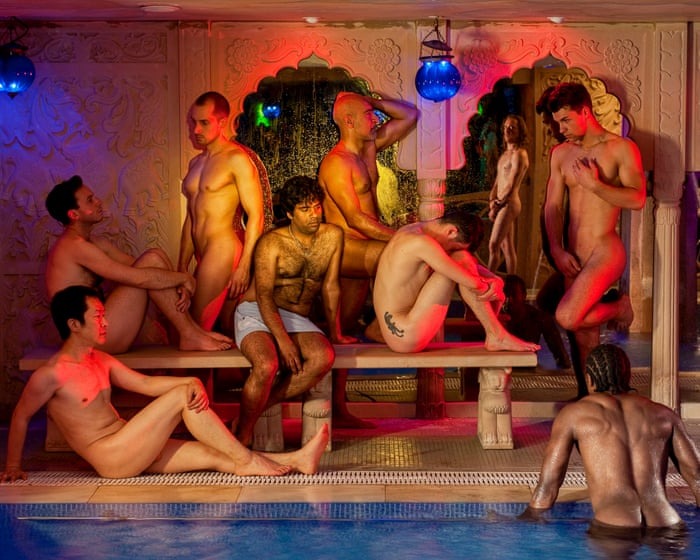
This is based on a scene from Chris Marker’s La Jetée. It brings together a gay photo history I was never taught but gathered for myself. Each person’s pose references a different historic image—from Robert Mapplethorpe to George Platt Lynes, back to Wilhelm Von Gloeden and French Romantic painting.
8. From the Black Experience
View image in fullscreen
Photograph: Sunil Gupta/© Sunil Gupta. All Rights Reserved, DACS 2025.
This was part of a show at [London gallery] Autograph in 1986, commissioned by the Greater London Council. Back then, “Black” meant anyone with heritage from the British empire—the GLC’s early definitions even included the Irish. I found myself caught between two struggles: Asians who didn’t think they were Black, and Black colleagues who weren’t looking at Asian culture at all. I thought if I didn’t make pictures about South Asians, there would be no images of us in the show—so I made 10 pictures. That exhibition was the start of Autograph. It’s incredible that it’s still around.
9. From Homelands
View image in fullscreen
Photograph: Sunil Gupta/© Sunil Gupta. All Rights Reserved, DACS 2026.
I was at a very low point. I was approaching 50. I’d been diagnosed with HIV, my work had declined, and my social life had disappeared. I got a three-year fellowship in Southampton, which was quite extraordinary. I made this project about me as a person with HIV, looking at the landscape and where I had come from. These pictures were both taken in London; one is at St Thomas’ Hospital, where I have my treatments and the unpleasant experience of a reverse drip coming out of my heart. The other image is on Drummond Street, where I would go to an Indian food place.
10. From Exiles
View image in fullscreen
Photograph: © Sunil Gupta. All Rights Reserved, DACS 2025.
In 1986-7, I got a commission from the Photographers’ Gallery in London. I thought I’d use it to go back to Delhi and do a project about Indian gay men. My informants took me to the places they went cruising and agreed to be in the pictures, up to a point. I would chat with many more people just using a tape recorder. The extracts are from the recordings, but they don’t always match the person in the picture. I felt that just pictures wouldn’t convey the complexity ofI think part of my journey has been to place Indian gay men in cultural history. When I was a student, you couldn’t find them anywhere. I’m so excited that this work has now been acquired by MoMA in New York, so I feel they’re in the history books now. My job is done. Sunil Gupta: Life with a Camera, 1970 – Now is at Kettle’s Yard, Cambridge, 19 September to 31 January.
Frequently Asked Questions
Here is a list of FAQs based on Sunil Guptas work and the quote We werent shy We were queers in leather
Beginner Questions
Who is Sunil Gupta
Sunil Gupta is a pioneering Indianborn photographer and activist He is famous for documenting gay male life queer identity and the South Asian diaspora since the 1970s
What does the quote We werent shy We were queers in leather mean
It is a statement of pride It means the subjects in his photos were not hiding their sexuality they were boldly and visibly expressing it through their style and presence
What kind of photographs did Sunil Gupta take
He took candid and posed photos of gay men in everyday life at protests and in social spaces like bars and clubs His work often focused on intimacy community and political activism
When and where were these photos taken
Much of this specific work was taken in the 1970s and 1980s primarily in London UK and New York City USA
Why are these photographs important
They are important because they provide a visual history of a community that was often ignored or misrepresented by mainstream media They show gay men as real people living their lives openly
Intermediate Questions
What is the significance of leather in the quote
In gay male culture leather refers to a specific style of dress associated with hypermasculinity rebellion and a distinct subculture It was a way to reclaim power and visibility
How did Guptas photography challenge stereotypes
He didnt just show gay men as victims of AIDS or discrimination He showed them as happy loving political and stylish He captured the joy and defiance of the community not just the tragedy
What is the South Asian diaspora connection in his work
Gupta often explored the intersection of being both gay and of Indian descent He documented the unique experience of queer South Asians living in the West who often faced racism within the gay community and homophobia within their own cultural communities
Was his photography considered political
Yes highly In the 1970s and 80s simply being openly gay in public was a political act His photos were a form of activism documenting protests and demanding visibility