Fascism relies on a two-part con. First, a leader claims to speak for the people. Then they insist that only by handing them sweeping powers can that will be fulfilled. Having grown up in Switzerland, I find it easy to see through this trick, because the policies the far right champions rarely survive a referendum.
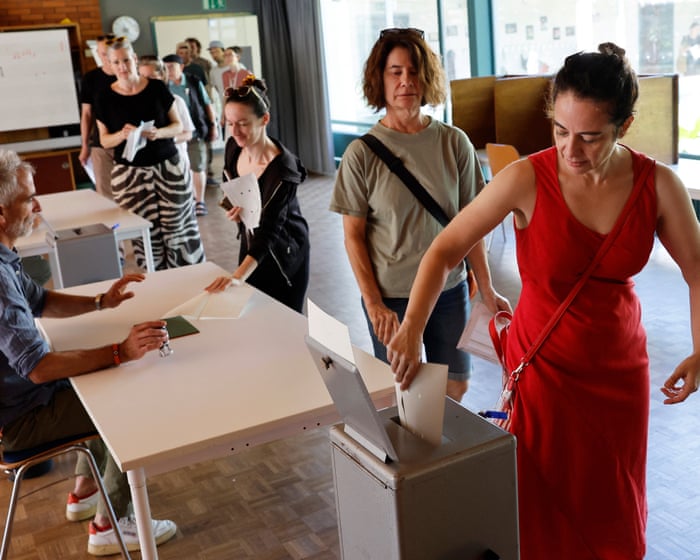
Dismantling publicly funded media? In March, 62% of Swiss voters rejected a far-right proposal to halve funding for the country’s public broadcaster. Corporate tax cuts? In 2017, 59% voted down the Swiss government’s plans. Immigration police hunting down migrants? Again, 59% rejected a far-right proposal to automatically deport foreign nationals convicted of crimes without judicial review. And this week, a resounding 70% voted “No” to a far-right plan to tighten Swiss neutrality so strictly that Bern would have been forced to drop its sanctions on Russia over Ukraine.
Switzerland is hardly a nation of progressives. Left-wing parties won just 29% of the vote in the most recent national elections. Women only gained the right to vote in 1971. The asylum law is one of the toughest in Europe. That, too, is the legacy of direct democracy.
Yet more often than not, the country’s tradition of putting decisions to referendums exposes how the far right, despite dominating social media and having its positions amplified by the press, thrives on imagined majorities.
Direct democracy also frustrates the second part of the authoritarian project: the power grab. From Donald Trump to Giorgia Meloni, the right seeks to centralise power. Direct democracy disperses it. History shows that parliamentarians can be pressured into surrendering their prerogatives. Good luck trying to persuade millions of voters to do the same.
View image in fullscreenA poster urging people to vote against the Swiss People’s party referendum titled ‘No to a Switzerland with 10 million inhabitants’, Bern, 18 May 2026. Photograph: Christian Beutler/ThirdParty/AP
Enter Hannah Arendt. Having fled Nazi Germany in 1933, the philosopher and political theorist spent much of her life trying to understand why democracies abolish themselves, and why the Weimar Republic failed.
Part of her answer was that parliamentary democracy can drift towards rule by party elites and bureaucracy. Autocrats exploit the sense of loss that arises when citizens feel disenfranchised.
The central question, then, is how to maintain the link between demos and kratos – between people and power. Arendt’s answer was citizen participation. She pointed to the town hall meetings of the American revolution and the soviet councils of the Russian revolution as possible models.
Indeed, deeper citizen involvement is one of the great unmet desires of European politics. Take the gilets jaunes movement in France in 2018. The protesters’ demands went well beyond better public services or lower taxes. At its heart was a plea to be seen and heard, embodied in the call for citizens’ referendums.
A 2017 poll found that 74% of German, French and Spanish people think public referendums would be a good way to govern their country. Yet whenever I argue for more direct democracy abroad, the reaction is always the same: curiosity from ordinary people, eye-rolling from political and economic elites. But aren’t referendums a high-risk way of governing, they ask? Brexit, anyone?
There are risks. In June, Swiss voters narrowly rejected (55%) a far-right proposal to cap the population at 10 million and terminate EU-Swiss economic agreements. But unlike the Brexit referendum in the UK, a vote is never a final decision for the Swiss. Since 2000, the Swiss have voted on relations with Brussels more than a dozen times. Unlike politicians, the demos has little trouble admitting that yesterday’s answer may not be right for today.
But wouldn’t voters, if given the chance, blow a massive hole in the budget deficit? As every parent knows, responsibility breeds responsibility. Two-thirds of Swiss voters rejectA proposal to extend annual holidays by two weeks has been made. A tragic case of excessive responsibility. It seems that many in Europe have forgotten that we want to live in republics not only because they “deliver” in terms of rubbish collection or maximising individual freedom. Democracy’s most powerful idea is the promise of self-government: a political order that recognises we humans not merely as consumers or subjects of politics, but as the authors of our common future.
Skip past newsletter promotion
Free newsletter | Weekly
Sign up to This is Europe
The most pressing stories and debates for Europeans – from identity to economics to the environment
Enter your email
Sign up
After newsletter promotion
When that promise is broken, when people feel their votes have little impact and elites always get their way, the difference between democracy and authoritarianism begins to blur. It is then that things become truly dangerous.
To put a lock on the far right and breathe new life into that republican promise, we need a transfer of power from the nation state to its citizens. But here is the crux. If we really want to reestablish the primacy of democracy, the transfer of power to citizens needs to be accompanied by a transfer of power from the nation state to Europe.
Let’s not fool ourselves: today, nation states often cosplay sovereignty more than they exercise it. To claw back power from Silicon Valley, Washington and Beijing, we must organise as Europeans. And this is where another of direct democracy’s secret superpowers comes in.
In Switzerland, with its four linguistic communities, referendums are what create a joint public sphere and a sense of national community. In a multicultural country, being governed together is not enough. A shared identity is built above all through the experience of debating and governing together.
For Europe to become a real political community, it must find a way to both connect and empower its citizens. Direct democracy delivers on both. Giving up some national sovereignty in return for more individual power is an attractive offer. It could open a new chapter in the continent’s coming together, one capable of inspiring genuine excitement.
Imagine Europeans debating and voting together on such things as migration policy, the 2035 ban on new petrol and diesel cars, or taxing the big digital corporations. Utopian? Perhaps. But every democratic advance once was.
Joseph de Weck is an associate fellow with the German Council on Foreign Relations and writes for Guardian Europe from Zürich and Paris.
Frequently Asked Questions
FAQs Switzerlands Referendums and the Far Right
1 What is a referendum in simple terms
A referendum is a direct vote where citizens decide on a specific issue or law themselves instead of leaving it to politicians
2 How often do Swiss citizens vote
Usually four times a year and they decide on several issues at oncelocal cantonal and federal
3 Whats the difference between a referendum and an initiative
An initiative lets citizens propose a new law or constitutional change A referendum lets them accept or reject a law already passed by parliament
4 How many signatures are needed to trigger a referendum
50000 signatures within 100 days to challenge a federal law An initiative needs 100000 signatures within 18 months
5 Why does Switzerland hold so many referendums
Direct democracy is part of Swiss political culture and law Citizens have the tools to challenge decisions and shape policy between elections
6 How does this keep the far right in check
Voters with antiimmigrant or nationalist views can push their ideas through referendums But to win they need a majorityso they must moderate their message and build broad coalitions
7 So the far right can still win votes
Yes In 2014 a referendum to limit immigration passed narrowly But the result was softened in parliament and voters later rejected a stricter version
8 What happens when a referendum passes
Parliament must implement it but often has room to shape how Courts and international law can also limit whats possible
9 Does direct democracy make politics more stable or less
Usually more stable It gives people a release valve so anger doesnt build up But it can also slow down decisions and create uncertainty
10 What are the downsides of frequent referendums
Voter fatigue low turnout on complex issues and campaigns dominated by money or emotion Populist slogans can oversimplify hard problems
11 Do referendums always reflect the popular will
Not perfectly Turnout mattersif only 40 vote the result may not represent everyone And campaign spending can tilt the playing field
12 Can a referendum violate human rights
In theory yes But Switzerlands constitution and international commitments set limits Courts and parliament can