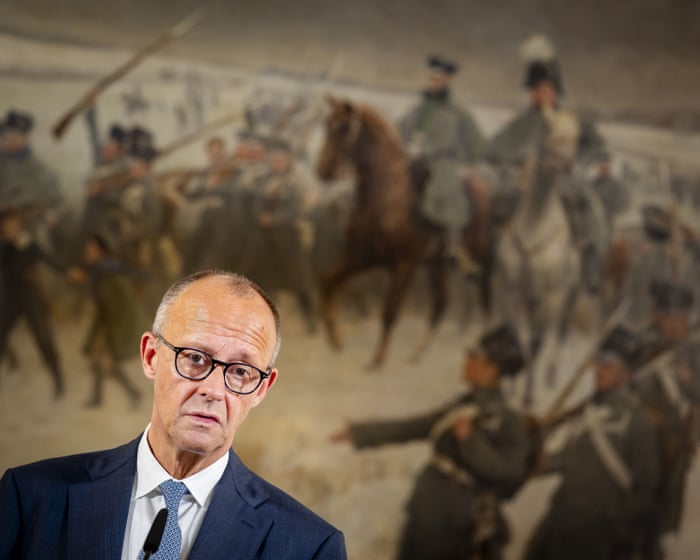
When German Chancellor Friedrich Merz visited the White House earlier this year for a high-stakes meeting with Donald Trump, he invited a Washington-based German researcher who is little known outside expert circles to a private dinner.
Liana Fix had caught his attention with a blunt essay in the journal Foreign Affairs warning of the dangers of Germany becoming “Europe’s next hegemon,” whose military dominance could end up frightening its neighbours and dividing Europe once again. That concern might seem far-fetched three decades after the fall of the Berlin Wall, during which a peace-loving, reunified Germany let its armed forces wither and rust, took pride in being a “civil power” and preached a gospel of military restraint.
Yet the combination of a sudden surge in German rearmament, growing doubts about whether the United States will remain the guarantor of European security through Nato, and the rise of the far-right nationalist Alternative für Deutschland (AfD) party, currently leading in opinion polls, has reignited old anxieties among Berlin’s neighbours, especially Poland and France.
Fix, a historian and senior fellow at the Council on Foreign Relations, has turned her argument into a timely and incisive book, Germany Rearmed: The Return of War and the End of Illusions. Among the myths she skewers are not only the delusion that economic interdependence would make Russia a benign partner for Europe—shattered by Moscow’s full-scale invasion of Ukraine—but also the end of what she calls “the illusion of the west,” which had been central to Germany’s identity and foreign policy since 1945. “It is not that Germany wants to leave the west, but the west seems to be abandoning Germany, in particular the US-led western order,” Fix told me in an interview.
To guard against any hegemonic temptation, she urges Berlin to anchor its future military power in closer European unification: by helping to finance European defence through joint defence bonds, embracing a Europeanisation of the continent’s national arms industries, and deepening the integration of the Bundeswehr into European armed forces.
There is little sign so far that Merz is heeding her advice. His first defence strategy, released in April, vowed to make Germany Europe’s strongest conventional army by 2039. Struggling with unpopularity, economic stagnation and a rising cost of living, the conservative chancellor has ruled out issuing eurobonds to fund European defence. His government scrapped two big arms cooperation projects with France—a next-generation fighter aircraft and a tank. Planned arms purchases worth €123.3bn notified to parliament last month are overwhelmingly from national and US industries, with only scraps for European partners.
To be sure, all of Berlin’s armed forces are committed to Nato, unlike France’s, and it has invited allies to join its European Sky Shield air and missile defence programme. Germany is the biggest donor of financial and military assistance to Ukraine. It is working with the UK on deep precision strike weapons. And it has stationed a brigade in Lithuania to help protect Europe’s eastern flank—the first permanent deployment outside its territory since 1945.
Defence industrial nationalism is by no means confined to Germany. France and the UK are equally protective of their national arms makers. The EU’s defence commissioner, Andrius Kubilius, laments that up to 80% of European defence purchases are made through direct awards to national prime contractors without a competitive tender, exploiting a security exemption in the EU treaty.
The fact that German rearmament coincides with a severe slump in core manufacturing industries such as cars, chemicals and machinery is an extra reason to “buy national.” But Berlin, once on the frontline of east-west confrontation, is now cushioned by a buffer zone of central European allies and should have an interest in helping them invest in their own defence. For practical reasons, it’s better to help equip friends and neighbours to interEuropean countries should intercept drones and missiles before they reach Germany, rather than waiting to shoot them all down over Berlin and Frankfurt. Fix is right to argue that, because of its dark history and its central position in Europe, Germany must do more than others to reassure its neighbours and to embed its rearmament in common European industrial, political and military structures. As Timothy Garton Ash has argued in the Guardian, that is what Helmut Kohl achieved a generation ago by anchoring German reunification in a common European currency.
Otherwise, the question of German power and its political uses is bound to return sooner or later, especially if the Russia-friendly AfD, which opposes assistance for Ukraine and advocates withdrawal from the EU, continues to gain ground in German elections.
“The German question is not dead,” Fix told me. “It’s dead in the sense that a militaristic Germany will not re-emerge under a centralised government. But the German question can also just be a question of dominance and of balance. And this is the thinking we unfortunately have to revive.”
Paul Taylor is a senior visiting fellow at the European Policy Centre.
Frequently Asked Questions
Here is a list of FAQs based on the article Germany is right to rearm but Europe has legitimate fears about it by Paul Taylor
Beginner Questions
Q What is this article about
A Its about Germany deciding to significantly increase its military spending and rebuild its armed forces The article argues this is the right thing to do but it also explains why other European countries are nervous about it
Q Why does Germany need to rearm
A The main reason is Russias invasion of Ukraine This war made Germany and other European countries realize they can no longer rely on others for their security and need to be able to defend themselves
Q Why would anyone be afraid of Germany having a strong army
A Because of history Germany started World War II and its military aggression caused millions of deaths This history makes many of its neighbors like Poland and France very cautious about a powerful German military
Q What does rearm mean
A To rearm means to build up a countrys military strength again This includes buying new weapons increasing the number of soldiers and improving military technology
Q Who is Paul Taylor
A He is a journalist and writer who focuses on European politics and international affairs He writes for publications like Politico
Advanced Questions
Q What is the core argument of Paul Taylors article
A Taylor argues that Germanys rearmament is a necessary and correct response to Russian aggression However he contends that Europes historical fears are legitimate and must be addressed through deep integration of Germanys military into NATO and the EU ensuring it acts as part of a collective European defense rather than a unilateral German force
Q What specific historical fears do European countries have
A The fears are rooted in the 20th century Twice a powerful militarized Germany invaded its neighbors causing catastrophic destruction Countries like Poland which suffered immensely under Nazi occupation are particularly sensitive The fear is that a militarily dominant Germany could once again pursue its own national interests at the expense of others
Q How does Germanys rearmament fit into the broader European security framework