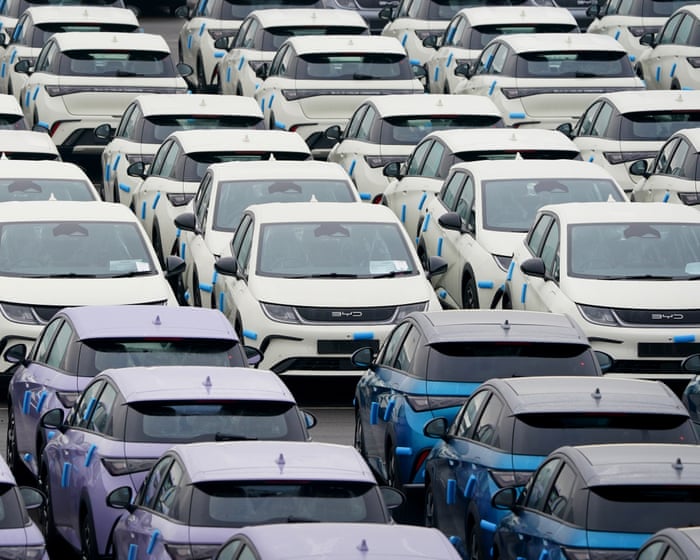
Sales of Chinese hybrid cars in the EU have soared over the past four and a half years, according to data, highlighting Brussels’ growing concerns about the future of the European car industry.
In 2022, only 659 Chinese-made full hybrids—vehicles where the petrol or diesel engine charges the motor and battery—were sold in the EU. But after Brussels imposed anti-subsidy tariffs on fully electric cars from China in 2024, hybrid sales jumped to 160,662 in the first seven months of this year.
Eurostat figures show that sales of Chinese-made plug-in hybrids—models popular for longer distances that can recharge via both the fuel engine and an external power source—have also surged, rising from 56,706 in 2022 to 217,764 between January and July this year.
The growing number of Chinese hybrids on European roads is now alarming both the car industry and Brussels, which has asked China to voluntarily cut its hybrid exports to the EU or face safeguards, likely in the form of quotas.
On Thursday, the German car industry signalled for the first time that it would be willing to consider tariffs specifically on Chinese hybrids.
The German Association of the Automotive Industry (VDA) called on the European Commission to carry out a full assessment of the impact of any trade safeguards, which can range from quotas to price floors and tariffs.
It said: “The EU must also have an effective and up-to-date set of trade defence instruments at its disposal. Where unfair conduct is proven, the use of WTO-compliant trade defence instruments must be considered; these are legitimate and tried-and-tested means of achieving a level playing field and safeguarding fair conditions of competition.”
According to new figures from the European Automobile Manufacturers’ Association (ACEA), hybrids now make up almost 37% of the overall market, while electric cars account for just over 21%.
ACEA figures show three Chinese manufacturers—BYD, Chery and Leapmotor—making significant gains with triple-digit growth in the EU.
A fourth company, Geely, saw steady 8% growth in the first eight months of the year and remains the most popular Chinese brand in the EU, with 205,000 cars sold in that period. Its brands include Sweden’s Volvo and Polestar, the EU’s only all-electric car manufacturer.
BYD is catching up with Geely, with sales soaring 163% year on year to 177,000 units.
Both companies, along with a fifth Chinese manufacturer, SAIC, are now well ahead of Elon Musk’s Tesla, which sold 142,000 cars across the bloc in the first seven months of the year.
European manufacturers still dominate, with the Volkswagen group selling 2 million cars in the first eight months of the year.
Electric car sales are also growing fast in parts of Europe, including Germany, where they rose 75% to 69,000 units in August, and France, where sales were up 112%. In Slovenia, sales increased by 266%. By comparison, the UK saw a 27% rise in August to 28,000 EVs sold, while Ireland was up just 7% to 2,200 units.
Earlier this month, European Commission president Ursula von der Leyen described the bloc’s trade deficit with China—now €1.18 billion a day—as having reached an unsustainable “tipping point”.
The EU’s trade commissioner, Maroš Šefčovič, and his Chinese counterpart, Wang Wentao, will meet on 8 and 9 October to try to build a truce.
Also hoping for a trade truce are Donald Trump and Xi Jinping, who meet in Washington on Thursday for their third summit in 12 months.
Trump agreed in South Korea last October to drop tariffs on certain Chinese imports in exchange for a suspension of China’s export restrictions on rare earths, which are critical to the car industry across the US.The EU and the UK. Some believe a deal may not have been reached yet, and the suspension may not be announced until the Asia-Pacific Economic Cooperation conference next month.
Frequently Asked Questions
Here is a list of FAQs about the surge in Chinese hybrid car sales in the EU
1 What is actually happening with Chinese hybrid cars in Europe
Sales of hybrid cars made by Chinese companies are growing very fast in the EU This has caught the attention of European regulators and carmakers who see it as a major competitive threat
2 Why are these cars so popular
They offer a mix of low price good technology and low running costs Many Chinese hybrids are cheaper than similar European models and come with features that usually cost extra on European cars
3 What is a hybrid car in simple terms
A hybrid uses both a petrol or diesel engine and an electric motor It does not need to be plugged in to charge The car charges itself while driving and uses the electric motor to save fuel
4 Are Chinese hybrids different from Chinese electric cars
Yes Chinese electric cars have been in the news for over a year Now Chinese hybrids are also selling well Hybrids are often more practical for buyers because they dont need charging stations
5 Why is Brussels worried
The EU is concerned that Chinese government subsidies give their carmakers an unfair price advantage There are also fears about job losses in Europes car industry and overdependence on Chinese supply chains
6 What has the EU done so far
The EU has already placed extra tariffs on Chinese electric cars Now it is looking at whether similar action is needed for hybrids It is also investigating subsidies and monitoring import numbers
7 Are these cars safe
Most Chinese hybrids meet European safety standards and have good crash test ratings However some cheaper models may have fewer advanced safety features than European rivals
8 What are the main benefits for buyers
Lower purchase price lower fuel bills and often a longer warranty Many also come with modern tech like big screens and driver assistance systems as standard
9 What are the common problems with these cars
Some owners report issues with software glitches weak dealer networks and difficulty finding spare parts Resale values can also be lower than for established European brands
10 Can I get one serviced easily in Europe
It depends on the brand Bigger Chinese brands are building service networks but smaller ones