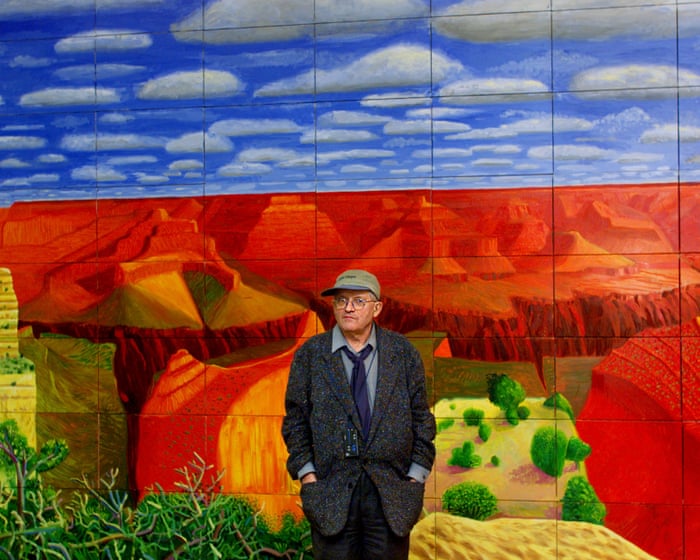
David Hockney changed the world just by looking at it. His art was a celebration of pure visual joy—a long, delighted feast of seeing. He was someone who found wonder in flowers in a vase and sunlit freeways, and who constantly thought of new ways to capture such fleeting treasures in pictures. It never seemed to occur to him that his way of seeing was revolutionary. All he cared about was truth. But no one had ever captured the look and feel of the modern world with such acceptance before. He has the same simple perfection as the Beatles—just as they captured the sound of the modern world, he captured its look.
The most telling thing about Hockney is that he loved Los Angeles. Where others might see a mindless chaos, he saw freedom and possibility under a non-judgmental blue sky. Low houses with patio doors that glinted emptily, tall thin palm trees with tiny tops, the white splash of a diver hitting the water—Hockney’s California is a vision of paradise. He is the Matisse of pop art, and A Bigger Splash is the 1960s answer to Matisse’s 1904 manifesto for pleasure, Luxe, Calme et Volupté.
Pop art often had a gloomy side, as wide as a Chevrolet. Most of its great figures—Richard Hamilton, Andy Warhol, Gerhard Richter—were not fans but cold critics of the new Western consumer society taking shape by 1960. Then came Hockney. Growing up in the smoke-blackened industrial landscape of Bradford, he became a young artist free from both nostalgia and snobbery. His early works, made when he was a student at the Royal College of Art in London, accept modern life not with irony or ideology, but simply because it was his life: from desk lamps to dancing to taking a shower, why shouldn’t he show how his generation lived?
Being gay was just part of the truth he lived and painted. It wasn’t a big deal, and he’d be upset if we remembered him as “Britain’s first openly gay artist.” It’s exactly his relaxed and untroubled portrayal of a sexuality that was illegal in early 1960s Britain that makes his art so effortlessly subversive. From his splashy 1960–61 painting Doll Boy, which confesses his passion for Cliff Richard (“very attractive, very sexy”), to a calm 1968 portrait of a mature and confident couple, Christopher Isherwood and Don Bachardy, Hockney’s artistic development during that revolutionary decade is very much about finding the right style to show gay life as it is.
Yet Hockney is never just a participant in the new, free, fulfilled world he sought in swinging London—and found in California. He is also an observer, and a highly self-aware one. When he first visited the US in 1961, he made a comic record of the trip in a series of prints modeled on William Hogarth’s The Rake’s Progress. The bespectacled, scrawny Rake is Hockney himself, both fascinated and puzzled by America as he discovers there’s a gay scene and ends up surrounded by jeans-wearing clones listening to pop music on headphones (this was nearly 60 years ago: Hockney was already picturing the way we live now, even back then).
By the end of the 1960s, an eerie stillness took over his paintings as he became more openly the observer, the onlooker. The loneliness of looking is the theme of what may be his greatest painting, Portrait of an Artist (Pool with Two Figures). It’s certainly his most expensive, selling in 2018 for $90.3 million. In this huge 1972 canvas—an almost mystically radiant work—a young man in a pink jacket stands by an outdoor swimming pool, watching a swimmer whose pale flesh flickers under translucent turquoise water. To give the kind of gossipy detail Hockney came to hate, the man by the pool is Peter Schlesinger, and the painting captures the end of their relationship—a trauma that gives it painful authority.Visions of paradise… Hockney at home in Malibu, California, in 1991. Photograph: Paul Harris/Getty Images
But even though looking can be a solitary act, it’s also a joy. It’s almost embarrassing to admit that, despite all the psychological tension in this painting, the glowing, molten landscape of the colorful, sun-drenched hills beyond the pool is just as mesmerizing. Such sights captivated Hockney, and his art shares that wonder. Some of his most memorable works are simple still lifes: his 1972 painting Mount Fuji and Flowers, or his beautiful study of a fragile porcelain teapot set against a churning, heaving blue sea, Breakfast at Malibu, Sunday 1989.
In both of these pieces, delicate still-life scenes are placed alongside vast, awe-inspiring images of nature. It’s the kind of art history play—here, pitting Chardin against Turner or Hokusai—that Hockney could pull off effortlessly because he was so curious about how art’s changing styles shape the way we see the world. There was nothing naive about his realism. One of his biggest heroes was Picasso. He not only imagined a meeting between the two of them in a brilliant imitation of Picasso’s own graphic style, but also, in an experiment far from his easel, tried to apply Picasso’s shifting cubist perspectives to photography. His layered photo arrays, which aim to capture the many glances and fragmented views through which we truly see the world, are among his most instantly recognizable works.
Hockney once took me around a Caravaggio exhibition at the National Gallery to explain why he believed the painter must have used some kind of early camera. Then, at his London home, he brought out a Japanese scroll to show how Eastern landscape art uses shifting, unfolding viewpoints that embrace the world’s scale far more than the single-point perspective that has obsessed Western art. His argument was fascinating, and so was the scroll—which wasn’t an original but a copy. In other words, he valued it not for its rarity but for its usefulness.
View image in fullscreen
Have a seat … Hockney smokes by two works. Photograph: J-P/Photo Credit: Jean-Pierre Gonçalves de Lima
Hockney’s house in Bridlington was also beautifully but simply decorated. He didn’t use his wealth to live luxuriously, but to work and research. There was a modesty and directness about him that was deeply moving. He became famous for his stubborn refusal to give up smoking, but as a non-smoker, I can confirm that when he once drove me across Yorkshire, he used a high-tech ashtray that kept his smoke to himself. He was a courteous libertarian.
That character came through in public and made Hockney a celebrity. He achieved a kind of popularity that younger British artists haven’t reached, more like that of David Attenborough or the queen. David Hockney was the real thing—a great artist and a great human being.
Frequently Asked Questions
Here is a list of FAQs about David Hockney and how his work captured the essence of the modern world written in a natural tone with clear answers
BeginnerLevel Questions
1 Who is David Hockney
David Hockney is a famous British artist best known for his vibrant paintings drawings and photo collages Hes been a major figure in pop art since the 1960s
2 Why do people say Hockney captured the essence of the modern world
He focused on the things that define modern life bright swimming pools sleek California architecture the rise of photography and the way we see the world through screens and technology His work feels fresh and of its time
3 What is Hockneys most famous painting
Portrait of an Artist is his most iconic work It shows a man in a pink jacket looking down at a swimmer in a pool It perfectly captures the leisure and style of 1970s California
4 Did Hockney only paint pools
No but pools are a recurring theme He also painted landscapes portraits still lifes and used new technologies like photocopiers fax machines and iPads to create art
5 What does a feast for the eyes mean in this context
It means his art is visually rich colorful and joyful to look at He uses bright bold colors and clever perspectives that make you want to keep exploring every detail
Intermediate Questions
6 How did Hockney use photography to capture the modern world
He created photocollages where he took many Polaroid photos of one scene from different angles and then arranged them in a grid This mimics how our eyes actually move and see the worldnot as a single snapshot but as a series of glances
7 What role did technology play in Hockneys art
Hockney embraced new tools He used a photocopier to make layered prints a fax machine to send drawings across the world and later an iPad to paint directly on a screen This shows how modern tools become part of how we create and see
8 How did Hockneys style change when he moved to California
Moving from England to sunny California