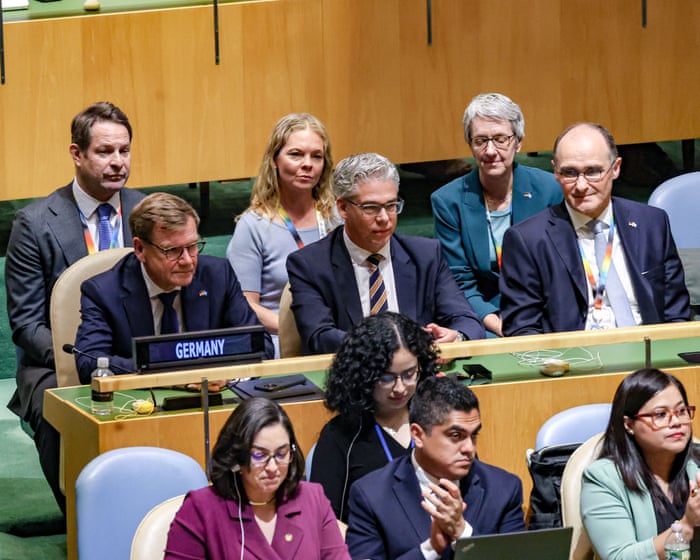
Germany’s unprecedented failure to win one of the rotating seats on the UN Security Council has sparked intense soul-searching in Berlin and raised doubts about its claims to international leadership under Friedrich Merz.
The council vote on Wednesday, which elected Austria and Portugal to two-year terms alongside Trinidad and Tobago and Zimbabwe, was a blow to Merz’s struggling government. It had been trying to position itself as a leading European voice on the global stage.
In an awkward rivalry among EU partners, Portugal received 134 votes and Austria 131, while Germany got just 104—well below the required 127 votes, despite Berlin expressing confidence just hours earlier that it would win.
Both winners were seen as representing the interests of smaller countries. Austria may have benefited from its perceived neutrality as a non-NATO member, while Portugal highlighted its strong ties in Africa and Latin America.
German Foreign Minister Johann Wadephul, who had campaigned hard for the seat, blamed the “bitter defeat” on Germany’s active role in rallying support for Ukraine and its firm backing for Israel.
“We have always taken a clear stance on certain issues, and these are positions that not all member states share,” Wadephul told reporters. He said it was “no secret” that Russia had stirred up sentiment against Germany, now Kyiv’s largest national provider of military aid.
“There is our firm support for Ukraine; the fact that [permanent member] Russia does not want such a voice at the Security Council,” he said.
“The fact that Germany must always assume a special responsibility for Israel in the Middle East conflict may also have cost votes,” he added, referring to Germany’s support for Israel as a key part of its foreign policy, in atonement for the Holocaust.
Wadephul said Germany would stand by Israel even if it criticized the government’s actions in Gaza, West Bank settlements, and military strikes in Lebanon.
Chancellor Friedrich Merz, whose popularity has plummeted in his first year in power, congratulated the winners of the secret ballot for five seats on the 15-member council and said Berlin’s commitment to the UN would remain unwavering.
Germany, the second-largest contributor to the UN, remains a “reliable pillar of multilateralism,” he said, “acting with determination and a sense of responsibility.”
Since Merz took office last May at the head of an uneasy right-left coalition government, he has tried to steer Europe’s largest economy back to strength while making Berlin’s voice heard on global issues, backed by a sharp increase in military spending.
The results at home and abroad have been mixed, even sparking speculation in recent days that Merz could be replaced as chancellor by a fellow conservative, Hendrik Wüst, the premier of North Rhine-Westphalia, if he fails to turn things around.
While such a scenario still seems highly unlikely, critics from across the political spectrum said Merz and his allies had only themselves to blame for the latest debacle.
The opposition Greens called it an “embarrassing defeat,” with deputy parliamentary group leader Agnieszka Brugger pointing to a failure to “back this bid with modern ideas” about leadership on climate protection, the international rules-based order, and development aid.
Alice Weidel, co-leader of the far-right Alternative for Germany party, now leading in German opinion polls, and a fierce critic of Berlin’s support for Kyiv, said in a scathing post on X that it confirmed a narrative of national decline.
“One embarrassment follows the next: while Merz had intended to bring our country ‘back onto the international stage’ at the start of his chancellorship, Germany now finds itself without a seat on the UN Security Council.”She said, “Security Council.” The Social Democrats, the junior coalition partners in the government, also criticized the vote, calling it “not a mere hiccup, but a warning sign.”
Adis Ahmetović, the party’s foreign policy spokesperson, said Berlin was paying the price for perceived hypocrisy in holding back criticism of allies like Israel and the US. “Anyone who claims to be the guardian of the rules-based international order must not apply double standards when it comes to international law,” he told Spiegel magazine.
Merz initially avoided commenting on whether Donald Trump’s military attacks in Venezuela and Iran complied with international law. But he later angered the US president by saying the Americans were being “humiliated” by Tehran due to their poorly prepared campaign.
Because of Germany’s militaristic past and concerns about it becoming too dominant in Europe again, the country has mostly relied on “chequebook diplomacy” to exert influence within international institutions during the post-war period. This makes being sidelined at the UN especially painful.
Germany has served on the Security Council six times, most recently in 2019-20.
Manuel Fröhlich, a political scientist at the University of Trier in western Germany, said the high-profile campaign to win the seat, which went down to the wire, would further hinder Merz’s efforts to make a comeback.
“The government would certainly have celebrated it as a success, and in that sense, it will no doubt have to take responsibility for this defeat,” he told public broadcaster Phoenix. “So, it is a significant setback.”
Frequently Asked Questions
Here is a list of FAQs regarding Germanys failed UN Security Council bid and the resulting pressure on Friedrich Merz
BeginnerLevel Questions
Q What exactly happened with Germany and the UN Security Council
A Germany was trying to win a temporary seat on the UN Security Council for 20272028 They lost the vote to Italy which is widely seen as a diplomatic failure
Q Why is this considered embarrassing for Germany
A Germany is Europes largest economy and a major donor to the UN Losing a seat to a fellow EU country suggests its usual diplomatic influence has weakened which is a public blow to its prestige
Q Who is Merz and why is the pressure on him
A Friedrich Merz is the leader of Germanys opposition CDU party He was heavily involved in pushing Germanys bid and has been a vocal critic of the current governments foreign policy Critics are now blaming his aggressive approach for the failure
Q Did Germany lose because of something the current government did wrong
A Many analysts say the failure was due to a lack of coordination mixed signals from Berlin and Germanys controversial stance on issues like arms exports to Israel The opposition had been warning about this for months
AdvancedLevel Questions
Q What specific countries voted against Germany and why
A Italy won the seat with 132 votes to Germanys 108 While the exact votes are secret its believed many African Asian and Latin American countries backed Italy because they felt Germany was too focused on European priorities and not enough on their concerns
Q How does this failure affect Germanys longterm goal of becoming a permanent Security Council member
A Its a major setback Germany has long campaigned for a permanent seat Losing a nonpermanent race suggests it lacks the broad global support needed for such a major structural change making its campaign look weaker
Q What does pressure mounting on Merz mean in practice