In late 2024, I visited the Namibian port town of Lüderitz and came across a small museum run by descendants of German settlers. Alongside imperial German flags and memorabilia, it displayed artifacts from the Herero tribe that had been recovered from nearby Shark Island. What wasn’t mentioned is that, from 1905 to 1907, Shark Island was the site of a concentration camp where Herero and Nama prisoners were forced into hard labor, starved, and systematically abused. At least 3,000 people are believed to have died there.
When I visited, Shark Island was being used as a tourist campsite. Monuments on the island honored Adolf Lüderitz and Heinrich Vogelsang, the German merchants who helped establish the colony known as German South West Africa. Today, it’s widely reported that Namibia’s white minority—less than 2% of the population—owns about 70% of commercial farmland.
A new exhibition called Fractured Lifeworlds opens in Berlin this week, focusing on questions of memory, geography, and accountability. It presents four years of research by Forensic Architecture, a multidisciplinary group that uses visual reconstructions to investigate human rights abuses in places like Syria, Palestine, Greece, and Germany.
Created together with its Berlin-based sister organization Forensis and developed with Namibian researchers, the exhibition traces the legacy of what has been called the first genocide of the 20th century. It was first shown at Namibia’s National Art Gallery in Windhoek last year and now comes to Spore Initiative in three seasonal parts: Bush, Wind, and Sand. Each part looks at how colonial violence became embedded in Namibia’s dry landscape.
The centerpiece of the show is a series of films that combine oral stories from descendants of genocide victims with detailed geological research. A haunting 30-minute film about Shark Island reconstructs the concentration camp, showing how German authorities used the island’s harsh environment against prisoners—and shipped their skulls back to Germany for pseudoscientific research. The investigation also identifies nearby sand mounds believed to be unmarked mass graves for prisoners killed on Shark Island.
Underneath Shark Island, the Lüderitz port is set to expand as part of Hyphen, a multibillion-euro British-German green hydrogen project being developed in Namibia. The project plans to use Namibia’s abundant wind and solar resources to produce green hydrogen and ammonia for export. For Germany, it promises clean energy and less reliance on foreign fossil fuels.
For many Nama and Herero descendants, it feels like a familiar pattern of extraction. Much of the project’s infrastructure is being built across a 4,000 square kilometer area of ancestral land that belongs to Nama communities. According to human rights groups, they have been left out of any meaningful participation in the project.
Many descendants also worry that the Hyphen project could harm efforts to preserve Namibia’s genocide sites as places of remembrance. Sima Luipert, an adviser to the Nama Traditional Leaders Association (NTLA) and a collaborator on the exhibition, fears the port expansion could disturb burial grounds. “When they dredge, they don’t seem to realize that they are not simply moving dirt. They are disturbing the dead,” she says. “The water is the burial site.”
Germany refuses to pay reparations to Herero and Nama descendants, offering instead development aid payments negotiated with the Namibian government. When Germany formally recognized the atrocities in 2021, it described them as a genocide “from today’s perspective”—a phrase critics say avoids the legal and political consequences of recognition. By that logic, no act committed before the 1948 genocide convention can be considered genocide under international law.To Luipert, the agreement clearly shows a double standard. “Germany can quickly compensate Holocaust victims while using strict legal excuses to deny reparations to Africans,” she says. For her, the exhibition is a way to present evidence—”a digital shield against historical denial.”
In recent years, Forensic Architecture’s work has sparked debate. Critics see it as persuasive visuals built on evidence that can be unclear; supporters argue the group has found new ways to reveal structures of violence that might otherwise stay hidden.
In the works shown in Berlin, being open about methods is key. This is most convincing in a film about the 1893 Hornkranz massacre, when German colonial troops under Curt von François attacked the settlement of Nama leader Hendrik Witbooi, killing dozens of civilians. Using oral histories, photos, and detailed analysis of landscape changes, the film reconstructs an atrocity largely missing from German collective memory.
The film’s reconstruction process is visible throughout the exhibition space. Historical drawings, maps, and a letter from von François are displayed alongside digital models that imagine how the village might have looked before the massacre.
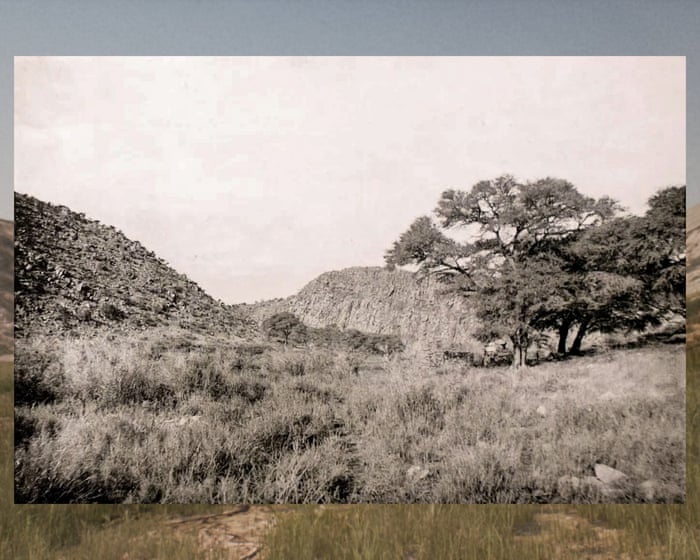
Mark Mushiba, lead curator of Fractured Lifeworlds and a researcher at Forensis, explains that historians have mostly relied on colonial documents. Forensic Architecture and Forensis instead tried to “read the landscape.” In Hornkranz—now a private farm—that meant finding old bullet casings, identifying former homesteads through unique vegetation patterns, and treating plants as historical evidence. “We were absolutely shocked by how little physical investigation had been done here,” Mushiba says.
Forensic Architecture founder Eyal Weizman describes their approach in Namibia as a form of “forensic botany.” With Forensis, the research agency analyzed shades of gray in colonial photos to infer grass density patterns, and combined these findings with other sources to reconstruct how local communities were erased. The goal is to recover a record written into the landscape. In Weizman’s words, the exhibition is about finding ways to “send a satellite back in time.”
This approach is mirrored in a work called Satellite Images of Hatsamas, which consists of three digital prints in bright red and green tones. Combining local knowledge, historical photos, and modern satellite data, the prints aim to show changes in vegetation over 150 years. The result reveals how colonial settlement has shaped the land, leading to bush encroachment and desertification.
Contemporary artworks add another layer to the exhibition. Tuli Mekondjo contributes an embroidered Herero uniform titled Schutztruppe. Originally worn by German colonial soldiers, the garment was adopted by Herero communities as an act of resistance and remembrance. By stitching a human skeleton onto the fabric, Mekondjo turns it into a wearable memorial for prisoners who died on Shark Island.
Speaking about the exhibition, Weizman often returns to the link between genocide and the desert: from the forced marches of Armenians into the Syrian desert to Gaza, where widespread destruction has flattened much of the land. Fractured Lifeworlds shows how colonial violence leaves traces in the landscape. As Germany continues to debate the meaning and scope of its memory culture, this exhibition is a timely reminder that the past is still part of the present.
Fractured Lifeworlds is at Spore Initiative, Berlin, from June 7 to April 30.
Frequently Asked Questions
Here is a list of FAQs about the topic They are disturbing the dead rebuilding the site of the forgotten first genocide of the 20th century based on the Herero and Nama genocide in German South West Africa
BeginnerLevel Questions
1 What exactly is the first genocide of the 20th century
It refers to the Herero and Nama genocide where German colonial forces killed tens of thousands of Herero and Nama people in what is now Namibia Many historians consider it the first systematic genocide of the 20th century
2 Why is it called forgotten
Unlike the Holocaust or the Armenian Genocide this event received little international attention for decades It was omitted from most history books and Germany only officially acknowledged it as genocide in 2021
3 What does disturbing the dead mean in this context
It refers to the physical disturbance of graves and mass burial sitesoften by construction mining or farmingand the broader metaphor of disturbing a silenced history by forcing people to remember and rebuild
4 Who is trying to rebuild the site
Descendants of the Herero and Nama communities along with Namibian activists historians and some German and international organizations are working to preserve burial grounds build memorials and restore cultural dignity
5 Where is the main site located
The most significant sites are in central and southern Namibiaespecially near the town of Okakarara and the Shark Island concentration camp near Lderitz
Advanced Questions
6 What evidence exists that this was a genocide not just a colonial war
Historians point to General Lothar von Trothas explicit extermination order the deliberate use of thirst and starvation in the desert and the establishment of concentration camps where thousands died from forced labor disease and medical experiments
7 Why are human remains a major issue in the rebuilding effort
German museums and universities held