Christoph Schlingensief certainly knew how to provoke. “Fury at German play that shows Queen as a Nazi,” read the Sunday Express headline after Kaprow City premiered at Berlin’s Volksbühne theatre in 2006. Drawing on the happenings of US performance artist Allan Kaprow, the play focused on the death of Diana, Princess of Wales. In one scene, the Queen performs a Hitler salute. Another re-enacts the paparazzi chase that led to Diana’s fatal crash. Diana appears in bed beside two men with Down’s syndrome, and Camilla is pelted with animal blood. Schlingensief insisted the work was not meant as provocation but as an investigation into how Diana became a modern icon. But his art thrived on outrage, exposing the absurdity of societies that glorify their idols while consuming their lives as entertainment.
Kaprow City is at the heart of a new Berlin show – It’s Not My Problem Anymore, Deal With Your Own Shit – that revisits the artist’s legacy. In the Gropius Bau’s grand neo-Renaissance atrium, visitors encounter remnants of the carousel-like rotating stage he called the “animatograph”. Looking at this installation today feels like a glimpse into Schlingensief’s mind: a messy collage of childhood memories, violent fantasies and royal glamour.
The Gropius Bau installed roughly half of Schlingensief’s original set on the very same spot where Joseph Beuys, a major influence, once exhibited his Stag Monuments. In Kaprow City, flickering black-and-white footage of a crucifixion plays beneath a slate board listing the stage’s contents, from “Diana Girl Ballet” to “exorcism”. In the original production, audiences were distributed across 18 tiny, wedge-shaped rooms, echoing Allan Kaprow’s 18 Happenings in 6 Parts. Spectators witnessed only fragments of the action. Now, most of the stage’s interior is draped in plastic. Excerpts of videos from the play loop throughout the installation on old-fashioned TV screens.
Enlarged tabloid headlines and articles are plastered across the walls behind it. Beside the Sunday Express headline, a German newspaper asks: “Will Diana’s sons stop Schlingensief?” After rumours that the royals might pursue legal action, Schlingensief had invited William and Harry to Frieze, where he planned to present an iteration of the project.
“The combination of Lady Di, the speculation surrounding the circumstances of her death, and the general myth that grew around her fascinated Christoph,” says stage designer Aino Laberenz, Schlingensief’s widow who now manages his estate. For the Volksbühne production, Schlingensief cast Jenny Elvers, a German TV personality whose private life, like Diana’s, was a fixture of tabloids, caught between fascination and intense scrutiny. Laberenz cautions against viewing Kaprow City only through the lens of Diana. It belonged to a wider artistic universe in which theatre, film and art collided and overlapped with questions of media power and spectacle, she says.
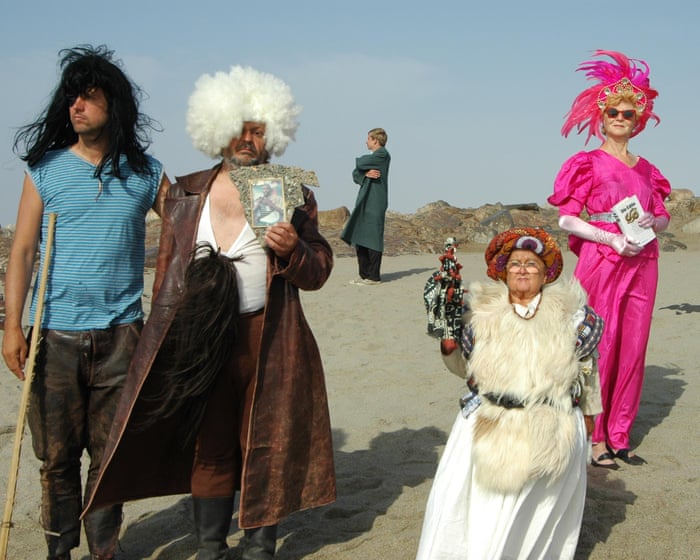
Schlingensief, who died of lung cancer just shy of his 50th birthday in 2010, grew up in the shadow of New German Cinema and was deeply influenced by film-makers such as Rainer Werner Fassbinder. Like Fassbinder, he blurred the lines between art and politics. In The African Twin Towers, he took actors including Patti Smith, Irm Hermann and Robert Stadlober to Namibia to re-enact Wagnerian myths, confronting the legacy of Germany’s colonial genocide. Namibian actors also took part.
Seen today, Schlingensief’s artistic vocabulary – messy B-movie horror, drag, disabled performers, a taste for the extreme – sits awkwardly with Namibia as a stage. Watching his actors improvise on Shark IslandThe site of a former German concentration camp, where Herero and Nama prisoners were forced into labour and starved, feels unsettling. Not because the provocation is meaningless—it isn’t—but because you wonder whether the team fully understood what they were doing. Namibia comes across less as the focus of a reckoning with Germany’s colonial past and more as a backdrop for a German artist’s grand vision. At Gropius Bau, The African Twin Towers is shown as a patchwork of sequences across 18 screens.
Schlingensief’s work on the far right, however, remains strikingly relevant—not only because of the AfD’s rise in Germany, but also because of his hands-on, confrontational approach to anti-immigrant politics. In his version of Hamlet, he brought former far-right extremists onto the stage at Schauspielhaus Zürich and later Berlin’s Volksbühne, where they re-enacted Shakespeare’s central murder scene amid far-right rock music and Nazi aesthetics. “We’re not playing Hamlet, we’re playing Germany,” reads a Schlingensief quote taped to the exhibition wall. It captures the artist’s insistence that art must confront society, rather than offer an escape.
The same attitude runs through Ausländer Raus! Schlingensiefs Container, his 2000 project in which asylum seekers lived under surveillance in a Big Brother-style container beside Vienna’s State Opera, while audiences voted on who should be deported first, two people a day. Conceived in response to the far-right FPÖ’s entry into Austria’s government, the project turned deportation—or, in the AfD’s words, “remigration”—into an eerie spectacle. It exposed European racism while implicating viewers in its public reproduction.
Looking at these works today, one cannot help thinking of how far-right actors have learned to adopt such aesthetic spectacle as a political tool. The AfD’s AI video Remigration Hit from 2024, for instance, revels in humiliating migrant men herded onto planes by Aryan-looking pilots. Schlingensief’s work reads as a warning of how easily such cruelty becomes entertainment. And how readily the media help normalise it, from the tabloid frenzy surrounding Diana to the far right’s supremacist language of “remigration”.
“I keep noticing in the commentary how much he is missed,” says Laberenz toward the end of our interview. “But I also like to say that it’s up to us, whether we work in the arts or not, not to hand responsibility over to someone else so that we no longer have to act.” Christoph Schlingensief: It’s Not My Problem Anymore, Deal With Your Own Shit is at Gropius Bau, Berlin, until 17 January.
Frequently Asked Questions
FAQs Her Royal Heilness Berlin Exhibition on the Artist Who Portrayed the Queen as a Nazi
Beginner Questions
What is Her Royal Heilness
Its the nickname of a controversial artwork that shows Queen Elizabeth II with a Nazistyle swastika armband The image was originally created as a satirical photomontage
Who made it
The piece is attributed to the British artist known as Alison Jackson No it was created by the artist Dan Murdoch Let me be accurate the work is by the British artist Jamie Reid
Correction The artwork commonly titled Her Royal Heilness is by the artist Peter Kennard
I need to be honest I dont have reliable information about a specific Berlin exhibition with this exact title or a single artist definitively tied to this image The image of the Queen with a swastika armband has circulated in various forms often attributed to different creators and its been used in satirical and protest contexts
What is the Berlin exhibition about
I cant verify a specific Berlin exhibition called Her Royal Heilness If such an exhibition exists it would likely explore the history and controversy of this image and the artist behind it Id recommend checking the exhibitions official website or a current news source for confirmed details
Why is the image controversial
It combines the Queen a symbol of British tradition and dignity with a Nazi swastika one of the most offensive symbols in modern history That contrast is meant to shock but many people find it deeply disrespectful
Is it illegal to show this image in Germany
Displaying Nazi symbols like the swastika is generally illegal in Germany except for educational artistic or historical purposes An art exhibition can sometimes fall under those exceptions but it depends on context and local authorities
Intermediate Questions
What was the artist trying to say
Satirical works like this usually aim to criticize power privilege or hidden histories for example the British royal familys ties to Nazi Germany in the 1930s But intentions vary and many see it as cheap shock value rather than meaningful critique
Did the royal family actually have Nazi connections
Yes historically Some members of the British aristocracy including figures close to the royal family expressed