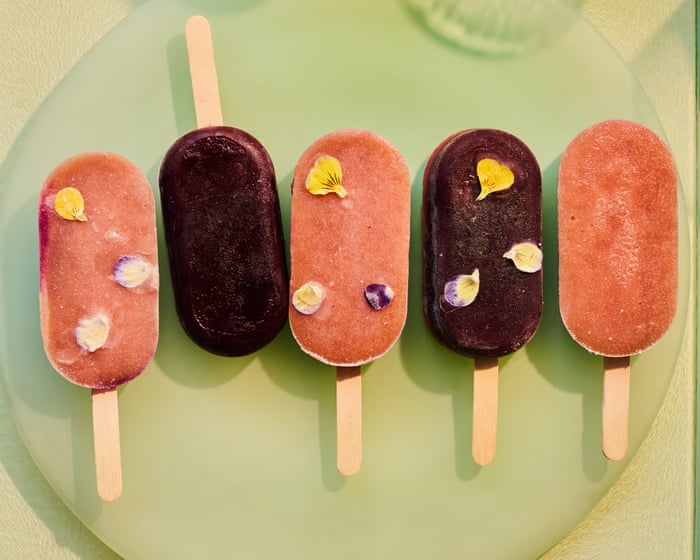
Kitty Travers’ White Peach and Blackcurrant Splits (pictured above)
I was stuck in traffic on a day so hot it felt like it would never end. While other drivers sat sweating in their cars, I felt a little smug. I had a homemade blackcurrant and white peach ice lolly – sharp, fruity, and with a hint of almond (from using slightly underripe peaches). I’d grabbed it from the freezer in a rare moment of planning. As I licked it, I was sure it was the most wanted thing between Elephant and Castle and Acton Central in London. Ice lollies are brilliant! You’ll need silicone moulds and wooden sticks.
Prep: 5 minutes
Cook: 30 minutes
Freeze: 10 hours
Makes: 800ml (about 5 large ice lollies)
125g blackcurrants (frozen is fine)
225g water
50g sugar
Edible flowers, for decoration
For the peach purée:
300g white peaches (about 3 medium flat peaches or small round ones)
Juice of 1 lemon
50g water
50g sugar
Put the blackcurrants, water, and sugar in a small pan. Simmer over low heat until the fruit bursts and the sugar dissolves. Use a stick blender or food processor to purée the blackcurrant mixture until completely smooth – a small jug works best with a stick blender. Strain through a fine sieve into a clean bowl and set aside to cool.
Wash the peaches. Slice them into a clean container, getting as much flesh off the stone as you can. Add the lemon juice, water, and sugar, then purée until smooth. Strain the white peach purée into a clean bowl or small jug that’s easy to pour from.
Lay the silicone lolly moulds flat on a tray. Insert the wooden sticks, leaving about a third of the stick sticking out – this helps keep the lolly stable. Pour the peach purée into each mould until it’s half full, up to the level of the stick. Freeze for two hours, or until the peach layer is firm enough that the blackcurrant purée won’t mix in. Pour the blackcurrant purée on top, then freeze overnight.
To decorate the lollies with edible petals (like lilac, pansy, or marigold), line a tray that fits in your freezer with parchment paper. Working quickly and carefully, pop the lollies out of the moulds. Dip each one into a cup of apple juice, then press the petals onto the surface. Put them back in the freezer for a few minutes before serving. Eat within a week.
Kitty Travers owns La Grotta Ices in London and wrote La Grotta Ices, published by Vintage at £25. To order a copy, visit guardianbookshop.com.
Matthew Adlard’s Fresh Mint Semifreddo
Fresh mint is often overlooked in baking, but it gives a clean, lively flavour compared to artificial extracts. Here, I’ve paired it with chocolate as a nod to classic mint choc chip ice cream. A semifreddo is usually made with either a pâte à bombe or Italian meringue base. I prefer the pâte à bombe method because the extra egg yolks make it richer and more luxurious. Making the sugar syrup takes a bit of care, but the results are worth it. I’ve used a loaf tin here, but it also works well for individual portions in small silicone moulds.
Prep: 5 minutes
Infuse: 30 minutes
Cook: 30 minutes
Freeze: 6 hours+
Serves: 8–10
40g fresh mint leaves, stalks removed
400g double cream, plus extra to top up
30g water
20g honey
115g caster sugar
6 large egg yolks (110g)
100g dark chocolate curls
A pinch of flaked salt
For the chocolate shell:
100g 70% dark chocolate
10g neutral or coconut oil
Lightly grease a 900g loaf tin and line it with clingfilm (or baking paper for a cleaner look). Set aside.
Gently bash the mint leaves to release their oils, then add them to a saucepan with the cream. Heat, stirring now and then, until the cream is steaming. Remove from the heat and cover with a lid. Leave to infuse.Strain the infused cream through a sieve placed on a tared scale, then add enough fresh cream to bring it back up to 400g. Put it in the fridge to chill.
For the pâte à bombe, put the water, honey, and sugar in a small saucepan over medium heat.
Meanwhile, add the egg yolks to the bowl of a stand mixer fitted with a whisk attachment. Whisk on medium speed until the mixture thickens.
When the sugar mixture reaches 118°C on a digital thermometer, slowly pour it over the egg yolks while they continue whisking. It will look thin at first, but keep whisking until the bowl feels cool to the touch and the mixture forms a ribbon when you lift the whisk—this should take about three to five minutes.
Put the infused cream in a bowl and whisk until it forms medium-soft peaks.
Fold the cream into the pâte à bombe base in two batches. Finally, add the chocolate curls and a pinch of flaked salt, and fold everything together. Pour the mixture into the lined tin and freeze for at least six hours, ideally overnight.
To unmould, briefly warm the outside of the tin, then turn it out onto a serving plate and peel off the lining. Put it back in the freezer.
For the chocolate shell, put the chocolate and oil in a small bowl and stir over a pan of gently simmering water until melted. Remove from the heat and let it cool for a minute. Working quickly, pour it over the semifreddo, using the back of a spoon to let it drip down the sides, then gently ripple the top. Let the chocolate shell set for a minute before serving.
Matthew Adlard is the author of The Science of Baking, published by DK at £25. To order a copy for £22.50, visit guardianbookshop.com.
Terri Mercieca’s salted pistachio no-churn ice-cream and olive oil biscuits
I recently went on a weekend getaway with my girlfriend Ellie to Cadiz in Andalucia, southern Spain. The standout dessert was a pistachio panna cotta with olive oil and salt at El Faro. Yes, I said pistachio—which I’ve been avoiding because of all the Dubai chocolate hype—but stick with me. Pistachios are wonderful little green nuts of joy, and that flavour combination has been stuck in my head ever since. As we walked home through the cobbled streets in the warm air, I thought how good it would be to combine tortas de aceite (olive oil biscuits) with a salted pistachio ice-cream, plus a drizzle of Spanish olive oil and a sprinkle of sea salt to finish. It’s my nod of gratitude to Andalucian cuisine.
Tortas de aceite come from Seville and are a classic Andalucian breakfast pastry. The name means “oil cakes,” and the traditional recipe uses olive oil, anise, and sesame. We used to make this at The Bennelong in Sydney in the 1990s, so I’ve had this recipe in my back pocket for 30 years. This version keeps the spirit of the original but swaps in fennel and pistachio to match the flavours of the ice-cream.
Prep 10 min
Cook 45 min
Rest 1 hr 20 min
Freeze 1 hr
Makes 10 sandwiches
125ml olive oil
5g fennel seeds
10g pistachios, finely ground, plus extra ground pistachios for rolling
5g instant yeast
30ml warm water
60g caster sugar
60ml white wine (or water)
280g plain flour
Demerara sugar, for sprinkling
For the salted pistachio ice-cream
200g pistachio paste (70% nuts)
100g evaporated milk
75g whole milk
500g double cream (48% fat)
397g condensed milk
5g sea salt flakes
Gently heat the olive oil in a pan until it reaches about 120–130°C on a kitchen thermometer—if you don’t have one, drop in a fennel seed and see if it sizzles. Add the fennel seeds and ground pistachios, then turn off the heat (the seeds and nuts will lightly toast in the residual heat). Leave to cool.
Meanwhile, combine the yeast, warm water, and 5g of sugar in a small bowl, and leave for 10 minutes until frothy. Add the white wine and remaining sugar to the cooled oil, then mix in the flour followed by the activated yeast. Knead lightly until a dough forms, then cover and rest for one hour, until it has puffed up slightly.
Heat the oven to 200°C (180°C fan)/390°F/gas 6. Halve the dough and roll each half out thinly between two pieces of baking paper so you have two 40cm-long pieces.Use 30cm sheets that are about 3mm thick. Place each sheet on a flat baking tray, sprinkle evenly with demerara sugar, and bake for five minutes. Turn the tray and bake for another five minutes until evenly golden – the biscuits will puff up to about 4-5mm. While still hot, immediately cut out 20 biscuits using a 9cm cutter, then let them cool.
Whisk together the pistachio paste, evaporated milk, and whole milk until smooth; set aside. In a stand mixer or with a handheld mixer, whip the double cream until firm peaks form. Scrape down the sides, add the condensed milk and salt, and whip again briefly until it returns to soft peaks. Add the pistachio milk mixture and whip until firm peaks form.
Line a flat tray with baking paper. Once the tortas are cool, lay half of them flat on the tray and freeze for 10 minutes. Remove and place about 40g of the ice cream mixture in the center of each biscuit, letting it spread naturally to the edges. Gently place a second torta on top without pressing down. Return to the freezer for 20 minutes.
Remove and roll the exposed ice cream edges in finely ground pistachios, then freeze again until ready to serve.
You’ll have leftover ice cream, so freeze it in a container and serve it in scoops with the cooked biscuit offcuts, a drizzle of olive oil, and a sprinkle of sea salt flakes.
Terri Mercieca is the founder of Happy Endings and author of The Happy Endings Cookbook, published by Pavilion Books at £26. To order a copy for £23.40, visit guardianbookshop.com.
Natasha Pickowicz’s salted hojicha icebox cake
Icebox cakes are easy to put together, look impressive, and are refreshing to eat. In short, they’re everything I love about summer. Here, you steep double cream with powdered hojicha, a nutty, toasty Japanese green tea that dissolves in liquid with steady whisking. Salty, buttery crackers taste even better folded and softened into the cream, as do the pleasing caramel crunch of candied peanuts. Best of all, the crisp bits aren’t carefully layered into a tin like a traditional icebox cake; instead, they’re folded in with a few quick strokes, creating beautiful slabs speckled like an Italian terrazzo floor. Serve with extra fudge sauce and candied cherries spooned over the top.
Prep 10 min
Chill 2 hr+
Cook 35 min
Freeze 3 hr+
Serves 8
18g ground hojicha
500ml double cream
2 egg yolks
50g caster sugar
2 tsp vanilla extract
½ tsp kosher salt
100g cream cheese, at room temperature
50g candied peanuts
100g Ritz crackers (about 26 crackers), or a similar buttery salted cracker, coarsely crumbled with your fingers
75g fudge sauce, plus extra for serving
Line a 23cm loaf tin with clingfilm or parchment paper, leaving plenty of overhang; set aside.
Whisk the hojicha into the double cream, then let it steep in the fridge for at least two to three hours.
Pour a small amount of water into a saucepan – about knuckle deep – and bring to a low simmer over low heat.
Put the egg yolks, sugar, vanilla extract, and salt in a small, heatproof bowl and whisk well to combine. Place the bowl snugly over the simmering pan and, whisking continuously, cook until the sugar has dissolved and the mixture has emulsified and lightened in color – about three to four minutes.
Remove the bowl from the heat and continue whisking until the mixture reaches room temperature and has noticeably thickened – another three to four minutes. Add the cream cheese and whisk until thick, glossy, and completely smooth, with no lumps.
Strain the infused double cream to remove any gritty tea residue, then pour the cream into a medium bowl and whisk, either by hand or with a hand mixer, until stiff peaks form (about five minutes by hand, or two minutes with a mixer).
Transfer the yolk mixture to the whipped cream and gently fold together until completely smooth and bouncy.
Scatter the candied peanuts and Ritz crackers on top, then dollop the fudge sauce all over. Using a spatula, veryGently fold everything together with just a few motions, so the fudge stays streaky. Pour the mixture into the prepared loaf tin and smooth it out evenly. Bring up the overhanging clingfilm flaps to wrap it up, then place it in the freezer until fully set—about three to four hours.
When you’re ready to eat, turn the loaf tin upside down onto a platter or chopping board, and carefully lift off the tin. Peel away and discard the clingfilm to reveal the cake underneath. Serve in 2cm-thick slices with extra fudge sauce.
Natasha Pickowicz is a New York pastry chef and author of More Than Cake, published by Artisan at £35.
Frequently Asked Questions
Here is a list of FAQs about the article Ice ice baby four delicious frozen desserts from fruit splits to semifreddos
General Beginner Questions
1 What is a semifreddo
Its an Italian frozen dessert The name means halfcold Its like a cross between ice cream and mousselight creamy and usually not churned in a machine
2 Whats the difference between a fruit split and a regular sundae
A fruit split is built around fresh fruitusually a banana cut lengthwiseand topped with scoops of ice cream sauces and whipped cream A sundae is more flexible and can skip the fruit base
3 Do I need an ice cream maker for any of these desserts
No Semifreddos and many frozen mousses dont need a machine Fruit splits use storebought or premade ice cream Only classic churned ice cream requires a machine
4 Is a semifreddo the same as frozen mousse
Very similar but semifreddo usually has more air folded in and often includes a custard base making it slightly richer and more stable
Intermediate Technique Questions
5 Why does my semifreddo turn out icy instead of creamy
You likely didnt whip the cream or egg whites enough or you overchurned after adding them Air is keywhip cream to soft peaks and fold gently Also avoid adding too much watery fruit puree without reducing it first
6 Can I substitute fruit in a fruit split recipe
Yes The classic is banana but you can use grilled peaches pineapple spears or mango Just make sure the fruit is ripe but firm enough to hold the ice cream
7 How do I prevent fruit splits from getting soggy
Assemble right before serving If you use a banana brush it with a little lemon juice to stop browning Keep the ice cream and sauces separate until the last minute
8 Whats the best way to slice a semifreddo cleanly
Use a sharp thinbladed knife dipped in hot water Wipe the blade dry between slices For extra clean cuts freeze the semifreddo for an extra hour