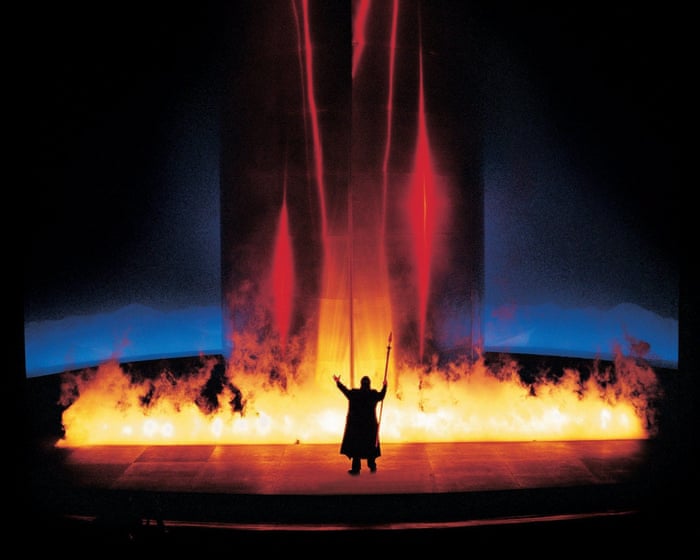
One hundred and fifty years ago this summer, Richard Wagner wanted to change the world. Not just the world of music, but ideas about nationhood, political thought, and even what it means to be human. The first Bayreuth Festival opened on August 13, 1876, with the first complete performance of Der Ring des Nibelungen staged in Wagner’s custom-built Bayreuth Festspielhaus in Bavaria. The audience included kings, emperors, aristocrats, and politicians, as well as Europe’s musical and creative elite—among them Tchaikovsky, Grieg, Bruckner, and Liszt. Wagner, who had been a revolutionary on the streets of Dresden in the 1840s, intended the Ring’s four operas to bring about a new world—one redeemed and made wise by this epic story of power, love, redemption, betrayal, and renewal.
Wagner’s enormous impact is almost impossible to grasp today. Beyond stage design—he pioneered hiding the orchestra entirely in the pit and darkening the auditorium at Bayreuth—his influence spread across the arts. It shaped how Wagnerism gripped German philosophers and Parisian painters and poets in the 19th century, caused seismic shifts in cultural politics, and left a toxic legacy through the antisemitic followers who carried his torch after his death in 1883.
Did what Thomas Adès has called the “fungus” of Wagner’s sounds and ideas suffocate Western music?
But here’s a thought experiment: can we imagine a world where Wagner never existed? What would happen if Bayreuth vanished as magically as it appeared? What might music and culture have looked like without him?
For starters, Bavaria would have had more money. King Ludwig bankrupted the state to fund Wagner’s dreams and indulgences. Without Wagner, the musical avant-garde would likely have been led by Franz Liszt—that complex but generous virtuoso of piano and composition. Instead of Bayreuth, Liszt’s Weimar would have remained the center of 19th-century visions for music’s future. Liszt’s ego was big enough, but he never came close to Wagner’s narcissism and will to power (Wagner married Cosima, making him Liszt’s son-in-law). The circle of composers Liszt inspired and admired would have thrived without Wagner, while his own symphonic poems and later piano pieces would have earned the place they deserve in the late 19th-century repertoire—a place they never quite achieved. Instead of Wagner’s grandiosity and wordiness, Liszt’s pieces are musical question marks, stones tossed into the future.
Without Wagner pushing forward, the focus on late-Romantic ideas of progress and development might have given way to a greater diversity of composing voices and visions. Without Bayreuth, the Great Exhibitions in Paris and London during the second half of the 19th century might have become even more important in opening creative minds to a wider range of musical cultures. Musical scenes in Russia, the Americas, France, and the UK might have flourished without being stifled by what Thomas Adès calls the “fungus” of Wagner’s sounds and ideas. (That’s the problem in a nutshell: imagining a world without Wagner is like imagining The Last of Us without the mushrooms—they’re everywhere, and so is he!)
The key question is what music might sound like without Wagner. His world of shadows, constant exposition, and ideas always in the process of forming—just as his characters are in constant emotional and harmonic flux—doesn’t belong only to him. Richard Strauss or Arnold Schoenberg would surely have written similar music without Wagner, but they might have found their own paths.Without his influence, there would be no sense of connection, and languages would feel more original, less tied to Wagner’s ideas about ego and expression.
Meanwhile, in the early 20th century, Debussy and Stravinsky wanted exactly that—a world without Wagner—and they achieved it by reacting against his influence as strongly as they could in their own music. But without Wagner, they wouldn’t have had the same force to push back against, so their music might have been less clear in its goal of escaping him. Be careful what you wish for: a world without Wagner might have ended up being more—well, Wagnerian!
Brahms’s vision is anti-utopian and empathetic, the opposite of Wagner’s.
But that’s just the beginning: no Wagner means no Bayreuth, no secular German temple for Hitler to worship at. Would Hitler have set up a shrine to his favorite composer, Franz Lehár, and his sugary operettas instead? Or would the Nazi poison have been even more viciously applied to Mozart, Beethoven, and Bruckner? The impossibility of the idea proves the point: a world without Wagner is almost unimaginable.
Almost. The clear historical winner in an anti-Wagner world is Brahms. His vision of past and future coming together in the emotionally ambiguous and complex present, his personal and political stand against the rising antisemitism he saw in Vienna in the 1880s and 90s—these are the rallying cries of a radically different sensibility and creative consciousness compared to Wagner’s. Brahms’s music—especially his late piano pieces, songs, and orchestral works—acknowledges the limits of what music can do. It mirrors the tensions of a historic moment and turns them into a conversation that can’t pretend to change the world, but can speak from one heart to another. Brahms’s vision is anti-utopian and empathetic, the opposite of Wagner’s. Those are qualities that culture then, and the world now, needs more than ever. Imagine a world without Wagner…
This week Tom has been listening to: pianist Simone Dinnerstein’s new album, Hourglass, which features ensemble works by Philip Glass with the string players from her group Baroklyn. Listen to the final movement of the Tirol Concerto to hear tempo, texture, and counterpoint pushed to their limits. It’s music that’s the opposite of predictable pattern-weaving; more like a rollercoaster that’s kept—just barely—on the rails. Listen on Spotify | Apple Music Classical
Frequently Asked Questions
Here is a list of FAQs based on the prompt Imagine a world without Wagner its hard to picture but lets give it a try
BeginnerLevel Questions
1 Wait who is Wagner Why would it be hard to picture a world without him
Answer Richard Wagner was a hugely influential 19thcentury German composer He changed how opera worksmaking it more like a continuous dramatic movie than a series of songs His music is so epic and unique that its hard to imagine the soundtracks to our lives movies and even some modern music without his influence
2 What exactly would be missing in a world without Wagner
Answer Youd lose some of the most powerful dramatic and instantly recognizable music ever written Think of the dramatic Ride of the Valkyries or the Bridal Chorus His entire style of building huge emotional climaxes would be gone
3 Would movies be different without Wagner
Answer Absolutely Wagner invented the concept of the leitmotifa short musical theme that represents a character place or idea Every movie score you love from Star Wars to Jaws and Lord of the Rings uses this idea Without Wagner film scores would be much less memorable and emotionally powerful
4 Is Wagner just for classical music snobs
Answer Not at all Youve heard his music even if you dont know it Its in cartoons commercials and rock songs His ideas about big dramatic storytelling are everywhere in pop culture You dont need to be an expert to feel the power of his music
AdvancedLevel Questions
5 How did Wagner change the very definition of an opera