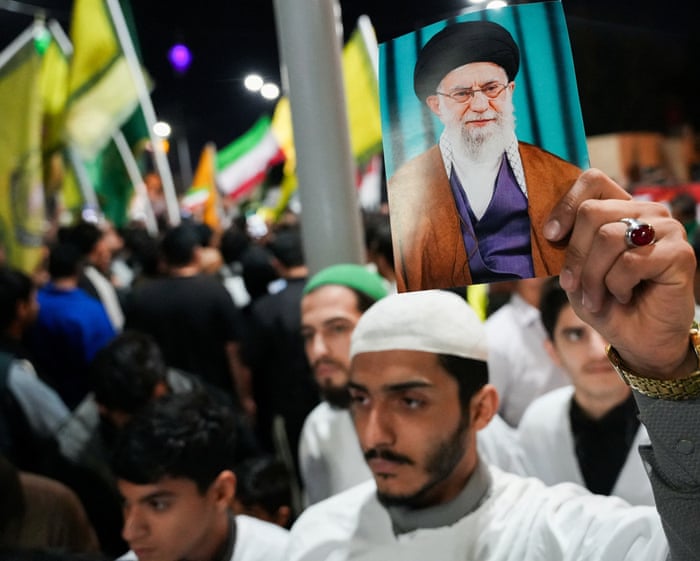
In the early hours of Saturday morning, coordinated strikes by the United States and Israel reignited a conflict that had been simmering since last summer’s 12-day war. The attacks targeted key command structures and killed senior figures, most notably Iran’s Supreme Leader Ali Khamenei, who had held power since 1989. Donald Trump marked his death with a social media post calling Khamenei “one of the most evil people in history” and stating, “This is not only justice for the people of Iran, but for all Great Americans.”
Israel has reported that other senior officials, including IRGC commander Mohammad Pakpour, Defense Minister Aziz Nasirzadeh, and defense council head Admiral Ali Shamkhani, were also killed. In response, Iranian forces have launched missiles and drones at Israel, US bases in the Gulf, Iraq, and Jordan, as well as some civilian targets across the region. Events are now moving rapidly and unpredictably.
An emboldened Trump framed the attack not as a limited action, but as a decisive campaign to eliminate what he called a longstanding threat to the US—one he argued previous presidents had avoided confronting directly.
The strikes came after rounds of regionally supported diplomacy aimed at a preliminary nuclear deal. However, instead of allowing those efforts to develop, Trump—likely influenced by Israeli Prime Minister Benjamin Netanyahu and conservative hawks in his administration—chose to strike at a moment widely seen as one of Iranian weakness. He immediately suggested the Iranian people should now determine their own future, making clear that Washington supports internal regime change. “This is the single greatest chance for the Iranian people to take back their country,” he posted on Truth Social after announcing Khamenei’s death.
Some context is useful regarding timing, as this weekend’s escalation was not a sudden break but the culmination of two years of widening confrontation. Since October 7, 2023, Israel has conducted sustained military campaigns not only against Hamas in Gaza, Hezbollah along its northern border, and Houthi targets linked to Red Sea attacks, but also indirectly against Tehran itself. These operations steadily eroded Iran’s forward defense strategy and weakened its core military capabilities. What had remained relatively intact until now was Iran’s territory, its missile program, and, crucially, its regime leadership.
The strikes have produced immediate results, yet wars rarely unfold as initially planned. While Iran cannot match US conventional military power, it retains asymmetric tools. Its only viable option has been to widen the conflict, spreading the costs and increasing regional risks. The immediate retaliation against Israeli territory and US installations across the Gulf signals precisely that strategy. This is a dangerous gamble, especially given Tehran’s fragile ties with neighboring Gulf states, but it views sustained escalation as the only path to securing an eventual ceasefire.
It is important to note that the three main actors enter this confrontation with different objectives. For the Islamic Republic, the priority is survival: absorbing the shock, maintaining military and political cohesion, and continuing its military response. Iran is not fighting to win in conventional terms, but the regime is fighting to endure.
In contrast, Trump appears to be seeking a decisive outcome that demonstrates he has neutralized a longtime US adversary. On Saturday night, he promised that the bombing “will continue, uninterrupted throughout the week, or as long as necessary to achieve our objective.” His strategy relies on the assumption that overwhelming force targeting infrastructure,Targeting key assets and leadership could undermine Iran’s strategic position, forcing it to either surrender or fracture internally. While Israel’s goals generally match those of Washington, its focus is more specific. Despite Netanyahu’s public calls for Iranians to overthrow their government, Israel’s real aim is to keep Iran distracted by internal problems and strategically weakened, if not permanently.
Following the initial bombings and the death of Khamenei, several possible paths now emerge. In the coming days, the White House might pause operations after causing significant damage, to see if this pressure leads to Iranian concessions and de-escalation. Tehran’s remaining leadership would then face a difficult choice: whether to submit to U.S. demands in order to preserve what is left of the regime.
The system will not automatically collapse without Khamenei. The constitutional succession process could be followed, with the Assembly of Experts appointing a new Supreme Leader. In reality, however, the Revolutionary Guard and security forces would likely hold decisive power, aiming to tightly control the transition and prevent elite fragmentation. A temporary collective leadership might form to stabilize the situation, but it would be vulnerable to pressure from within the military, as well as from continued U.S. and Israeli actions.
Alternatively, sustained military pressure could reveal divisions within Iran’s political elite. Economic hardship, military casualties, and internal rivalries could weaken central control, creating opportunities for internal power struggles that opposition groups might support.
The most dangerous outcome would be uncontrolled fragmentation. Libya serves as a warning: Gaddafi’s fall led not to an orderly transition, but to institutional collapse, militia warfare, and foreign intervention layered onto domestic conflict. Iran is a more complex state with stronger institutions, but removing the regime’s leadership without a managed political transition could still empower armed factions and trigger proxy conflicts on its soil.
What is already certain is that the region will not return to its pre-war state. Gulf states that were cautiously improving relations with Tehran now face renewed threats. Energy markets and maritime security, especially around critical waterways, will remain vulnerable to further escalation. Regional actors will rethink their alliances and defense strategies in light of the risks demonstrated by direct U.S. and Israeli military action.
Iran may survive this war, but the Islamic Republic as we know it will be fundamentally changed. The decisive phase of this conflict will not be the initial attacks, but the political order that emerges from prolonged military pressure. The U.S. may achieve its short-term goals. The more important question is whether it is ready for the Iran and the region that will follow.
Sanam Vakil is the director of the Middle East and North Africa Programme at Chatham House.
Frequently Asked Questions
Of course Here is a list of FAQs about the statement Iran may survive this war but the Islamic Republic as we know it cannot remain unchanged
BeginnerLevel Questions
1 What does this statement even mean
It means that while the country of Iran and its people will likely continue to exist through current regional conflicts and pressures the specific political systemthe Islamic Republic ruled by Supreme Leaders and the Revolutionary Guardswill be forced to undergo significant reforms or transformations to survive in the long term
2 What war is this referring to
Its not referring to one single declared war It typically refers to the combination of intense pressures Iran faces a shadow war with Israel potential open conflict a severe economic war due to sanctions and an internal war of ideas with its own dissatisfied population
3 Why cant the system stay the same
The system is under unprecedented strain from all sides a young population demanding more freedoms and a better economy relentless international sanctions crippling growth and escalating military confrontations that drain resources and risk a larger war This level of pressure forces change
4 What kind of changes are we talking about
Changes could range from moderate internal reforms to radical transformation
5 Is this just about war with Israel
No its broader Conflict with Israel is a major flashpoint but the war includes economic survival managing domestic protests and navigating relations with global powers The systems rigidity is being tested on multiple battlefields at once
Advanced Practical Questions
6 What are the main signs that the system is being forced to change
Key signs include public protests chanting against the leadership factions within the government publicly disagreeing on strategy attempts to negotiate nuclear deals to relieve sanctions and the rise of alternative power centers like the IRGC in the economy
7 Could the Islamic Republic actually collapse
Its possible but not guaranteed Collapse would likely require a catalyst like a major military defeat a severe economic collapse or a massive sustained uprising