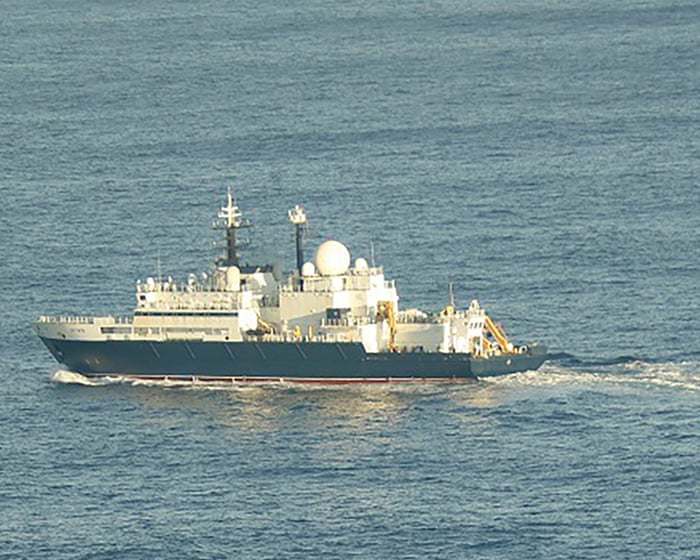
For a long time, Ireland paid little attention to the seas around it—a vast maritime area ten times the size of its land. Alarm bells only started ringing when a Russian spy ship, the Yantar, began showing up in Irish waters. The vessel, officially described as a research ship, is believed to be capable of attaching spy equipment to undersea cables and has made its presence known. While lingering in the Irish Sea in 2024, it stayed over a gas pipeline connecting Ireland and the UK and switched on its transponder, almost as if it was advertising how close it was to critical infrastructure.
In recent weeks, Irish officials have also noticed a rise in Russian shadow fleet vessels crossing the north Atlantic to avoid British and French waters, where controls have been tightened.
For officials, the Russian presence in or near Irish waters highlights that Ireland—which has long seen itself as protected by geography, out of sight and out of mind—is actually on the frontline.
And the threat is wide-ranging. Irish waters are busy: packed with shipping lanes, gas pipelines, and transatlantic internet cables, which helped draw US tech companies to set up their European headquarters in Ireland. Nearly 75% of transatlantic subsea cables pass through or near Ireland’s exclusive economic zone—the 200-nautical-mile area where it has sovereign rights over natural resources, which is seven times larger than its landmass. Over an even broader area, it has more limited jurisdiction.
When Ireland took over the EU’s rotating presidency last month, it had a clear message. While its iconic neutrality is not up for debate, the days of Ireland sleeping on defence are over. Security is now listed as a priority for Ireland’s six months chairing the Council of the EU.
Ireland would work with other European nations “on shared objectives and priorities in defending our critical infrastructure, and making sure that we are focused on security more broadly,” Ireland’s foreign minister, Helen McEntee, told reporters last month. “We are not immune to any threat.”
That may sound unremarkable, but it signals a shift in how Ireland approaches defence. In February, McEntee published Ireland’s first ever maritime strategy, which aims to end Ireland’s “sea blindness”—the idea that security was only about the land. Officially, it aims to ensure Ireland can defend its maritime domain, including critical undersea infrastructure.
There is still a long way to go. “We are dependent on the goodwill of friends and neighbours,” said retired Irish naval officer Caoimhín Mac Unfraidh. “But it wasn’t always the case and it won’t always be the case.”
During a 29-year career in the Irish Naval Service, Mac Unfraidh commanded two ships, the LÉ Orla and the LÉ Eithne. Both were decommissioned in 2022, along with a third vessel.
He described the maritime strategy as “a good effort,” but feared spending remained “minimalist,” despite pledges for sonar and radar equipment. “What is needed is that sort of overarching vision for a maritime nation to have a navy worthy of its name. And that means new ships, with new capabilities, recruitment campaigns, and the establishment of several more bases.”
In 2025, Ireland’s government confirmed only two ships were in operation out of a fleet of eight, partly because of a staffing crisis.The military issue came into focus earlier this month when Volodymyr Zelenskyy turned down an offer from Dublin to send 27 light-armoured combat vehicles to Ukraine. The Ukrainian president said, “The cost of restoring them is higher than the value they would provide.”
Irish government officials stress that Ireland has pledged €1.7bn (£1.4bn) in defence capital spending for 2026-30, a 55% increase on the previous period. The government also believes it has turned a corner on naval recruitment, with more new joiners leading to a 12% rise in personnel in 2025 compared with the year before.
But Ireland still spends the least on defence in the EU, at a time when other countries are sharply increasing their budgets. In 2024, Ireland spent just 0.2% of its gross domestic product on defence, far behind the EU average of 1.3% and notably lower than neutral Austria (0.6%).
EU officials have offered quiet criticism. Margrethe Vestager, the former European Commission vice-president responsible for tech policy, warned Ireland in 2022 that it had a responsibility for the maritime zone: “No one can be a weak link of our chain of protection.”
In 2025, former Estonian president Toomas Hendrik Ilves sharply criticised Ireland’s then president Michael Higgins after Higgins condemned Nato’s “appalling” appeal for higher spending in response to the Russian threat. Ilves said, “Do these people have any sense of self-awareness, their privileged geography or the appropriateness of even commenting as the beneficiary of implicit Nato security?”
Despite being an island nation, the sea was nobody’s political priority. Ireland gained independence in 1922, but the British retained control of Irish waters until 1938. Ireland did not have a fully fledged navy until 1946.
Eoin McNamara, at the Finnish Institute of International Affairs, notes: “National security tends to be very divisive politically in Ireland, without bringing a whole lot of political reward, aka votes.”
Last year, the Nato-critical leftwinger Catherine Connolly won a landslide to become Ireland’s president. During her campaign, she compared Germany’s military spending to the 1930s and said she was concerned about arms spending and the “militarisation” of the EU.
Meanwhile, people see the cost of living, housing, and immigration as the most important issues facing Ireland, according to a recent poll from More in Common. Foreign and security issues were barely on the radar: 5% cited the war in Ukraine and 4% defence.
“There is a lot of momentum from public opinion to focus on these bread-and-butter domestic issues,” McNamara said. Defence, he said, was “the insurance policy of the economy”, alluding to the profound economic shock posed by disruption to internet or energy cables. “I don’t think that has reached public opinion yet.”
Frequently Asked Questions
Here is a list of FAQs about Irelands unprotected ocean and its role in European defense ranging from beginner to advanced levels
1 What does unprotected ocean mean in this context
It means the vast stretches of the Atlantic Ocean that are Irish territory but are not constantly monitored by military radar or patrolled by naval ships Its a blind spot where submarines or drones could operate undetected
2 Why is the ocean around Ireland so important for Europes defense
Because of geography Ireland sits on the Atlantic edge of Europe The deep water between Ireland and the continent is a natural highway for Russian submarines leaving their northern ports to reach the Atlantic and threaten transatlantic supply lines between the US and Europe
3 I thought NATO protected Europe Why is Ireland a weak link
Ireland is not a member of NATO It has a policy of military neutrality While NATO uses Irish airspace and waters for transit Ireland does not contribute to NATOs integrated military command and its own navy is small and focused on fisheries protection not antisubmarine warfare
4 What exactly is the weak link that experts are worried about
The weak link is the GIUK Gap The UK part of that gap is effectively the waters around Ireland If Ireland doesnt monitor its seabed and undersea cables Russia can use that area as a backdoor to cut the internet cables that connect Europe to North America
5 Is this about spy submarines
Yes partly The concern is that Russian submarines can hide in the deep Atlantic trenches off Irelands west coast They are so quiet that they can sit there undetected mapping the seabed or preparing to sever the fiberoptic cables that carry 99 of transatlantic data
6 What are undersea cables and why should I care
They are massive fiberoptic cables laid on the ocean floor that carry almost all internet and financial data between Europe and the US If a hostile power cuts them it could cause massive internet outages and cripple the global economy Ireland is a major hub for these cables
7 Has Ireland actually ignored this problem
Historically yes For decades Irish defense spending was very low and the