Forget the idea that youth is the peak of life—your best days may still be to come. Henri Matisse’s certainly were, even after he narrowly survived surgery in his early seventies as war spread across France. Confined to a wheelchair, his hand unsteady and weak, his body too frail to stand and paint, he reinvented himself and in doing so, transformed modern art.
The Grand Palais’s expansive exhibition on Matisse’s final years—from his 1941 surgery to his death in 1954—is a dazzling, joyful celebration of color, form, line, light, and yet more color. It is brilliant, beautiful, and utterly overwhelming. With Matisse as its subject and France’s vast collection of his works at its disposal, the show was destined to be a hit.
The exhibition begins intimately, almost claustrophobically. In his Nice studio, Matisse paints still lifes: red tulips, lilac-fleshed oysters, lemons, mimosa, and bursts of green, red, and yellow. War loomed over the Riviera. In 1944, his wife and daughter, who had secretly joined the resistance, were arrested by the Gestapo. German planes buzzed overhead. Though these paintings appear light and airy, they are small, tightly composed, and repeatedly reworked. Matisse paints the same group of models, rearranging them around the room, adjusting window slats for light, moving screens to cast shadows. It’s obsessive, repetitive, and deliberately cinematic, as if he’s creating dozens of film stills from a single scene.
But this repetition, along with a rediscovered passion for drawing, sparked something in him. His Themes and Variations series features the same reclining woman, the same vase of flowers, the same face, drawn over and over. Each time, he refines the line, simplifies the image, stripping everything down to its essence. “I have attained a form filtered to its essentials,” he said.
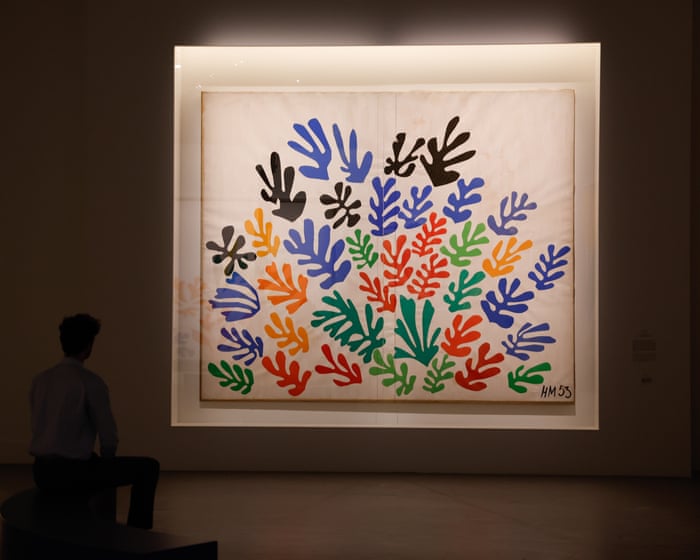
That marks the first artistic revolution here. The second came when he set aside brushes and pens entirely and picked up scissors. This is the late Matisse we all recognize—radical compositions, jagged shapes, and eye-popping Technicolor boldness—and it begins here. In 1944, commissioned to create a book about color, he far exceeded the brief. The maquettes for that book are filled with swirling leaves, diving bodies, ultramarine skies, purple funerals, white elephants, and his stunning black Icarus falling past a swirl of yellow stars. He titled the book Jazz, as if composing chords from color. It’s a remarkable moment in art, beautifully presented here—though the soundtrack of contemporary jazz improvisation made me wish I were deaf.
After an air raid on Nice, Matisse moved to Vence in the hills behind the city. He covered his bedroom walls from floor to ceiling with cutouts. It’s as if his world expanded as he explored the possibilities of this new approach. He returned to painting as well—lighter, airier, and simpler than before, with shapes in his interior still lifes reduced and refined. Then he removed color entirely, and even in black and white, the works feel luminous and startling.
But the cutouts are on another level: audaciously bold and graphic, direct, bright, and decorative. You can almost feel the breeze in his blue-and-white collages of Polynesian landscapes, or smell the seaweed in his vast, swaying fronds.
As the 1950s began, Matisse was asked to design a chapel in Vence, and he embraced the project wholeheartedly. He created priests’ vestments in green and yellow, and stained glass adorned with plant motifs symbolizing his late-life rebirth. The work is spiritual and religious, yet not overtly godly. Sitting here, surrounded by his creations, one feels the profound impact of his final, fearless reinvention.Gazing up at the maquettes and the gleaming stained glass, I’m not thinking about deities. It’s art I’m communing with.
I first saw the chapel works as a child, having grown up nearby. They’re one of the main reasons I became interested in art history. Seeing them here is so moving I never want to leave. They affect me in a way that only great art can.
The famous—and very much objectifying—Blue Nudes come later, somehow distilling the entire history of nude painting into four of the simplest images you’ll ever see. They are shown alongside a final self-portrait in gouache, which is, of course, also perfect.
But for me, this enormous exhibition peaks with a single painting of a face: black ink on yellow paper. Count the lines—there are just seven. The bare minimum he needed to convey a face, to paint a life. At 80 years old, sick and frail, he truly had it all figured out.
At the Grand Palais, Paris, from 24 March to 26 July.
Frequently Asked Questions
Frequently Asked Questions about the Matisse 19411954 Exhibition
General Beginner Questions
Q What is this exhibition about
A It focuses on the final incredibly vibrant and innovative period of Henri Matisses life from 1941 until his death in 1954 It showcases the masterpieces he created during this time
Q Why is this period of his work so special
A Despite aging and illness Matisse experienced a huge creative surge He invented his famous cutout technique creating large bold and joyful compositions that are celebrated as some of his greatest achievements
Q I only know Matisses early paintings Will I still enjoy this
A Absolutely This exhibition reveals the thrilling evolution of his genius Youll see how his love for color form and the art of balance reached its dazzling peak
Q What are the cutouts I keep hearing about
A They are Matisses revolutionary technique He painted sheets of paper with pure color then cut shapes freehand and arranged them into largescale compositions They are like drawing with scissors
Planning Your Visit
Q How long should I plan to spend at the exhibition
A To fully appreciate the detail and impact of the works plan for at least 15 to 2 hours Its filled with major pieces so its worth taking your time
Q Is the exhibition suitable for children
A Yes the large scale and bright bold colors of the cutouts can be very engaging for children Its a great way to introduce them to modern art
Q Are there any famous works I should look out for
A Yes you can expect to see iconic pieces like The Snail Blue Nudes and designs for the Chapel of the Rosary in Vence The exhibition is described as having one glorious masterpiece after another
Q Is there an audio guide or catalog available
A Most major exhibitions offer these Check the venues website for details on audio guides exhibition catalogs and guided tours to enhance your visit
Deeper Insights Context
Q The review says lifeaffirming What does that mean in the context of his life
A Matisse