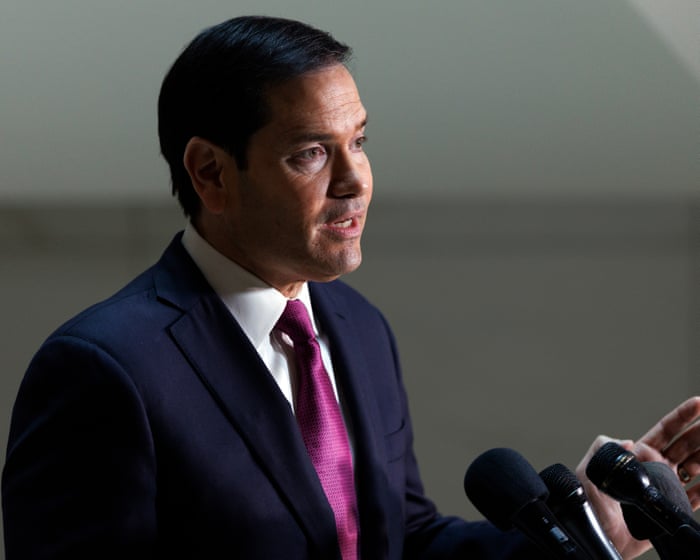
Secretary of State Marco Rubio offered a new explanation for Washington’s unexpected entry into the conflict, stating that Israel’s determination to attack Iran and the certainty that U.S. troops would be targeted in response forced the Trump administration to launch pre-emptive strikes.
This rationale received mixed reactions from top members of Congress, who on Monday evening attended the first briefing by the Trump administration since it ordered the air campaign to begin over the weekend.
Rubio, CIA Director John Ratcliffe, and Joint Chiefs of Staff Chairman Dan Caine spoke to lawmakers behind closed doors at the Capitol. This came ahead of an expected House vote later this week on a war powers resolution, which presents an unlikely chance to force President Trump to end hostilities against Iran.
“It was abundantly clear that if Iran came under attack by anyone—the United States, Israel, or anyone else—they were going to respond, and respond against the United States,” Rubio told reporters at the Capitol. “We knew that an Israeli action was coming. We knew that would trigger an attack against American forces, and we knew that if we didn’t pre-emptively strike before they launched, we would suffer higher casualties.”
In a Monday night interview on Fox News, Vice President JD Vance said the U.S. aim was to ensure “Iran cannot have a nuclear weapon.” He added, “The president wants to make it clear to the Iranians and to the world that he will not rest until he accomplishes that all-important objective.”
Vance has been the member of Donald Trump’s administration most opposed to military interventions and has spoken less frequently about U.S. actions regarding Iran than Rubio.
Since the conflict began, the United States and Israel have carried out waves of airstrikes across Iran. Tehran has retaliated with drone and missile attacks against U.S.-aligned countries in the Middle East.
The air campaign has killed several of Iran’s top military and political leaders, including Supreme Leader Ayatollah Ali Khamenei. The U.S. military has acknowledged the deaths of six service members, while the Iranian Red Crescent Society reported more than 500 people killed in the country.
Reactions to the administration’s explanation for entering the war split along party lines. Republicans rushed to defend Trump’s decision, while Democrats condemned what they view as an unnecessary conflict with unclear goals.
“This is Trump’s war. This is a war of choice. He has no strategy, he has no endgame,” said Senate Democratic Minority Leader Chuck Schumer before the briefing. Afterward, he stated that lawmakers asked “a whole lot of questions” but found the officials’ responses “completely and totally insufficient. In fact, at least to me, that briefing raised many more questions than it answered.”
Mark Warner, the Democratic vice-chair of the Senate Intelligence Committee, expressed concern over the implications of the U.S. allowing Israel to essentially draw it into a new war. “There was no imminent threat to the United States of America by the Iranians. There was a threat to Israel. If we equate a threat to Israel as the equivalent of an imminent threat to the United States, then we are in uncharted territory,” Warner said.
On Monday night, Israeli Prime Minister Benjamin Netanyahu told Fox News that Iran had been building new underground sites “that would make their ballistic missile programs and their atomic bomb programs immune within months.” He warned, “If no action was taken now, no action could be taken in the future.””He said, ‘Sure,'” he stated, referencing Iran’s denial of pursuing nuclear weapons.
In recent media interviews, Trump has laid out multiple objectives for the war, such as eliminating Iran’s ballistic missile capabilities and naval forces, preventing the country from developing nuclear weapons, and cutting off Tehran’s support for proxy groups across the Middle East.
However, Rubio only mentioned two goals to reporters: destroying Iran’s ballistic missile capability and their navy. After the classified briefing, Warner expressed uncertainty about Trump’s endgame. “I think the president needs to address Congress, and the American people, and clarify which of these four or five outlined goals is the real objective,” the Virginia senator said. “What is the aim? What is our exit strategy? What responsibility do we have to the Iranian people if they protest, following his call for them to take to the streets? And what imminent threat to U.S. interests justified this conflict?”
Mike Johnson, the Republican House Speaker and a close Trump ally, defended the president’s actions, describing them as a “defensive operation.” “Israel was determined to act in self-defense here, with or without American support. Why? Because Israel faced what they consider an existential threat,” Johnson stated.
While he noted that the war’s goal was not “to go in and overthrow the regime,” he still welcomed the ayatollah’s death. “That occurred, and in my view, it’s a positive development for freedom-loving people worldwide,” Johnson told reporters. He was joined by the Republican chairs of the House intelligence and appropriations committees—the latter’s presence hinting that lawmakers might soon be asked to approve additional defense funding for the war.
Trump ordered the attack on Iran without first seeking Congressional approval, though Rubio mentioned that the Gang of Eight—comprising Democratic and Republican leaders from both chambers, along with top lawmakers from the House and Senate intelligence committees—were notified before the attack began.
The House is expected to consider a war powers resolution later this week, which, if passed, would force Trump to end hostilities against Iran. However, it faces significant hurdles to passage. Republicans control both chambers of Congress and rarely break with Trump in large numbers.
Even if Congress approves the resolution, Trump could veto it, and overriding that veto would require a two-thirds majority vote. Previous war powers resolutions in this Congress have been defeated, and Johnson expressed confidence that the latest one would not pass the House. “The idea that we would strip our commander in chief, the president, of his authority to finish this job right now is a frightening prospect to me. It’s dangerous,” Johnson said. “I am hopeful, and I believe we have the votes to defeat it.”
Frequently Asked Questions
Of course Here is a list of FAQs about Senator Marco Rubios claim regarding US strikes on Iran and Israels planned attack structured from basic to more advanced
Basic Understanding The Claim
Q1 What exactly did Marco Rubio claim
A Senator Rubio claimed that the United States carried out military strikes against Iranianbacked targets in February 2024 not just on its own but specifically to preempt or disrupt a larger more aggressive military attack that Israel was planning against Iran
Q2 Who is Marco Rubio and why does his statement matter
A Marco Rubio is a US Senator and the Vice Chairman of the Senate Select Committee on Intelligence His position gives him access to classified briefings so his public comments are often seen as hints at nonpublic intelligence or strategic discussions
Q3 What US strikes is he talking about
A Hes referring to a series of US airstrikes in February 2024 against Irans Islamic Revolutionary Guard Corps and affiliated militias in Iraq and Syria These were in retaliation for a drone attack that killed three American soldiers in Jordan
Motivations Strategy
Q4 Why would the US strike Iran to stop an Israeli attack
A The suggested logic is escalation management The US may have calculated that a forceful but limited US response would satisfy the need to retaliate for the American deaths while preventing a much broader Israeli strike that could trigger a major regional war dragging in the US
Q5 What are the potential benefits of the US acting first like this
A Potential benefits include maintaining control over the scale of the conflict sending a direct message to Iran without a surprise Israeli escalation and preserving broader US diplomatic goals in the region by avoiding an allout war
Q6 Did the US government confirm Rubios explanation
A No The Biden administrations official public justification for the strikes was solely to respond to the attack on US troops and degrade the capabilities of IRGCbacked groups They have not confirmed acting to preempt an Israeli plan
Analysis Implications
Q7 Is there any evidence for Israels planned attack
A There is no publicly available concrete evidence like official Israeli statements