The one-woman play Iphigenia in Splott first premiered in 2015. Eleven years later, Gary Owen’s modern take on a Greek tragedy—set in working-class Splott, Cardiff—has become a modern classic. It reimagines the mythological heroine Iphigenia as Effie, a young woman who spends her days drinking vodka from a mug while still in her dressing gown. The play tackles poverty, social inequality, closures, cuts, and public services worn down by austerity. A five-star review from The Guardian in 2022 urged: “Everyone should see this.”
One person who did was Leisa Gwenllian, a final-year drama student from north Wales. “I was on the front row with my friend,” says Gwenllian, now 24, sipping mint tea in a London hotel. “I remember thinking: wow! A Welsh woman with a strong Cardiff accent on stage at the Lyric [in Hammersmith, London]—that’s what it’s all about.” At the Oxford School of Drama, she mostly studied classics alongside people with different accents and backgrounds from her own. “Seeing yourself on stage is really powerful.”
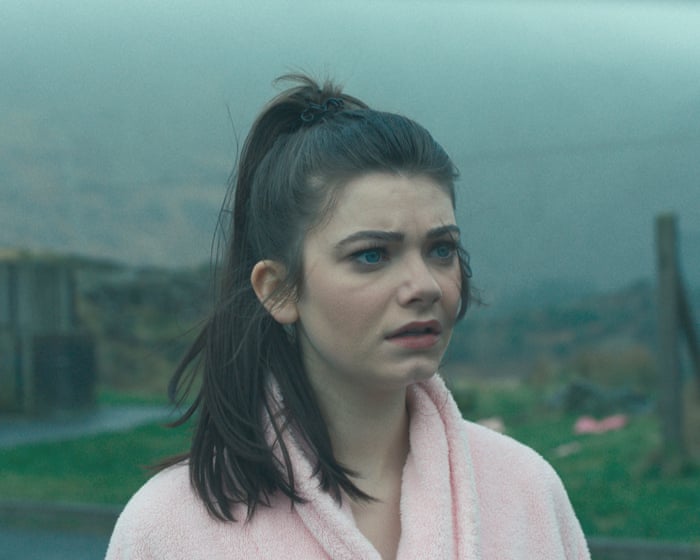
Four years later, she stars in a Welsh-language film adaptation of the play, Effi o Blaenau. Funny, bold, and vulnerable, she delivers a breakthrough performance that makes you feel like you saw her first. Even when Effi—the final “e” was dropped from her name for the film to match Welsh spelling rules—yells at her long-suffering grandmother, her honesty and open expression make it impossible not to cheer for her. Then, after a big night out in Llandudno, she becomes pregnant, and everything changes. The film is directed by Marc Evans, who co-wrote the script with Owen, moving the setting from Cardiff to Blaenau Ffestiniog, a former slate-mining town in north-west Wales.
Over a video call, Owen says expectations for Iphigenia in Splott were low when it opened at the Sherman Theatre in Cardiff in 2015: “They only scheduled it for two and a half weeks and were worried about selling tickets.” When he wrote the play in 2014, he was living in Splott during the height of austerity. “We were told we all had to accept these cuts because we were all in it together.” But looking around Splott—at people relying on community centres and Flying Start (Wales’ version of the early-years support scheme Sure Start) to get by—it didn’t feel like everyone was suffering equally. “It was clear that cutting public services would hit the most vulnerable, who depended on them the most, the hardest.” Effie was partly inspired by his neighbors across the street, who lived in supported housing—“not always the easiest neighbors,” he says with a smile.
His own experience also shaped the play. When his second child was born, Owen’s partner went into early labor—just like Effie does. There was no bed available in Cardiff’s special care baby unit, so they called hospitals in Newport and Swansea. None had beds. The nearest was in Abergavenny, an hour’s drive north, but it was snowing and the road often closed in bad weather. The baby is now 13. “But weeks after he was born, I was sitting giving him a bottle, and snow was still on the mountains. He needed to be intubated right after birth. If something had gone wrong, he likely would have died. It was one of those moments where I thought: oh, this happened because of cuts to services.”
The play he wrote in 2014 still feels painfully relevant—and continues to be performed. What does that say about where we are now? Owen sighs. “Austerity has become the norm. Services are falling apart, and life is just very hard for a lot of people.”People. I don’t think things have gotten better—I think they’ve gotten worse.
Iphigenia in Splott has been translated into French and Spanish. The idea for a Welsh-language film came from producer Branwen Cennard at S4C, the free-to-air TV channel for Welsh speakers. Making the film in Welsh with subtitles was non-negotiable, she says: “I wouldn’t have considered doing it any other way.”
Why the move from Cardiff, I ask Evans? “Blaenau is a town where people live their lives in Welsh. If you really want to understand Welsh-language working-class culture, you have to go to the north. That’s where kids swear and fight in Welsh, to put it bluntly.” The town’s landscape, surrounded by huge man-made mountains of slate waste, is also a gift. “Blaenau is amazing because you just look at it and it screams ‘post-industrial.’”
Not that he wanted to direct the film, Evans says. His plan was to hire a female director, step back, and take an executive producer credit. “I was very aware of the male-gaze aspect of it.” What happened? “I don’t know—there seems to be a shortage of female directors here in Wales at the moment, at least in the Welsh language.” He made up for it by hiring women as department heads and in senior roles on the crew, including, crucially, cinematographer Eira Wyn Jones. “I knew there were certain scenes where it really came down to the lens and Leisa, so I think that balanced things out a bit.”
When it came to casting, Evans assumed they’d have young actors lining up around the block to audition. “The acting culture is really strong in Wales,” he says. (His last film, Mr Burton, told the story of a young Richard Burton.) But there were fewer applicants than he expected, which he thinks might be linked to the shrinking pool of talent from less privileged backgrounds. “Acting has become a tough field if you’re working class or can’t afford to go to college. You’re really taking a gamble with acting, which is so unstable,” he says.
Gwenllian grew up just down the road from Blaenau Ffestiniog. “I don’t think I realized how Welsh my area was until I moved away. We’d go months without speaking English at all, except on the phone. You can go to my local McDonald’s and order in Welsh. It’s quite a bubble.” In fact, when she was 12 and a BBC casting director came to her choir looking for a girl to appear in the kids’ show Rocket’s Island, she was nervous about auditioning in English. “I remember telling my mom: I’m not going to do it because it’s in English. You don’t really start English lessons at school until you’re about seven or eight.”
After Rocket’s Island, Gwenllian landed a part in the long-running Welsh-language soap opera Rownd a Rownd: “I did that until I was 19.” The money she earned from acting paid for drama school: “It opened a lot of doors and opportunities that my mom wouldn’t have been able to afford.” When she auditioned for a place at the Oxford School of Drama, she had to read a passage from Iphigenia in Splott. “My acting teacher had introduced me to the play when I was 15 or 16. I connected with it so much.”
It must have felt like fate when she heard a film was being made in her home area of north Wales, I say. “Actually, I was hungover at the audition. We’d had a big night out the night before.” Looking back, that might not have hurt her chances. “It was quite Effi.”
Her performance is the heart of the film. She’s in almost every scene—and what scenes they are. She downs huge amounts of vodka, does an especially awkward dance in a nightclub, has sex, gives birth, and lives through a terrible tragedy.
Did she have a method for getting into character? “No. I don’t think there’s any secret recipe. I read it a million times and thought about it a lot.”Her and the story. I just saw her as a real person, because there are plenty of real-life Effis out there.” Getting into costume helped too: “Once I had the lashes on and the eyeliner, I felt like Effi.” Effi o Blaenau is released in the UK on 19 June.
Frequently Asked Questions
Here is a list of FAQs about the article Sex hardship and mugs of vodka how the Greek myth of Iphigenia became a hit Welshlanguage film
BeginnerLevel Questions
1 What is this film about
Its a modern Welshlanguage film called Y Gwyll that reimagines the ancient Greek myth of Iphigenia Instead of a princess being sacrificed for a war fleet the story follows a young woman in a bleak modernday Welsh coastal town dealing with family secrets poverty and difficult choices
2 Why does the title mention sex hardship and mugs of vodka
Those are key themes in the film Sex refers to the raw complicated relationships hardship is the crushing poverty and family struggles and mugs of vodka is a literal image from the film showing how characters cope with their bleak lives
3 Is this film actually a hit
Yes It became a surprise success in Wales drawing large audiences and critical praise for its gritty realism and powerful performances despite being in Welsh and having a low budget
4 Do I need to know the Greek myth to understand the film
No The film works as a standalone drama Knowing the myth adds depth but the story is told in a very grounded modern way that anyone can follow
5 Is the film only in Welsh
Yes the dialogue is primarily in Welsh but it typically has English subtitles for nonWelsh speakers
IntermediateLevel Questions
6 How does the film update the Iphigenia myth
In the original myth King Agamemnon sacrifices his daughter Iphigenia for wind to sail to war In Y Gwyll the sacrifice is more psychological and sociala young woman is pressured into a life of exploitation and silence to protect her familys reputation and survival in a deprived community
7 Why is the film considered gritty or raw
It uses a documentarylike style handheld cameras and natural lighting The setting is a rundown seaside town and the characters swear drink heavily and face domestic violence and poverty It doesnt glamorize anything
8 What role does the Welsh language play in the films success
Its